Jurassic Dinos editorial · Updated · Source-based review
What was Juravenator?
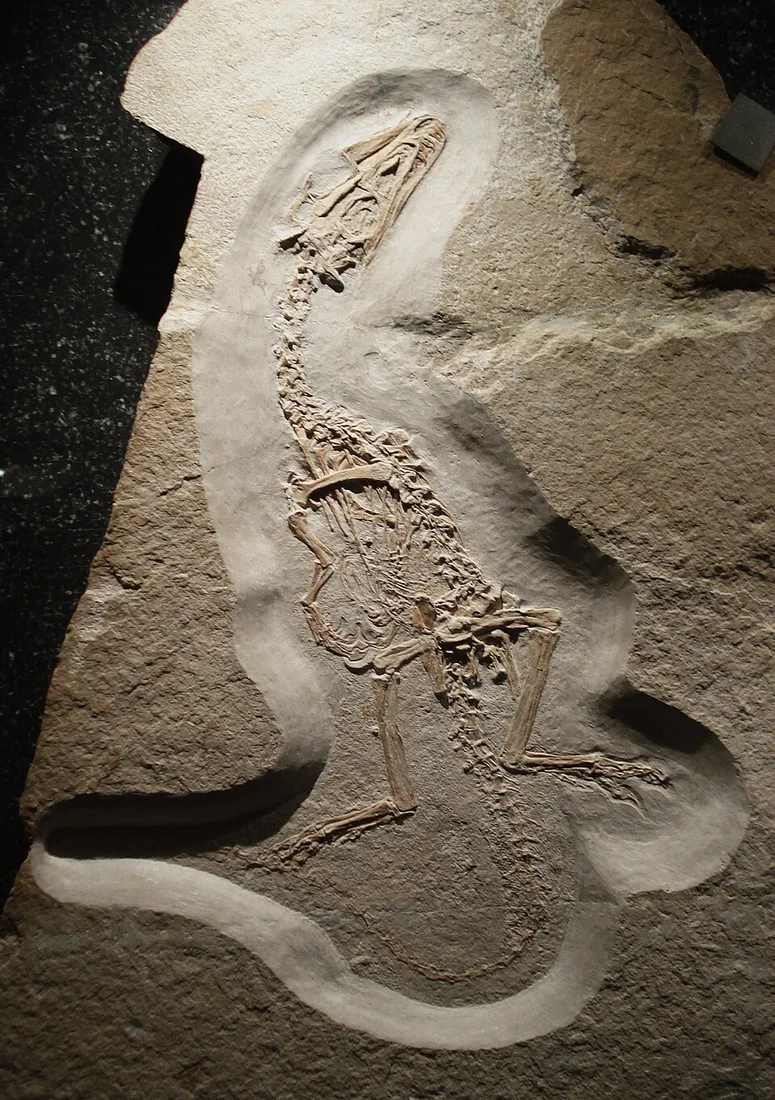
Juravenator was a small theropod from Late Jurassic Germany. It is known from an exceptionally preserved juvenile, including traces of the body covering. That combination makes it useful for studying both anatomy and the limits of interpreting young specimens.
What makes the fossil distinctive?
The fossil preserves much of the skeleton and areas of skin. Researchers have discussed scales, possible filamentous structures and small surface features. Different preservation conditions and interpretations make a simple “all scaled” or “all feathered” label inadequate.
Where was it found and how was it named?
The genus was named in 2006 from material found in the Franconian Jura. Its small size reflects a young individual, so it does not establish adult dimensions. Growth can also change features used in evolutionary comparisons.
What can we infer, and what remains uncertain?
Soft-tissue traces require careful imaging and comparison. A mark beside a bone could have several explanations, and a structure preserved in one body region does not establish the covering everywhere else. Juravenator is therefore a useful lesson in reading a fossil patch by patch rather than colouring the whole animal from a single observation.
Was the known Juravenator a fully grown miniature dinosaur?
No. The principal specimen was juvenile, so its size and proportions do not directly describe an adult.
How can you check the evidence?
The Paleobiology Database record catalogues Juravenator under Coelurosauria. Its linked bibliography identifies this research starting point: U. B. Göhlich and L. M. Chiappe. 2006. A new carnivorous dinosaur from the Late Jurassic Solnhofen archipelago. Nature 440:329-332. Open the bibliographic record. A catalogue entry establishes the source trail; it does not independently verify every later illustration or behavioural claim.
Use the dated genus overview to follow the references behind the discovery and anatomy discussed above. When sources disagree, compare which specimen and rock layer each author studied. A reconstructed whole animal can combine original bones with comparisons to relatives; those two kinds of evidence should not be confused. The account above explains the particular limits that matter for Juravenator, rather than supplying unsupported size, speed or lifespan figures.
Read the image and keep exploring
The juvenile Juravenator specimen preserves much of the skeleton in a slab, with body-covering traces requiring closer examination. A displayed specimen or skeletal mount can include restored parts. Its appearance should be read alongside the original specimen description.
Compare Compsognathus, Archaeopteryx. Find more names in the J index and explore theropod field notes. The glossary explains unfamiliar fossil terms.
Quick answers
- Where have Juravenator fossils been found?
- The discoveries discussed here come from Germany. Modern place names describe discovery locations, not a complete ancient geographic range.
- When did Juravenator live?
- It is placed in the Jurassic period. See the discovery discussion for qualifications about the particular rock layers and dating.
- Where can I compare Juravenator with related dinosaurs?
- Follow the related field notes below. Comparisons explain shared anatomy; they do not imply that all the animals lived together.