Jurassic Dinos editorial · Updated · Source-based review
What is Scelidosaurus?
Scelidosaurus was an Early Jurassic English armored ornithischian known from well-preserved Dorset fossils.
Distinctive features and evidence
Its skeleton provides a valuable early comparison with later stegosaurs and ankylosaurs. The ancient island geography differs from today’s British coastline, and local burial context should be retained in habitat discussion.
Genus overview and research references.
Scelidosaurus fossil discoveries
The first Scelidosaurus bones were found in the 1850s at Black Ven, a cliff on the Dorset coast near Charmouth and Lyme Regis, by the quarry owner James Harrison. Harrison and the collector Henry Norris sent limb bones to Richard Owen in London. Owen named the genus in 1859 and the species Scelidosaurus harrisonii in 1861, honouring Harrison, and he described a nearly complete skeleton in 1863.
The type specimen caused trouble for more than a century. The fossils Owen first used had been mixed with remains of a meat-eating theropod, and the knee joint chosen as the official type in 1888 turned out to belong to that theropod. In 1994 the international naming commission replaced it with the skull and skeleton known as NHMUK PV R 1111. That skeleton is quite complete, though the snout tip, the base of the neck, the forelimbs and the end of the tail are absent, and hundreds of armour plates were found with it.
How big was Scelidosaurus?
Scelidosaurus was small compared with most later dinosaurs, but medium-sized for the Early Jurassic. Estimates are about 4 metres long, and Gregory Paul gave 3.8 metres and 270 kilograms in 2010. Its head was only about 20 centimetres long, low and triangular when seen from above.
It walked mainly on four legs, with hind legs longer than the forelimbs. Whether it could rear up to feed is debated: a skeleton with fairly long arms points to mostly four-legged posture, and a trackway in Poland attributed to a similar animal suggests it might have been better at walking on two legs than expected.
What did Scelidosaurus armour look like?
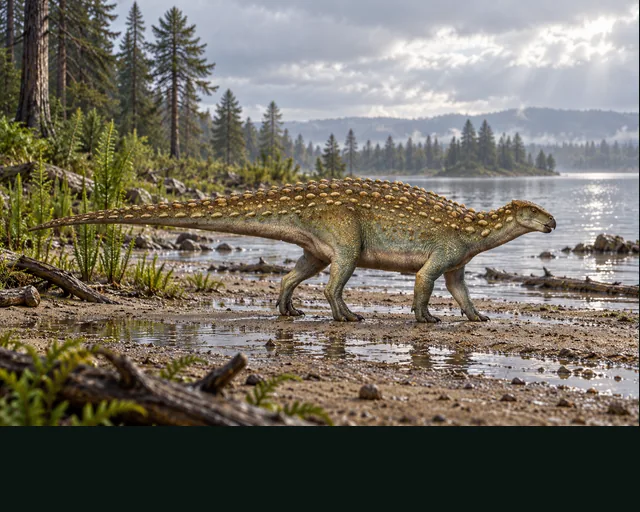
Scelidosaurus carried bony scutes embedded in its skin, arranged in long, horizontal rows. Most were oval plates with a high keel. There were three rows of large scutes along each side of the body and four rows along the tail, with smaller scutes between them. Two rows of larger plates ran along each side of the neck, with a pair of three-pointed scutes just behind the head, and the skull carried horn-like plates pointing up and back.
Compared with the later ankylosaurs, it was lightly armoured, with no continuous plating, no big spikes and no hip shield. Skin impressions show rounded, non-overlapping scales between the scutes, and a tentatively assigned tail fragment with preserved soft tissue, reported in 2000, suggests the plates were covered in a tough, probably keratin-based layer.
What did Scelidosaurus eat?
Scelidosaurus ate plants. It had small, leaf-shaped teeth suited to cropping vegetation, and a jaw joint that allowed only an up-and-down movement. Norman concluded that it browsed low, scrubby plants up to about a metre high, with the large gut helping to digest them. Ferns and conifers would have been available, as grasses had not yet evolved. All of this is inferred from teeth and bones.
Is Scelidosaurus a stegosaur or an ankylosaur?
Neither, strictly. Scelidosaurus is an early thyreophoran, a member of the armoured branch of ornithischian dinosaurs. Over the past 150 years it has been called a stegosaur, an ankylosaur and even a running ornithopod, though the last idea was rejected. Analyses regularly place it outside the group that contains Stegosaurus and Ankylosaurus, though others see it as the closest relative of the ankylosaurs, as David Norman did in 2020.
A smaller early armoured relative, Scutellosaurus, may have walked on two legs at least some of the time. The ancestors of these armoured forms are thought to have resembled early ornithischians like Lesothosaurus.
Where and when Scelidosaurus lived
The best specimens come from marine mudstones of the Charmouth Mudstone Formation near Charmouth in Dorset, from the late Sinemurian, about 191 million years ago. Other sources give wider intervals, so the exact span is uncertain. At that time, Europe was a scattering of islands, and pollen in the sediments suggests that conifers grew on them. The skeleton itself lay in marine deposits.
Classification and fossil record
The Paleobiology Database taxonomic record catalogues Scelidosaurus under Scelidosauridae. This is the immediate parent in that catalogue, rather than a complete list of evolutionary relationships.
Discovery and naming history
Initial Dorset discoveries in the 1850s preceded Richard Owen’s 1859 genus description and the 1861 species name Scelidosaurus harrisonii. The exceptionally preserved fossils made this animal important to early armored-dinosaur comparisons. Historical overview.
The sourced length estimate for Scelidosaurus is 3.8–4 metres. This is an estimate for the reconstructed animal, not a measurement shared by every individual. See the body-size discussion and linked evidence for context.
Research starting point
The catalogue links Scelidosaurus to Owen, 1859, published in The Encyclopaedia Brittanica, or Dictionary of Arts, Sciences, and General Literature (8th Edition). This identifies a research starting point; the catalogue’s citation alone does not verify every later reconstruction or species assignment.
For the meaning of taxonomic terms and how evidence is checked, see the glossary and editorial policy.
Quick answers
- Is Scelidosaurus a dinosaur?
- Yes. Scelidosaurus was an armoured ornithischian dinosaur and a plant eater, known from well-preserved fossils found in Dorset, England.
- When did Scelidosaurus live?
- It lived in the Early Jurassic. The best specimens date to the late Sinemurian, about 191 million years ago, though sources vary on the full range.
- How big was Scelidosaurus?
- It was about 4 metres long, according to common estimates, with one 2010 estimate of 3.8 metres and 270 kilograms. Its head was only about 20 centimetres long.
- Is Scelidosaurus an ankylosaur?
- Not clearly. It is a basal thyreophoran, and scientists debate whether it is close to the ankylosaurs, to both ankylosaurs and stegosaurs, or just outside them.
- What did Scelidosaurus eat?
- Scelidosaurus ate low plants such as ferns and conifers, cropping them with small leaf-shaped teeth. This is inferred from tooth and jaw anatomy.
- Where was Scelidosaurus found?
- Its best fossils come from the Charmouth Mudstone Formation near Charmouth in Dorset, southern England, found by James Harrison in the 1850s.