Jurassic Dinos editorial · Updated · Source-based review
What was Emausaurus?
Emausaurus was an early armoured dinosaur from Jurassic Germany. It belongs near the beginning of thyreophoran history, before the highly specialised body plans of familiar stegosaurs and ankylosaurs. Its fossil offers a partial view of how that armoured lineage developed.
What makes the fossil distinctive?
The material includes skull and jaw bones, parts of the skeleton and bony armour elements. These armour bones are called osteoderms because they formed in the skin. They are different from the ribs and vertebrae that make up the internal skeleton.
Where was it found and how was it named?
The genus was named in 1990 from material recovered near Grimmen in northern Germany. The name incorporates the initials of the university associated with its study. The fossil comes from the Early Jurassic, although the specimen’s incomplete and immature nature limits some reconstructions.
What can we infer, and what remains uncertain?
Whether Emausaurus routinely walked on two legs, four legs or used both postures is less secure than its armoured identity. Its missing parts should not be filled by assuming it behaved exactly like a much later ankylosaur. Comparing it with Scelidosaurus and Scutellosaurus helps investigate changes in armour and locomotion without treating evolution as a ladder with only one straight route.
Are osteoderms part of the backbone?
No. Osteoderms are bones formed within the skin, separate from the internal vertebral column.
How can you check the evidence?
The Paleobiology Database record catalogues Emausaurus under Scelidosauridae. Its linked bibliography identifies this research starting point: H. Haubold. 1990. Ein neuer Dinosaurier (Ornithischia, Thyreophora) aus dem unteren Jura des nördlichen Mitteleuropa. Revue de Paléobiologie 9(1):149-177. Open the bibliographic record. A catalogue entry establishes the source trail; it does not independently verify every later illustration or behavioural claim.
Use the dated genus overview to follow the references behind the discovery and anatomy discussed above. When sources disagree, compare which specimen and rock layer each author studied. A reconstructed whole animal can combine original bones with comparisons to relatives; those two kinds of evidence should not be confused. The account above explains the particular limits that matter for Emausaurus, rather than supplying unsupported size, speed or lifespan figures.
Read the image and keep exploring
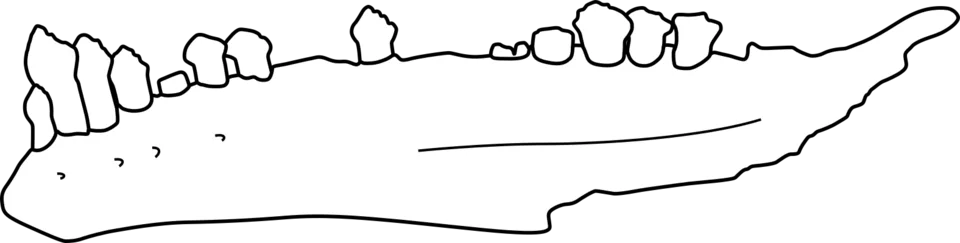
A drawing of Emausaurus jaw material focuses on the tooth-bearing bone rather than inventing a complete armour arrangement. This diagram explains the stated evidence; schematic elements are not additional fossil observations.
Compare Scelidosaurus, Scutellosaurus, Huayangosaurus. Find more names in the E index and explore ornithischian field notes. The glossary explains unfamiliar fossil terms.
Quick answers
- Where have Emausaurus fossils been found?
- The discoveries discussed here come from Germany. Modern place names describe discovery locations, not a complete ancient geographic range.
- When did Emausaurus live?
- It is placed in the Jurassic period. See the discovery discussion for qualifications about the particular rock layers and dating.
- Where can I compare Emausaurus with related dinosaurs?
- Follow the related field notes below. Comparisons explain shared anatomy; they do not imply that all the animals lived together.