Jurassic Dinos editorial · Updated · Source-based review
What was Mantellisaurus?
Mantellisaurus was a lightly built iguanodontian from Early Cretaceous Europe. It was long classified as a species of Iguanodon before receiving its own genus. The name honours Gideon Mantell, an important figure in the early study of dinosaurs.
What makes the fossil distinctive?
Relatively complete skeletons show a more slender body than the robust Iguanodon bernissartensis. Differences in limb proportions help researchers compare posture and locomotion. They do not mean the animal was limited to one fixed pose in every activity.
Where was it found and how was it named?
The principal English specimen was discovered in 1914 and described as Iguanodon atherfieldensis in 1925. The separate genus Mantellisaurus was proposed in 2007. Related European material has been reassessed repeatedly as researchers compare complete skeletons and individual bones.
What can we infer, and what remains uncertain?
The history is a useful reminder that Iguanodon once served as a broad label for animals now separated into several genera. Updating a name should also update the associated anatomy, rather than leaving a slender skeleton under a generic bulky reconstruction. Compare Mantellisaurus with Iguanodon to see how careful specimen-level study reveals diversity hidden by a familiar name.
Is Mantellisaurus just a juvenile Iguanodon?
No. It is recognised from a distinct anatomical combination, including more slender proportions, rather than simply being a small young individual.
How can you check the evidence?
The Paleobiology Database record catalogues Mantellisaurus under Iguanodontia. Its linked bibliography identifies this research starting point: G. S. Paul. 2007. Turning the old into the new: a separate genus for the gracile iguanodont from the Wealden of England. Horns and Beaks: Ceratopsian and Ornithopod Dinosaurs. Open the bibliographic record. A catalogue entry establishes the source trail; it does not independently verify every later illustration or behavioural claim.
Use the dated genus overview to follow the references behind the discovery and anatomy discussed above. When sources disagree, compare which specimen and rock layer each author studied. A reconstructed whole animal can combine original bones with comparisons to relatives; those two kinds of evidence should not be confused. The account above explains the particular limits that matter for Mantellisaurus, rather than supplying unsupported size, speed or lifespan figures.
Read the image and keep exploring
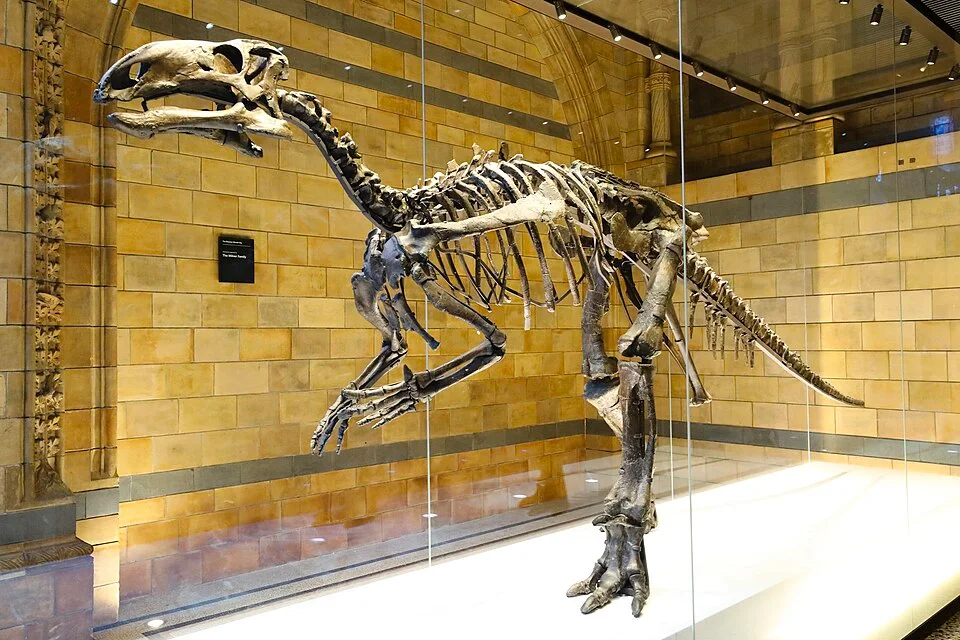
The Mantellisaurus skeletal mount shows its relatively slender iguanodontian proportions and long balancing tail. A displayed specimen or skeletal mount can include restored parts. Its appearance should be read alongside the original specimen description.
Compare Iguanodon, Ouranosaurus, Altirhinus. Find more names in the M index and explore ornithischian field notes. The glossary explains unfamiliar fossil terms.
Quick answers
- Where have Mantellisaurus fossils been found?
- The discoveries discussed here come from United Kingdom and Belgium. Modern place names describe discovery locations, not a complete ancient geographic range.
- When did Mantellisaurus live?
- It is placed in the Cretaceous period. See the discovery discussion for qualifications about the particular rock layers and dating.
- Where can I compare Mantellisaurus with related dinosaurs?
- Follow the related field notes below. Comparisons explain shared anatomy; they do not imply that all the animals lived together.