Jurassic Dinos editorial · Updated · Source-based review
What was Hypacrosaurus?
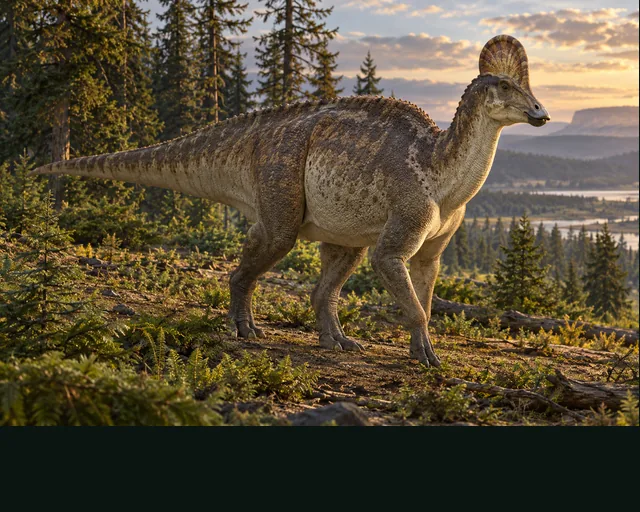
Hypacrosaurus was a crested plant-eating duck-billed dinosaur from Late Cretaceous North America. This account focuses on Hypacrosaurus altispinus, known from Alberta’s Horseshoe Canyon Formation record.
Its familiar rounded head crest and deep body make it visually distinctive, but recent research shows why a recognizable silhouette is not enough to define the boundaries of a scientific genus.
What did a northern Alberta skull add?
A 2026 study by Henry Sharpe and Caleb Brown described a well-preserved skull from Leduc. The specimen extended the known northern occurrence of H. altispinus and preserved a keratinous beak as well as scales in two modes of preservation.
Keratin is the structural material found in features such as bird beaks. Finding evidence of that covering adds information beyond the underlying bones. Preserved scales likewise help investigate skin, but do not automatically establish the animal’s full colour pattern.
Why were the species boundaries reconsidered?
The study compared the new specimen with other material and questioned several characters previously used to diagnose Hypacrosaurus. Crest dimensions, closure of certain skull openings and backbone spine height were not regarded as reliable generic distinctions in their existing form.
The authors also proposed moving the species traditionally called Hypacrosaurus stebingeri into Corythosaurus. That proposal is recorded here rather than presenting the older two-species arrangement as uncontested. It does not rename H. altispinus or mean that all crested duckbills belong to one genus.
Why connect anatomy with geological context?
The Horseshoe Canyon Formation records changing environments and dinosaur communities over time. Studies using dated volcanic layers help place its fossil assemblages in order.
However, a formation spans more than one moment. A numerical age from one layer should not be applied indiscriminately to every skeleton in it. This account uses the broader Late Cretaceous context instead of inventing an exact age for the new skull.
Reading the reconstruction
The approved complete Hypacrosaurus reference guided the rounded crest, broad beak, deep back, robust hindlegs and long tail. Its historical-style upward tail curl is retained as an artistic pose, not a proven habitual position.
The mottled pattern and colours are artistic too. Evidence of scales in a specimen does not establish this particular pattern. The portrait introduces the animal while the text explains why the source of each anatomical and taxonomic claim matters.
Compare Corythosaurus and Lambeosaurus, then browse the H directory.
Quick answers
- What species does this page focus on?
- Hypacrosaurus altispinus.
- What changed for stebingeri?
- A 2026 study proposed moving it to Corythosaurus rather than retaining it in Hypacrosaurus.
- Does every crest shape diagnose a genus?
- No. The newer study questioned several commonly used generic characters.
- Is the portrait pattern known?
- The historical-style reference pattern remains artistic, even though some specimens preserve scales.