Jurassic Dinos editorial · Updated · Source-based review
What is Maiasaura?
Maiasaura was a Late Cretaceous North American hadrosaur named following discoveries in Montana.
Distinctive features and evidence
Its name evokes parental care, but the evidential account should describe nesting material and the research interpreting it. A broad database or overview age interval should not become a claim that one species persisted unchanged across that entire interval.
Genus overview and research references.
Maiasaura fossil discoveries at Egg Mountain
The story begins in 1978 in Bynum, Montana, where Marion Brandvold, who ran a small rock shop, showed the palaeontologists Bob Makela and Jack Horner a handful of bones she had gathered. Two of them were tiny and turned out to be from baby hadrosaurs. She led the pair to the site near Choteau, and that summer they excavated what proved to be a nest holding 15 young animals.
In July 1979 a student on the dig, Fran Tannenbaum, found a whole dinosaur egg, reported as the first one found in North America. More eggs and eggshell followed, and the place became known as Egg Mountain. The skull used as the type specimen of Maiasaura peeblesorum, now kept at the Yale Peabody Museum, was found the same year; the species name honours the Peebles families who owned the land. More than 200 specimens of all ages have since been recovered.
Did Maiasaura really care for its young?
The name Maiasaura, “good mother lizard”, reflects the argument made by Horner and Makela in 1979 that these animals looked after their offspring. It rests on indirect evidence. Hatchlings from the nest had leg bones that were not fully formed, which suggests they could not walk far, yet their teeth were already partly worn, so they had been eating. The simplest explanation is that adults brought food to the nest.
The nests were mounds of earth, each with roughly 30 to 40 eggs arranged in a ring or spiral, and they sat only about 7 metres apart, closer than one adult was long. Researchers think the eggs were warmed by rotting plant material placed on them rather than by a parent sitting on top. No one has seen the behaviour directly, so this is a reasoned interpretation of fossils, but it was a major change from the older idea that dinosaurs abandoned their eggs.
How big was Maiasaura and how fast did it grow?
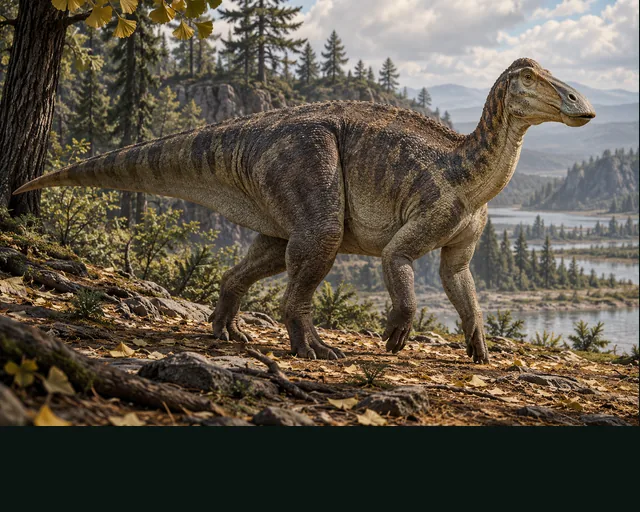
Adults reached about 9 metres in length. Mass estimates differ: the Natural History Museum lists about 2,500 kilograms, while other work gives up to around 4 tonnes. Because so many individuals are known, Maiasaura is often used to study how hadrosaurs grew.
Hatchlings measured roughly 41 centimetres and were about 147 centimetres long after a year of growth. Bone studies of about fifty shin bones, led by Holly Woodward and Jack Horner and published in 2015, estimated that nearly nine in ten animals died in their first year, that survivors reached sexual maturity around age three, and that the skeleton stopped growing at about eight. These are estimates from a sample, not a census.
What did Maiasaura eat?
Maiasaura was a plant eater with a horny beak at the front of the mouth and hundreds of chewing teeth behind it. A 2007 study of its teeth and wear patterns suggested a varied diet that included leaves, ferns, branches, bark and even rotting wood, and perhaps flowering plants and grasses. Young animals showed more crushing wear, as if eating harder items such as seeds or nuts, while adults showed more shearing, which suggests tougher fibrous plants.
Is Maiasaura a hadrosaur?
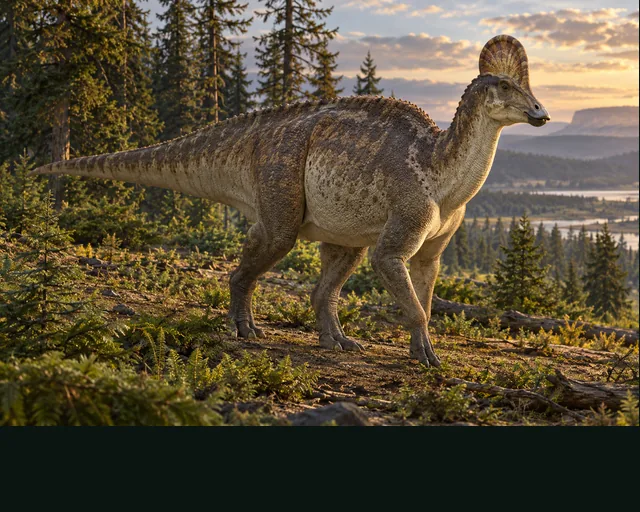
Yes. Maiasaura is a hadrosaur, one of the duck-billed dinosaurs, and belongs to a group called the Brachylophosaurini along with Brachylophosaurus, Acristavus, Probrachylophosaurus and Ornatops. What set it apart from many hadrosaurs was a short, solid crest between the eyes. Crested hadrosaurs such as Lambeosaurus are more distant relatives within the hadrosaur family.
When and where Maiasaura lived
Maiasaura fossils come from the middle part of the Two Medicine Formation in Montana, which was laid down in the Campanian stage of the Late Cretaceous. Published ages for this animal vary: the museum directory gives roughly 80 to 75 million years ago, the Paleobiology Database occurrences span about 83.6 to 72.2, and the formation interval is sometimes given as 86.3 to 70.6. These are database and rock-unit windows, not a statement that a single population lived unchanged across all that time.
Its neighbours included the small predators Troodon and Bambiraptor, the tyrannosaurid Daspletosaurus, and the small ornithopod Orodromeus.
Classification and fossil record
The Paleobiology Database taxonomic record catalogues Maiasaura under Brachylophosaurini. This is the immediate parent in that catalogue, rather than a complete list of evolutionary relationships.
The sourced length estimate for Maiasaura is about 9 metres. This is an estimate for the reconstructed animal, not a measurement shared by every individual. See the body-size discussion and linked evidence for context.
Research starting point
The catalogue links Maiasaura to Horner and Makela, 1979, published in Nature. This identifies a research starting point; the catalogue’s citation alone does not verify every later reconstruction or species assignment.
For the meaning of taxonomic terms and how evidence is checked, see the glossary and editorial policy.
Quick answers
- Is Maiasaura a dinosaur?
- Yes. Maiasaura was a hadrosaur, or duck-billed dinosaur, an ornithischian plant eater whose fossils come from the Late Cretaceous of Montana.
- What does Maiasaura mean?
- The name means 'good mother lizard'. It was chosen because the fossil nests and young suggested to Horner and Makela that the adults cared for their offspring.
- How big was Maiasaura?
- Adults grew to about 9 metres long. Mass estimates range from about 2,500 kilograms to around 4 tonnes, depending on the source and method.
- What did Maiasaura eat?
- It ate plants. Tooth wear suggests a mix of leaves, ferns, bark and woody material, with young animals feeding on harder items than adults did.
- Where was Maiasaura found?
- Maiasaura fossils were found in the Two Medicine Formation of Montana, including nests, eggs and young at the Egg Mountain site near Choteau.