Jurassic Dinos editorial · Updated · Source-based review
What is Monolophosaurus?
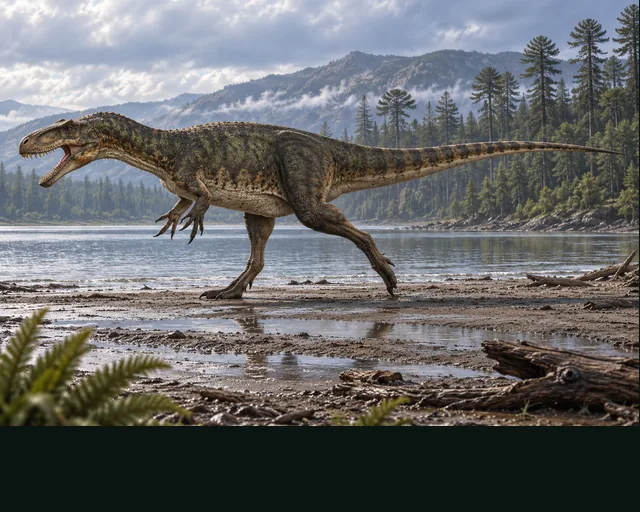
Monolophosaurus was a Middle Jurassic Chinese theropod with a single prominent skull crest.
Distinctive features and evidence
The crest inspired its name and provides a useful comparison with the paired crests of Dilophosaurus. A preserved ornament establishes anatomy, but not its exact color, sound or display routine.
Genus overview and research references.
Monolophosaurus fossil discoveries
Monolophosaurus is known from one skeleton. Dong Zhiming spotted it in 1981 in the Junggar Basin of Xinjiang, China, while surveying rocks for the oil industry, but it was not dug up until 1984. It was mentioned in the press in 1987 under the unofficial name Jiangjunmiaosaurus, and Zhao Xijin and Philip Currie gave it its formal name and description in 1993-94. The species name jiangi refers to Jiangjunmiao, an abandoned desert inn near the site.
The holotype includes the skull, lower jaws, much of the backbone and the pelvis, but the rear of the tail, the shoulders and the limbs were not recovered. It was restored with plaster for a travelling exhibition, and its left side was encased in foam, which made later study harder. Stephen Brusatte and colleagues redescribed it in detail in 2010.
What was the crest of Monolophosaurus for?
A single crest ran down the middle of the snout from the front of the upper jaw back to about the eyes, taking up around three-quarters of the length of the 80-centimetre skull. It was formed mostly by the nasal bones, and CT scans show that the inside is full of large air spaces. A smaller horn also sat behind each eye.
The Natural History Museum suggests the crest was perhaps for display. That is a reasonable idea given its position and the thin, hollow structure, but there is no direct evidence of how it was used, and the fossil cannot tell us its colour or whether it was used in signalling.
How big was Monolophosaurus?
Estimates for the single specimen run from about 5 to 5.7 metres in length. Gregory Paul estimated a body mass of about 475 kilograms in 2010, which is one estimate rather than a measurement. The specimen is an adult or nearly adult individual, so it may be close to full size, but with only one skeleton the range within the species is unknown. Some bones show signs of injury: two neural spines on the back were broken and fused together, and ridges on a jaw bone may be tooth marks.
Is Monolophosaurus an allosauroid?
It is often called one, but its position on the family tree has changed several times. It was first described as a megalosaur and later widely treated as an allosauroid. Studies from 2007 onward found primitive features suggesting it sits near the base of the tetanurans, the large group that includes most big theropods. A 2019 analysis found it the most basal member of Carnosauria, a 2023 study placed it as a relative of spinosaurids, and in 2024 one team included it inside Spinosauridae while another recovered it as a basal allosauroid. For a comparison with a better-known allosauroid, see Allosaurus.
A second question concerned Guanlong, a crested theropod from the same formation. In 2006 Thomas Carr suggested it was a young Monolophosaurus, but Brusatte’s team rejected this in 2010 because the Guanlong type specimen was fully grown.
Where and when Monolophosaurus lived
Monolophosaurus lived in the Middle Jurassic in what is now Xinjiang, in a warm, semi-arid and strongly seasonal climate with wetlands and well-drained floodplains. Conifers, ginkgoes and ferns grew there. Its neighbours included smaller dinosaurs such as Yinlong and Guanlong, and larger ones such as Sinraptor and the sauropod Mamenchisaurus. Published ages differ: the rock layers have been described as Bathonian-Callovian, the Paleobiology Database gives about 165 to 161.5 million years ago, and the Natural History Museum gives a broader 180 to 159 million years.
Classification and fossil record
The Paleobiology Database taxonomic record catalogues Monolophosaurus under Allosauroidea. This is the immediate parent in that catalogue, rather than a complete list of evolutionary relationships.
The corroborated occurrence sample includes China; those are modern discovery locations, not a complete ancient geographic range.
The sourced length estimate for Monolophosaurus is 5–5.7 metres. This is an estimate for the reconstructed animal, not a measurement shared by every individual. See the body-size discussion and linked evidence for context.
Research starting point
The catalogue links Monolophosaurus to Zhao and Currie, 1994, published in Canadian Journal of Earth Sciences. This identifies a research starting point; the catalogue’s citation alone does not verify every later reconstruction or species assignment.
For the meaning of taxonomic terms and how evidence is checked, see the glossary and editorial policy.
Quick answers
- Is Monolophosaurus a dinosaur?
- Yes. Monolophosaurus was a mid-sized theropod dinosaur from the Middle Jurassic of Xinjiang, China, known from a single skeleton.
- What does Monolophosaurus mean?
- It means 'single-crested lizard', named for the one crest on top of its snout.
- How big was Monolophosaurus?
- It was roughly 5 to 5.7 metres long, with one estimate of about 475 kilograms. Only one skeleton is known, so these figures are uncertain.
- What was the crest of Monolophosaurus for?
- It is not known. The crest was thin and hollow, so display has been suggested, but there is no direct evidence of its function.
- Is Monolophosaurus an allosauroid?
- It is debated. It has been called an allosauroid, a basal tetanuran, a carnosaur and even a relative of spinosaurids, depending on the study.