Jurassic Dinos editorial · Updated · Source-based review
What is Anchiornis?
Anchiornis was a small feathered paravian dinosaur from Late Jurassic China, with long feathers on both forelimbs and hindlimbs.
Distinctive features and evidence
Exceptional preservation makes it important for studies of early bird evolution and feather appearance. The presence of four feathered limbs does not on its own settle exactly how it moved through the air.
Genus overview and research references.
Anchiornis fossil discoveries
Anchiornis is known from hundreds of specimens, all from the Tiaojishan Formation of Liaoning Province in north-eastern China. The first, an incomplete skeleton without a skull, came from the Yaolugou area and was described by Xu Xing and colleagues in 2009. A second, more complete specimen, handed to scientists by a local farmer, showed long feathers on the arms, legs and feet and was published in Nature the same year.
Many more specimens have been identified, and more than 250 were reported to be held by one museum in China in 2010. Some preserve skin and muscle traces visible under laser fluorescence, which is why the animal’s appearance is known in unusual detail.
What did Anchiornis look like?
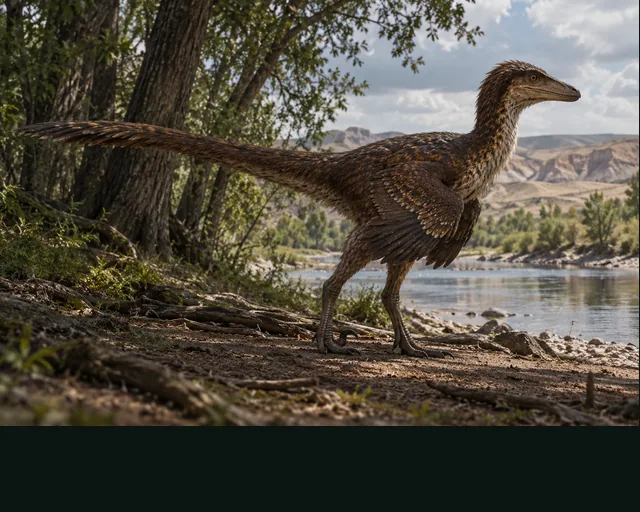
Anchiornis was about the size of a crow, with a triangular skull, long arms bearing wing feathers, long legs and a long tail. The largest specimens were 60 to 62 centimetres long and are estimated at 0.6 to 1 kilogram, while the type specimen was a smaller animal at about 34 centimetres and 110 grams. Feathers covered the head, body, legs and feet, with scales on parts of the toes, and a crest of long feathers on the head is possible.
Its feathers were not like those of modern flying birds. Body feathers were shaggy, with long, loose barbs, and the wings had 20 to 28 primary feathers, many more than in living birds.
What colour was Anchiornis?
It is one of the few dinosaurs whose colours have been studied directly. In 2010 researchers mapped melanosomes, tiny pigment structures preserved in the feathers, and compared them with those of living birds. The result was mostly grey and black body feathers, white wings tipped with black, and a red-brown crest on the head.
A second study in 2015, on a different specimen, found only grey-black pigment structures and no red-brown ones. Possible explanations include differences in preservation, in age, in sex, or in species. The colour picture is therefore a well-supported estimate for one individual, not a final answer for the whole genus.
Could Anchiornis fly?
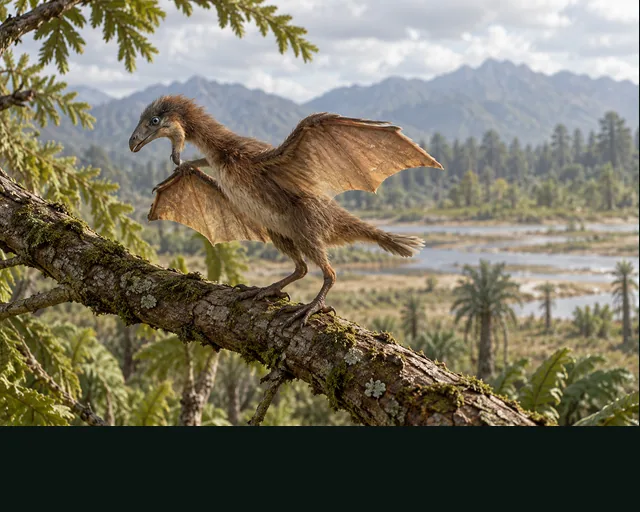
Probably not well, and perhaps not at all. It is often called four-winged because it had long feathers on the hind legs as well as the arms, but the leg feathers were not shaped like flight feathers and were probably mainly for display. The wing feathers had rounded tips and symmetrical shafts, which suggests poor aerodynamic ability.
A 2016 study concluded that young Anchiornis might have used their wings to help in running up a slope, but adults were too heavy for their wing area to benefit. A 2025 study of how the feathers grew and were replaced argued that it was probably flightless.
Is Anchiornis a bird?
No. Anchiornis was a paravian, a member of the group that includes birds, dromaeosaurids and troodontids. When first described it was placed among the earliest birds. Later work, starting with its second specimen, usually put it among troodontids, or as an early paravian outside those groups. It is therefore treated as a close cousin of birds. Compare it with Archaeopteryx or Microraptor to see other feathered members of this group.
Pellets from Anchiornis, lumps of indigestible bone and scales that some modern birds cough up, are the oldest such evidence reported for any theropod.
Classification and fossil record
The Paleobiology Database taxonomic record catalogues Anchiornis under Troodontidae. This is the immediate parent in that catalogue, rather than a complete list of evolutionary relationships.
Discovery and naming history
The species name Anchiornis huxleyi honors Thomas Henry Huxley. Its numerous finely preserved Tiaojishan Formation fossils provide an unusually detailed record of feathers, while the scientific name itself is not evidence of flight performance. Historical overview.
The corroborated occurrence sample includes China; those are modern discovery locations, not a complete ancient geographic range.
The sourced length estimate for Anchiornis is 0.6–0.62 metres. This is an estimate for the reconstructed animal, not a measurement shared by every individual. See the body-size discussion and linked evidence for context.
Research starting point
The catalogue links Anchiornis to Xu and Zhao, 2009, published in Chinese Science Bulletin. This identifies a research starting point; the catalogue’s citation alone does not verify every later reconstruction or species assignment.
For the meaning of taxonomic terms and how evidence is checked, see the glossary and editorial policy.
Quick answers
- Is Anchiornis a dinosaur?
- Yes. Anchiornis was a small feathered theropod dinosaur, a paravian, from the Late Jurassic of China. It is a close cousin of birds but was not a bird itself.
- How big was Anchiornis?
- About the size of a crow: the largest specimens were roughly 60 to 62 centimetres long and estimated at 0.6 to 1 kilogram, though the first specimen was a smaller animal.
- What colour was Anchiornis?
- One study of pigment structures found grey and black body feathers, white wings with black tips and a red-brown crest. A later study of another specimen found no red-brown, so it is debated.
- Could Anchiornis fly?
- Probably not well. Its wings had rounded feathers poorly suited to flight, adults seem too heavy for them, and a 2025 study suggested it was likely flightless.
- What did Anchiornis eat?
- Pellets found with specimens contained lizard bones and fish scales, so it ate small animals. Some pellets were still inside the body, which makes the evidence unusually direct.