Jurassic Dinos editorial · Updated · Source-based review
What is Gobivenator?
Gobivenator was a Late Cretaceous Mongolian troodontid represented by an unusually complete individual.
Distinctive features and evidence
The species Gobivenator mongoliensis comes from the Djadokhta Formation. Its completeness makes it valuable for anatomical comparison, although one skeleton cannot document all variation within a population.
Genus overview and research references.
Gobivenator fossil discovery
Gobivenator is known from one animal, catalogued as MPC-D 100/86 and kept at the Mongolian Paleontological Center in Ulaanbaatar. A Japanese-Mongolian expedition found it at the Dzamin Khond locality in the central Gobi Desert. Takanobu Tsuihiji, Rinchen Barsbold and colleagues described it in 2014 as a new genus and species, Gobivenator mongoliensis.
The skeleton is unusual because it is nearly complete and still lies in its natural position in three dimensions, whereas most troodontid fossils are less complete. The skull is well preserved, missing only the very tip of the snout. Gaps in the rest of the skeleton include the middle neck vertebrae, the lower arm and some leg bones, and most of the belly ribs (gastralia). The describing team called it the most complete Late Cretaceous troodontid known at the time.
How big was Gobivenator?
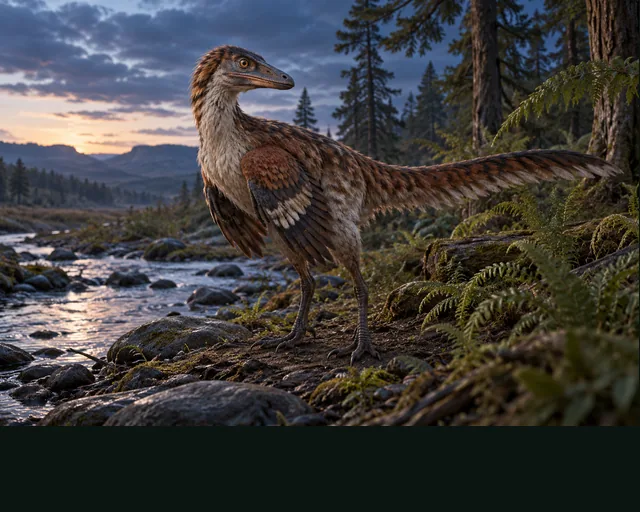
Gobivenator was a small, lightly built theropod. Summaries of the 2014 description give a length of about 1.7 metres and a weight of about 9 kilograms. These are estimates for a single individual, and one skeleton cannot show how much size varied in the population.
Why is the Gobivenator skull important?
The skull gave researchers an unusually clear look at the palate, the roof of the mouth, in a troodontid. The shape of the palate resembles that of dromaeosaurids and of Archaeopteryx, and the authors saw a trend across the line toward birds: one palate bone, the pterygoid process of the palatine, becomes longer, while the join between two palate bones becomes smaller.
The authors concluded that the skull was akinetic, meaning its parts did not move against each other as in many living birds. However, it already had some features that could have prepared for movement in bird skulls later, including the loss of one small bone, the epipterygoid, and smaller contact areas between bones. The team also named two unique features that separate it from other troodontids: a pointed front end of the fused parietal bones, and a pit on the surangular, a bone of the lower jaw.
Is Gobivenator a troodontid?
Yes. Troodontids were small, bird-like theropods with many teeth and well-developed senses. In the 2014 analysis Gobivenator came out as an advanced troodontid, close to the Late Cretaceous Mongolian genera Saurornithoides and Zanabazar and to North America’s Troodon. A 2024 study of another Mongolian troodontid, Hypnovenator, instead placed Gobivenator as the sister of that genus and as an early member of the subgroup Troodontinae.
Where and when Gobivenator lived
The fossil comes from the Djadokhta Formation in the Gobi Desert, assigned to the late part of the Campanian, a stage near the end of the Cretaceous, at roughly 72 million years ago according to published summaries. The Paleobiology Database gives the broader Campanian range of about 83.6 to 72.2 million years ago for the record, so the younger end of that span matches the summaries.
Classification and fossil record
The Paleobiology Database taxonomic record catalogues Gobivenator under Troodontidae. This is the immediate parent in that catalogue, rather than a complete list of evolutionary relationships.
The corroborated occurrence sample includes Mongolia; those are modern discovery locations, not a complete ancient geographic range.
Research starting point
The catalogue links Gobivenator to Tsuihiji and Barsbold, 2014, published in Naturwissenschaften. This identifies a research starting point; the catalogue’s citation alone does not verify every later reconstruction or species assignment.
For the meaning of taxonomic terms and how evidence is checked, see the glossary and editorial policy.
Quick answers
- Is Gobivenator a dinosaur?
- Yes. Gobivenator was a small, bird-like theropod dinosaur belonging to the troodontid family, from the Late Cretaceous of Mongolia.
- When did Gobivenator live?
- It lived in the Campanian stage of the Late Cretaceous. Published summaries put the Djadokhta rocks that held it at about 72 million years ago, in the late Campanian.
- How big was Gobivenator?
- Gobivenator was small, about 1.7 metres long and roughly 9 kilograms, based on a single skeleton, so these figures are only an estimate for one animal.
- Where was Gobivenator found?
- It was found at the Dzamin Khond locality in the Djadokhta Formation of the central Gobi Desert, Mongolia, by a Japanese-Mongolian expedition.
- Is Gobivenator a troodontid?
- Yes. Its skull and skeleton place it among the troodontids, close to genera such as Saurornithoides, Zanabazar and Troodon, though newer studies disagree on its exact position.