Jurassic Dinos editorial · Updated · Source-based review
What is Mei?
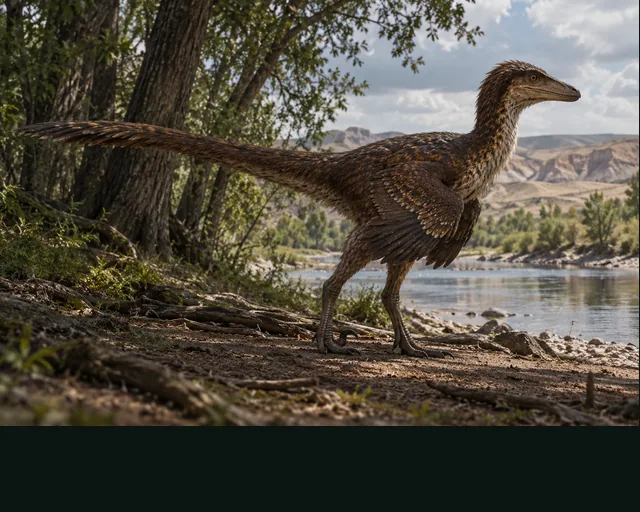
Mei was a small Early Cretaceous troodontid from China’s Yixian Formation.
Distinctive features and evidence
The species Mei long has a name meaning sleeping dragon. The name introduces its discovery story, but the actual specimen and its preserved posture are the evidence to examine rather than the translation alone.
Genus overview and research references.
Mei fossil discoveries
Mei was announced in 2004 by Xu Xing and Mark Norell in the journal Nature, based on a fossil from the Yixian Formation of western Liaoning, China. The first specimen is a very young animal about 53 centimetres long. It is complete and preserved in three dimensions, rather than squashed flat as many fossils are.
A second specimen, DNHM D2154, was later found that is also curled up. Its skull shape looks juvenile in some ways, but the fused backbone and dense bone suggest a small adult. Bone slices from its leg indicate an animal older than two years whose growth had slowed. Together the two specimens suggest that Mei stayed small even when fully grown.
Why is the sleeping posture of Mei important?
The type fossil lies with its snout tucked beneath one arm and its legs folded under the body, in a pose like the resting position of modern birds. The describing team stressed that this kind of behaviour is rarely preserved in fossils and had not been predicted for dinosaurs outside the bird line. They argued that it adds to evidence that many bird features appeared early in dinosaur evolution.
The chemistry of the surrounding rock and the neat pose suggest to researchers that the animal was probably buried quickly in volcanic ash. ‘Sleeping’ is therefore a reading of the posture: the fossil shows the way the body was arranged, not what the animal was doing.
How big was Mei?
Mei was small, often described as about duck-sized. The only measured specimen, the type, is a juvenile of roughly 53 centimetres, so a full adult length cannot be read from it. The second skeleton looks like a small adult, but the available fossils are too few to give a reliable length or weight.
Is Mei a troodontid?
Yes. Troodontids are small, slender, bird-like theropods with many closely packed teeth, a sickle-shaped claw on the foot and relatively large brains for non-bird dinosaurs. Mei is classified as one of the earliest members of the family, and a close relative is Sinovenator. It differs from other troodontids in several details, including very large nostril openings, and unlike later troodontids it has a bird-like hip structure. For another troodontid, see Troodon.
Where and when Mei lived
In the Early Cretaceous, about 125.8 million years ago (early Aptian), Mei inhabited what is now Liaoning. The area was dotted with volcanoes, with conifer forest, ferns, horsetails, ginkgoes and some of the earliest flowering plants, and rivers ran down into valley lakes. Many other small bird-like theropods lived nearby, along with early mammals and pterosaurs. Volcanic eruptions repeatedly buried animals in ash, which explains the exceptional preservation of the Yixian fossils.
Classification and fossil record
The Paleobiology Database taxonomic record catalogues Mei under Sinovenatorinae. This is the immediate parent in that catalogue, rather than a complete list of evolutionary relationships.
The corroborated occurrence sample includes China; those are modern discovery locations, not a complete ancient geographic range.
Research starting point
The catalogue links Mei to Xu and Norell, 2004, published in Nature. This identifies a research starting point; the catalogue’s citation alone does not verify every later reconstruction or species assignment.
For the meaning of taxonomic terms and how evidence is checked, see the glossary and editorial policy.
Quick answers
- Is Mei a dinosaur?
- Yes. Mei was a small, bird-like troodontid theropod dinosaur from the Early Cretaceous of Liaoning, China.
- What does Mei long mean?
- Mei long means 'sleeping dragon' in Chinese, a name that refers to the first fossil, which was preserved curled up with its snout under its arm like a resting bird.
- When did Mei live?
- Mei dates to the early Aptian stage of the Early Cretaceous, roughly 125.8 million years ago.
- How big was Mei?
- Mei was small, often described as duck-sized. The first specimen is a juvenile about 53 centimetres long, and adult size is uncertain.
- Is Mei a troodontid?
- Yes. Mei is a troodontid, placed near the base of the family and close to Sinovenator.