Jurassic Dinos editorial · Updated · Source-based review
What is Coelophysis?
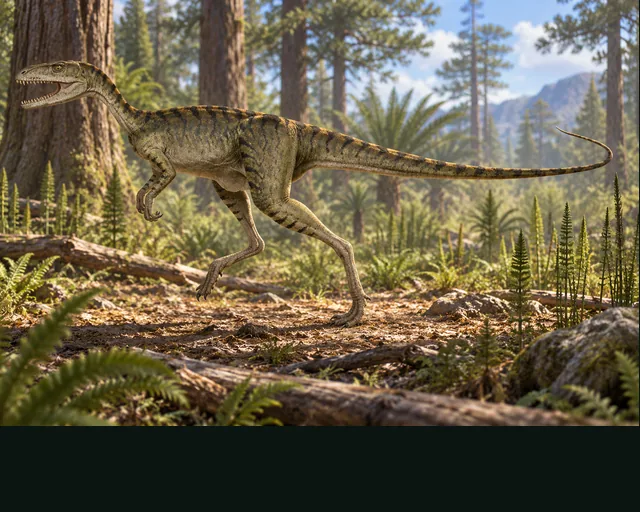
Coelophysis was a slender Late Triassic theropod from the southwestern United States, represented by many specimens.
Distinctive features and evidence
The abundant fossils support studies of variation within an early dinosaur genus. Similar animals from other continents should not automatically be called Coelophysis, and the former inclusion of Megapnosaurus reflects a debated taxonomic history.
Genus overview and research references.
Coelophysis fossil discoveries
Edward Drinker Cope described the first Coelophysis bones in 1887 and named the genus in 1889. They were collected in 1881 by David Baldwin in Rio Arriba County, New Mexico. They covered much of the skeleton but not the skull, and later researchers called the material scrappy.
The famous finds came in 1947, when a crew led by Edwin Colbert of the American Museum of Natural History found a claw at Ghost Ranch, New Mexico. Digging revealed a layer holding hundreds of skeletons in one place. The quarry was worked in 1947 and 1948 and again in 1981 and 1982, and blocks of rock holding many skeletons were shared between museums.
Because the early bones were so incomplete, it was unclear whether the name could be tied to the Ghost Ranch skeletons. In 1996 the international naming commission settled this by choosing a complete Ghost Ranch skeleton, AMNH 7224, as the reference specimen, and a rival name, Rioarribasaurus, was rejected.
How big was Coelophysis?
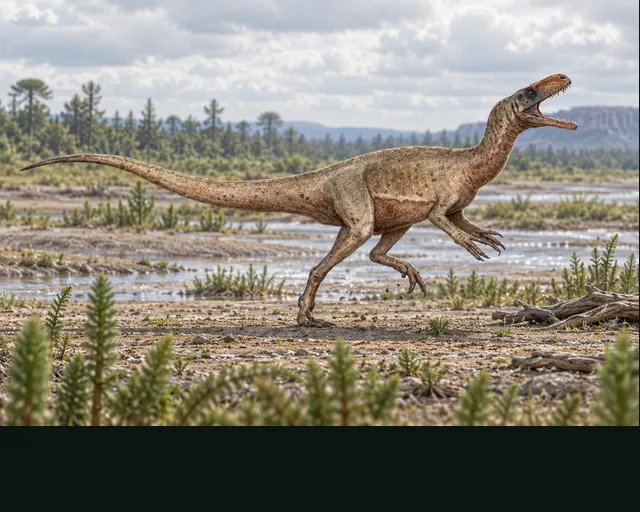
Coelophysis was a slender two-legged dinosaur up to about 3 metres long and over a metre tall at the hips, though the Natural History Museum lists about 2 metres. Gregory Paul estimated its weight at 15 to 25 kilograms, and the museum gives about 27. It had a long neck and tail and grasping arms. A study of the bony ring that supports the eye in a young specimen suggested that it hunted by day with sharp, bird-of-prey-like vision.
What did Coelophysis eat? Was it a cannibal?
Coelophysis was a meat-eater with blade-like, finely serrated teeth. Its arms were flexible but fairly weak, so it probably chased small, fast prey instead of large animals.
You may have read that Coelophysis ate its own young. The idea came from small bones inside the ribcage of some skeletons, but Robert Gay showed in 2002 that several of these belonged to small crocodile-line reptiles. In 2010 he found that the bones in AMNH 7224 were far too large for its stomach and lay below it in the rock. Regurgitated material near the mouth of another specimen was identified in 2009 as juvenile Coelophysis, so the question is not entirely closed, but the famous skeleton is not good evidence.
Did Coelophysis live in packs?
More than 1,000 individuals have been found at the Ghost Ranch quarry, which has often been taken as evidence for packs. There is no direct evidence for this. The rocks show only that many animals were buried together, and flash floods were common. The animals may have gathered at a shrinking waterhole or a fish run before being buried. About 30 skeletons of a close relative from Zimbabwe call for the same caution.
Is Coelophysis the same as Megapnosaurus?
Probably not. Megapnosaurus, from southern Africa, was first called Syntarsus, but that name was already used for a beetle, so it was renamed in 2001. Some authors have treated its species as part of Coelophysis, but many others cite differences in the neck, leg proportions, hand and tooth row. Coelophysis belongs to a wider group that also includes Dilophosaurus, and it has more features typical of later theropods than the earlier Herrerasaurus.
Where and when Coelophysis lived
Coelophysis is known from the Chinle Formation in New Mexico and Arizona, dating to the Late Triassic. Sources disagree about its exact age. Some layers have been dated to about 212 million years ago, in the middle Norian, whereas Thomas Holtz suggested that the Ghost Ranch quarry belongs to the Rhaetian, about 204 to 201.6 million years ago. The Natural History Museum gives 225 to 190 million years ago as a general range.
At Ghost Ranch the climate was warm and monsoon-like, with wet and dry seasons, and dinosaurs were rare. Coelophysis became the state fossil of New Mexico in 1981.
Classification and fossil record
The Paleobiology Database taxonomic record catalogues Coelophysis under Coelophysinae. This is the immediate parent in that catalogue, rather than a complete list of evolutionary relationships.
The corroborated occurrence sample includes United States; those are modern discovery locations, not a complete ancient geographic range.
The sourced length estimate for Coelophysis is 2–3 metres. This is an estimate for the reconstructed animal, not a measurement shared by every individual. See the body-size discussion and linked evidence for context.
Research starting point
The catalogue links Coelophysis to Cope, 1889, published in The American Naturalist. This identifies a research starting point; the catalogue’s citation alone does not verify every later reconstruction or species assignment.
For the meaning of taxonomic terms and how evidence is checked, see the glossary and editorial policy.
Quick answers
- Is Coelophysis a dinosaur?
- Yes. Coelophysis was a small, slender, two-legged theropod dinosaur from the Late Triassic of the southwestern United States.
- When did Coelophysis live?
- It lived in the Late Triassic, with estimates ranging from about 212 million years ago to roughly 201 million years ago, depending on how the Chinle Formation is dated.
- How big was Coelophysis?
- Coelophysis was up to about 3 metres long, though about 2 metres is also quoted, and probably weighed 15 to 27 kilograms.
- Did Coelophysis eat its young?
- Probably not. The famous cannibal skeleton was re-examined and the supposed young were other reptiles or too large for its stomach, though one 2009 find is still debated.
- What did Coelophysis eat?
- It was a meat-eater, probably hunting small, fast animals such as lizard-like reptiles, judging from its teeth, weak arms and the animals found with it.
- Where was Coelophysis found?
- Coelophysis fossils come from the Chinle Formation in New Mexico and Arizona, and the most famous site is the Ghost Ranch quarry in New Mexico.