Jurassic Dinos editorial · Updated · Source-based review
What is Ornithomimus?
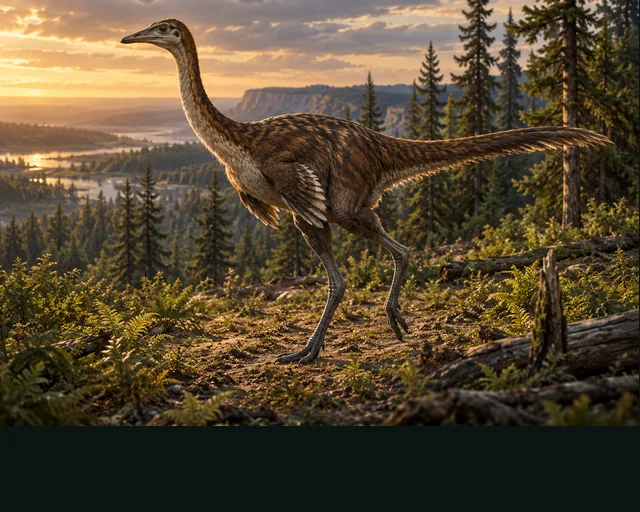
Ornithomimus was a feathered Late Cretaceous North American theropod with a small toothless beak.
Distinctive features and evidence
Many historically assigned species were later removed from the genus. Its long-legged skeleton supports locomotion analysis, while an omnivorous diet and exact speeds require interpretation rather than direct observation.
Genus overview and research references.
Was Ornithomimus feathered?
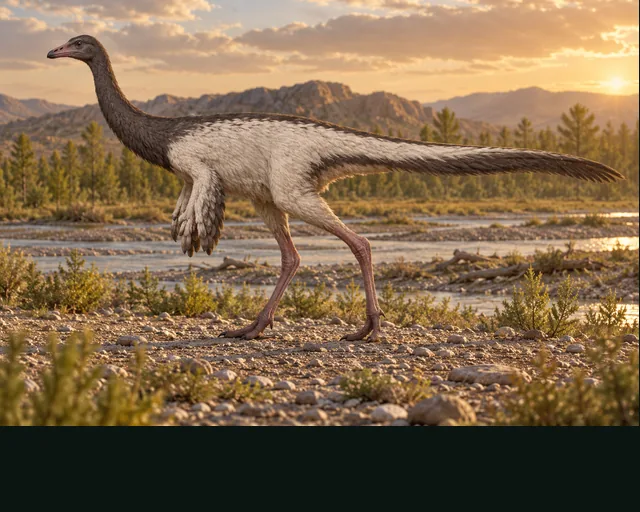
Yes, at least one species was. Starting in 1995, several specimens of Ornithomimus edmontonicus from Alberta were found with traces of feathers. Two adults showed carbonised marks along the lower arm that point to stiff, vaned feather shafts, and a juvenile preserved hair-like filaments up to five centimetres long over its rump, legs and neck.
A 2012 study concluded that the animal had soft, downy feathers at every growth stage, and that only adults carried the larger wing-like feathers on the arms. The authors suggested that such wings could have evolved for display during courtship. Other researchers questioned this in 2014, pointing out that simple filaments on the wings of living cassowaries could leave similar traces.
In 2015 a specimen from the Dinosaur Park Formation became the first of the genus to preserve tail feathers, which resembled those of an ostrich in structure. It also showed bare skin on the lower leg and a fold of skin joining the upper thigh to the body.
How big was Ornithomimus?
Ornithomimus was a slim, long-legged runner. Gregory Paul estimated in 2010 that Ornithomimus edmontonicus was about 3.8 metres long and weighed around 170 kilograms. The Natural History Museum lists 4 metres. These are estimates scaled from fossil bones, not measurements of a whole animal.
The two species still thought valid were different in size. The type species, Ornithomimus velox, is known from a smaller animal: its second hand bone is only 53 millimetres long, compared with 84 millimetres in the holotype of O. edmontonicus.
What did Ornithomimus eat?
Nobody knows for certain. Because Ornithomimus was a theropod, it could have been a meat eater, but its toothless beak and body shape fit a mostly omnivorous way of life better. Foods that scientists have suggested include insects, crustaceans, fruit, leaves, flowers, frogs, lizards and small mammals.
The hand bones look strikingly like those of a sloth, which led Henry Fairfield Osborn to suggest that the hands hooked branches while feeding. The large eye sockets suggest keen eyesight and have led to the idea that this dinosaur may have been active at night, although that is only a possibility.
How many species of Ornithomimus are there?
Far fewer than were once named. For decades, almost any ornithomimid found in North America was called Ornithomimus, and some early names turned out to be based on tyrannosauroid or alvarezsaurid bones. In 1972 Dale Russell separated several of these animals into other genera, including Dromiceiomimus and Archaeornithomimus.
Later work partly reversed that. In 2004 Makovicky, Kobayashi and Currie argued that Dromiceiomimus should be folded into Ornithomimus edmontonicus, and most later authors followed them. A 2015 re-description found that only the type specimen could be confidently assigned to O. velox, so specimens from other formations are sometimes labelled simply Ornithomimus sp. The group is still being sorted out.
Where and when Ornithomimus lived
The genus is known from western North America in the Campanian and Maastrichtian, the last two stages of the Late Cretaceous. The Natural History Museum gives a range of about 74 to 66 million years ago. The type species comes from the Denver Formation of Colorado, while the best skeletons of O. edmontonicus come from the Horseshoe Canyon Formation of Alberta and date to the early Maastrichtian. The species sometimes called O. samueli comes from the older Dinosaur Park Formation of Alberta, and some researchers think it may be a separate, still unnamed species.
Classification and fossil record
The Paleobiology Database taxonomic record catalogues Ornithomimus under Ornithomimidae. This is the immediate parent in that catalogue, rather than a complete list of evolutionary relationships.
Discovery and naming history
Marsh named Ornithomimus velox in 1890 from Colorado foot and hand material. Many species subsequently attached to the genus have been reassigned, so an old name list is not a count of currently recognized Ornithomimus species. Historical overview.
The corroborated occurrence sample includes Canada, United States; those are modern discovery locations, not a complete ancient geographic range.
The sourced length estimate for Ornithomimus is 3.8–4 metres. This is an estimate for the reconstructed animal, not a measurement shared by every individual. See the body-size discussion and linked evidence for context.
Research starting point
The catalogue links Ornithomimus to Marsh, 1890, published in The American Journal of Science, series 3. This identifies a research starting point; the catalogue’s citation alone does not verify every later reconstruction or species assignment.
For the meaning of taxonomic terms and how evidence is checked, see the glossary and editorial policy.
Quick answers
- Is Ornithomimus a dinosaur?
- Yes. Ornithomimus was a theropod dinosaur from the Late Cretaceous of North America, and it belongs to the ornithomimid family of bird-like, toothless runners.
- How big was Ornithomimus?
- Ornithomimus edmontonicus has been estimated at about 3.8 to 4 metres long and around 170 kilograms. The type species, O. velox, was a smaller animal.
- Did Ornithomimus have feathers?
- Yes, fossils of Ornithomimus edmontonicus preserve feather traces, including soft filaments on juveniles and larger arm feathers on adults. Scientists still debate how wing-like those arm feathers were.
- What did Ornithomimus eat?
- Its diet is debated. The toothless beak and body shape suggest a largely omnivorous animal that might have taken plants, insects and small animals.