Jurassic Dinos editorial · Updated · Source-based review
What is Gallimimus?
Gallimimus was a Late Cretaceous Mongolian ornithomimid known from specimens at several growth stages.
Distinctive features and evidence
Polish-Mongolian expeditions supplied material for comparing juvenile and larger individuals. Its long-legged bird-mimic appearance motivates locomotion studies, but does not yield an observed top speed or a settled menu.
Genus overview and research references.
Gallimimus fossil discoveries
Gallimimus was found by joint Polish and Mongolian expeditions to the Gobi Desert between 1963 and 1965. The teams collected ostrich-dinosaur skeletons of many ages at sites in the Nemegt Basin, including three partial skeletons. The largest, found by Zofia Kielan-Jaworowska at Tsaagan Khushuu in 1964, lay on its back with the skull beneath the pelvis. It became the type specimen of Gallimimus bullatus, the species that Osmólska, Roniewicz and Barsbold published in 1972.
In all, those authors listed twenty-five specimens, nine of them single bones. At the time, this was the most complete ornithomimid material known, and it also included the first Asian one with a skull. The species name refers to a bulb-shaped, hollow bone at the base of the skull, which was an unusual feature when it was described. More recent finds include a foot from a trackway site reported in 2017, although poachers appear to have removed the rest of that skeleton, and a slab of two specimens that was returned to Mongolia in 2014 after being smuggled abroad.
How big was Gallimimus?
Gallimimus is the largest known member of its family. The adult type specimen was about 6 metres long and 1.9 metres tall at the hip, with an estimated weight of 400 to 490 kilograms. The Natural History Museum gives the same length and the upper weight. A young animal, specimen ZPAL MgD-I/94, was only about 2.15 metres long and perhaps 26 to 30 kilograms.
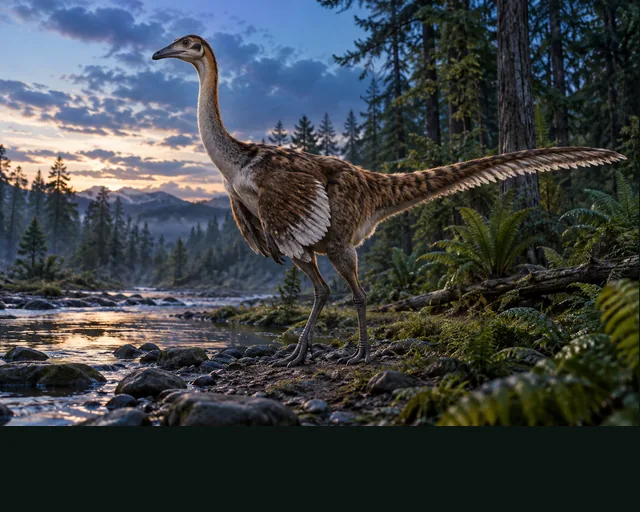
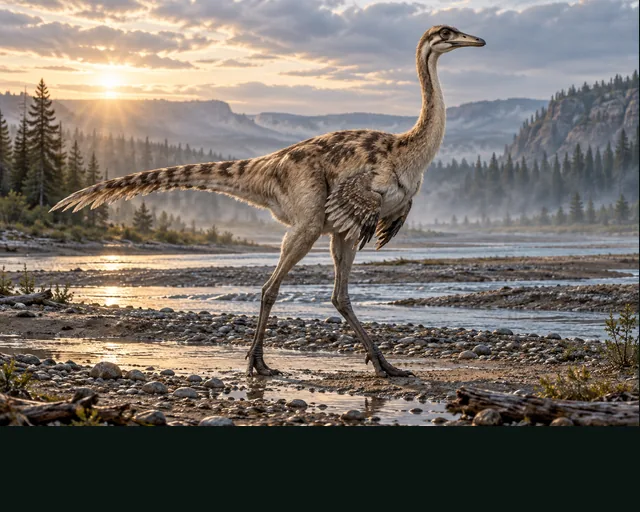
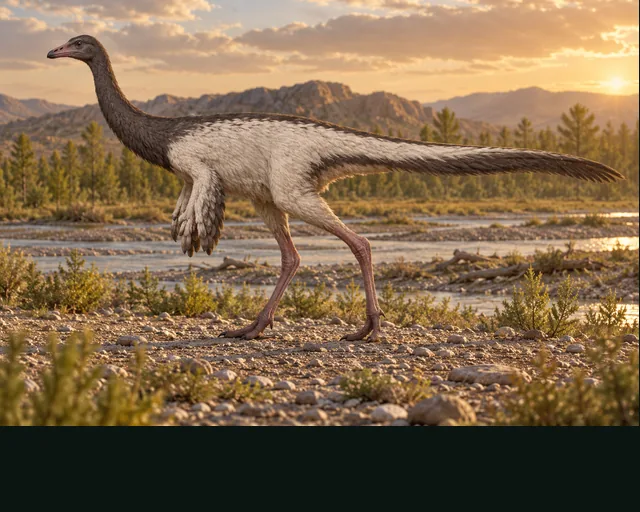
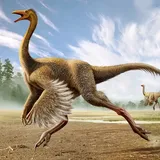
The skull was small and light, with large eyes on the sides of the head. The beak was broad and rounded at the tip, in contrast to the pointed beaks of North American relatives. The neck was long, and the hand was short with three clawed fingers. The legs were long and slender, and many vertebrae had air-filled hollows.
How fast was Gallimimus?
Gallimimus has a reputation as a sprinter, but no one has measured a speed. In 1982 Richard Thulborn estimated 42 to 56 kilometres per hour, and the museum quotes 47 to 55, compared with the roughly 70 to 80 of an ostrich. He thought it was slower mainly because the arms and tail added weight. Both figures come from models rather than tracks or direct observation.
The film Jurassic Park made a stampeding herd of Gallimimus famous, and in the film they are shown moving as a flock. The real evidence is thinner. A site with several skeletons together, along with the poached remains mentioned above, hints that Gallimimus may have lived in groups, but the museum notes that nobody knows for sure. It is also worth noting that the film’s dinosaurs lack feathers, while a close relative, Ornithomimus, shows that ornithomimosaurs had them, and scientists consider it highly likely that Gallimimus did too.
What did Gallimimus eat?
This is an open question. Gallimimus had no teeth, only a horny beak, and inside the beak were small, tightly spaced structures. The describing team compared the beak with that of a duck or goose and thought it took small live prey. A 2001 study compared the structures to the filtering plates of ducks and suggested filter-feeding, but in 2005 Paul Barrett argued that they looked more like the ridges in the beaks of turtles and plant-eating hadrosaurs, used to crop tough plants. Stomach stones found in some relatives also point to a plant diet.
The Natural History Museum treats an omnivore that ate plants and animals as the most likely answer. Because these dinosaurs have no teeth, their diet is poorly known, and a firm menu would be a guess.
Is Gallimimus an ostrich dinosaur?
Yes, in the sense that it belongs to the ornithomimids, nicknamed ostrich dinosaurs, a family of theropods within the group Ornithomimosauria. Its closest known relative is thought to be Anserimimus, also from Mongolia, and it is not closely related to ostriches. The museum explains that modern birds descend from a different branch, the maniraptorans, so the resemblance is convergent evolution. Other ornithomimosaurs in the encyclopedia include Deinocheirus, which lived alongside it, and Archaeornithomimus, the only Asian ornithomimid known before Gallimimus was named.
The genus has also been debated. In 1988 Gregory Paul moved most ornithomimids into Ornithomimus, although most researchers kept them apart, and a skeleton once informally called ‘Gallimimus mongoliensis’ probably belongs to a different genus.
Where and when Gallimimus lived
Gallimimus is known from the Nemegt Formation of the southern Gobi Desert, which has never been dated directly but is thought to be from the early Maastrichtian, around 70 million years ago. Its rocks record river channels, mudflats, shallow lakes and floodplains, a setting compared with the Okavango Delta, although droughts occurred at times. Gallimimus is the most common ornithomimosaur found there.
It shared its world with large predators such as Tarbosaurus, a relative of T. rex that lived in Mongolia, so the film’s chase scene between a Tyrannosaurus and Gallimimus could not have happened in life: the museum points out that T. rex lived in North America. Tarbosaurus may have hunted Gallimimus, but there is no direct evidence of that.
Gallimimus in the game
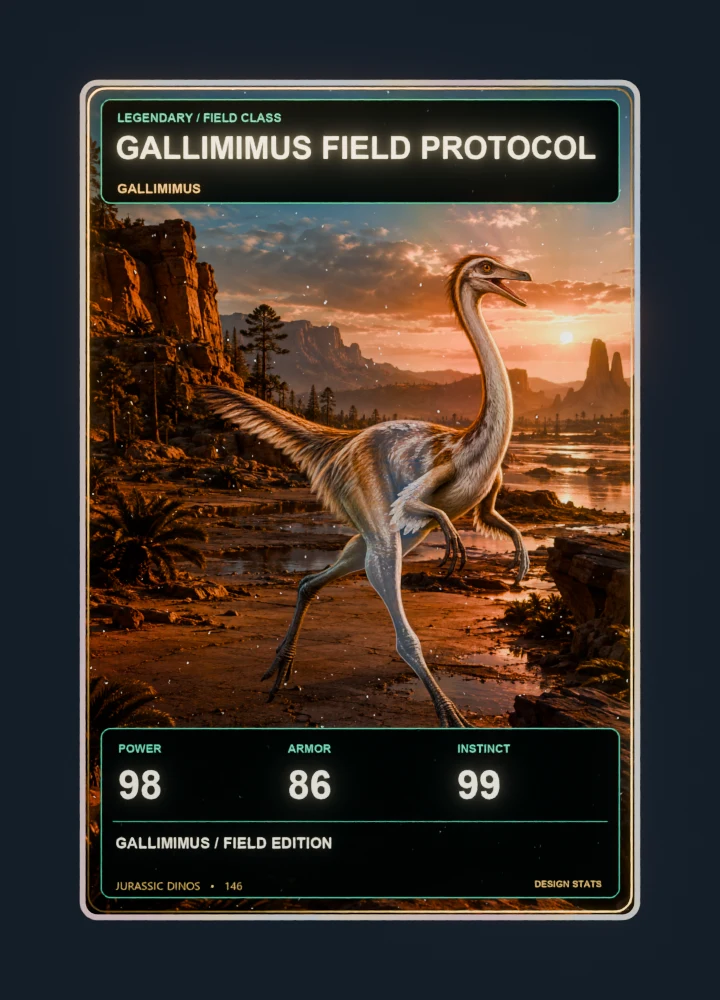
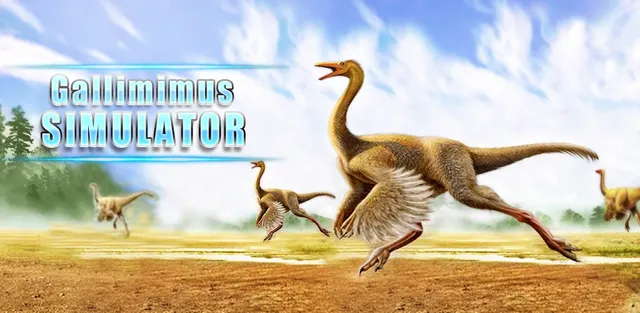
Gallimimus: Fastest Dino Sim is an Android game built around sprinting, evasion and survival. Its store listing describes speed-based gameplay, an open world with weather and day-night cycles, a flock to build, a quest system and RPG-style levelling. Several other Jurassic Dinos games, such as Iguanodon: Dinosaur Survival, list Gallimimus among the creatures a player may meet.
The listing calls Gallimimus the fastest dinosaur, but that is a promotional claim: the speed figures above are estimates, and no one can say it was the fastest. The game’s abilities, flock mechanics and chases are entertainment and not scientific evidence.
Classification and fossil record
The Paleobiology Database taxonomic record catalogues Gallimimus under Ornithomimidae. This is the immediate parent in that catalogue, rather than a complete list of evolutionary relationships.
The corroborated occurrence sample includes Mongolia; those are modern discovery locations, not a complete ancient geographic range.
The sourced length estimate for Gallimimus is about 6 metres. This is an estimate for the reconstructed animal, not a measurement shared by every individual. See the body-size discussion and linked evidence for context.
Research starting point
The catalogue links Gallimimus to Osmólska and Roniewicz, 1972, published in Palaeontologia Polonica. This identifies a research starting point; the catalogue’s citation alone does not verify every later reconstruction or species assignment.
For the meaning of taxonomic terms and how evidence is checked, see the glossary and editorial policy.
Quick answers
- Is Gallimimus a dinosaur?
- Yes. Gallimimus was a toothless theropod dinosaur, an ornithomimid or 'ostrich dinosaur', that lived in Mongolia in the Late Cretaceous.
- When did Gallimimus live?
- Gallimimus lived in the Late Cretaceous, probably in the early Maastrichtian about 70 million years ago, based on the fauna of the Nemegt Formation.
- How big was Gallimimus?
- Adults were about 6 metres long and 1.9 metres tall at the hip, with an estimated weight of roughly 400 to 490 kilograms.
- Is Gallimimus related to ostriches?
- Not closely. Gallimimus looked ostrich-like, but modern birds come from a different dinosaur branch, so the resemblance is convergent evolution.
- What did Gallimimus eat?
- Nobody knows for sure. Studies have suggested small animals, filter-feeding, or tough plants, and the Natural History Museum thinks it was most likely an omnivore.
- Where was Gallimimus found?
- The fossils come from the Gobi Desert of Mongolia, in rocks called the Nemegt Formation, and were collected by Polish-Mongolian expeditions in the 1960s.