Jurassic Dinos editorial · Updated · Source-based review
What is Archaeornithomimus?
Archaeornithomimus was an ornithomimosaur theropod from the Late Cretaceous Iren Dabasu Formation of Inner Mongolia.
Distinctive features and evidence
The genus adds to the Asian record of bird-mimic dinosaurs. The available introductory source identifies its provenance clearly but does not justify exact speed, body-mass or feeding claims on this page.
Genus overview and research references.
Archaeornithomimus fossil discoveries
The fossils come from a 1923 American Museum of Natural History expedition to Inner Mongolia led by Roy Chapman Andrews. Expedition member Peter Kaisen found theropod bones in three quarries. The material was mostly disarticulated and came from several individuals, and no skull or lower jaw bones were among it, so the head of Archaeornithomimus is unknown.
Charles Whitney Gilmore described the bones in 1933 and called them a new species of Ornithomimus, Ornithomimus asiaticus. Dale Russell gave them their own genus in 1972. He chose the name because he believed the rocks were about 95 million years old, which would have made this an unusually early ornithomimid. Gilmore had never picked a single type specimen, so in 1990 David Smith and Peter Galton, who produced the first full description, selected a foot (AMNH 6565) as the reference fossil.
How big was Archaeornithomimus?
Archaeornithomimus was a medium-sized ornithomimosaur, a slender, long-legged theropod. Published lengths are close: about 3.4 metres in one summary and 3.5 metres in the Natural History Museum directory. One of those sources puts the weight at a little over 71 kilograms, but that is a single estimate for an animal known from scattered bones, so treat it as rough.
The hind limbs were sturdily built. A detail of the foot is useful to specialists: the third metatarsal, the middle long bone of the foot, was not pinched at the top, so the foot was not of the narrow ‘arctometatarsalian’ type seen in some relatives. The neck vertebrae were hollowed by many internal chambers, which points to air sacs in the neck. In 2001 Bruce Rothschild and colleagues checked 229 foot bones for healed stress fractures and found none.
Did Archaeornithomimus have feathers and a beak?
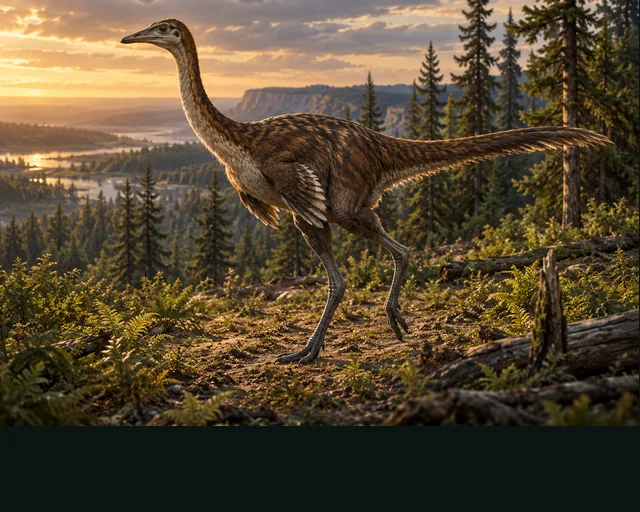
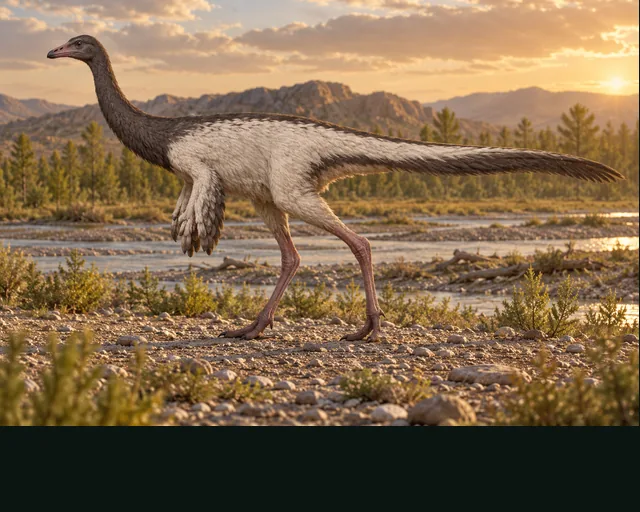
No feather or beak fossil of Archaeornithomimus itself has been described. Scientists infer both from close relatives among the ornithomimosaurs, where the evidence points to a horny beak and ostrich-like feathers. That makes it reasonable to picture Archaeornithomimus the same way, but it is an inference from relatives, not something seen in this genus.
Diet is likewise an inference. The museum directory lists it as carnivorous, while another summary suggests an omnivore with a beak that could have eaten plants, fruit, eggs and small animals. The two views show how little direct evidence there is: no stomach contents have been reported for this genus.
Is Archaeornithomimus an ornithomimid?
Russell placed it in the family Ornithomimidae, the ‘bird mimic’ dinosaurs, and that is still how the museum lists it. Newer analyses are less certain. Some confirm the placement, while others put it outside Ornithomimidae, near the base of the larger ornithomimosaur group. One broad analysis even grouped it with Arkansaurus in the family Garudimimidae.
The genus also has a tangled history of names. Foot bones from the Arundel Formation of Maryland were moved between Allosaurus, Dryptosaurus and Ornithomimus, and Russell made them a second Archaeornithomimus species. Smith and Galton later concluded they belong to some other small theropod, and other authors have suggested an unidentified ornithomimosaur. A second species named in 1995 from Uzbekistan was moved to a new genus, Dzharacursor, in 2025. This leaves Archaeornithomimus asiaticus from Inner Mongolia as the main species. Gallimimus is another ornithomimosaur that is often used for comparison, and Dryptosaurus is the genus once linked to the Maryland foot bones.
Where and when Archaeornithomimus lived
The Inner Mongolian fossils come from the Iren Dabasu Formation, dated to the Cenomanian stage of the Late Cretaceous at roughly 96 million years ago, though the dating carries a wide margin of error of several million years. Other sources give wider age ranges for the genus: the museum lists 95 to 70 million years ago, and the Paleobiology Database records span roughly 90 to 72 million years ago. The sources do not explain the difference, so the single Cenomanian date is the best-supported one for the type material.
The formation records a broad floodplain crossed by braided and meandering rivers that were linked to the sea. Plant-eating dinosaurs such as hadrosauroids were common. Other theropods in the same formation include Alectrosaurus, Gigantoraptor and Neimongosaurus.
Classification and fossil record
The Paleobiology Database taxonomic record catalogues Archaeornithomimus under Ornithomimidae. This is the immediate parent in that catalogue, rather than a complete list of evolutionary relationships.
The corroborated occurrence sample includes China; those are modern discovery locations, not a complete ancient geographic range.
The sourced length estimate for Archaeornithomimus is 3.4–3.5 metres. This is an estimate for the reconstructed animal, not a measurement shared by every individual. See the body-size discussion and linked evidence for context.
Research starting point
The catalogue links Archaeornithomimus to Russell, 1972, published in Canadian Journal of Earth Sciences. This identifies a research starting point; the catalogue’s citation alone does not verify every later reconstruction or species assignment.
For the meaning of taxonomic terms and how evidence is checked, see the glossary and editorial policy.
Quick answers
- Is Archaeornithomimus a dinosaur?
- Yes. Archaeornithomimus was a theropod dinosaur, an ornithomimosaur or 'bird mimic', known from Late Cretaceous rocks in Inner Mongolia, China.
- When did Archaeornithomimus live?
- The Iren Dabasu Formation fossils are dated to the Cenomanian, about 96 million years ago, with a margin of several million years. Wider ranges such as 95 to 70 million years ago include other assigned material.
- How big was Archaeornithomimus?
- It was about 3.4 to 3.5 metres long according to two summaries, making it a medium-sized ornithomimosaur. Weight estimates are rough because only scattered bones are known.
- Is Archaeornithomimus an ornithomimid?
- It was originally placed in Ornithomimidae, but newer analyses are mixed: some agree, while others put it outside the family or in the family Garudimimidae.
- Where was Archaeornithomimus found?
- The main fossils come from the Iren Dabasu Formation in Inner Mongolia, northern China, collected on the 1923 American Museum of Natural History expedition.