Jurassic Dinos editorial · Updated · Source-based review
What is Dromiceiomimus?
Dromiceiomimus is an ornithomimid name from Late Cretaceous Alberta with a disputed relationship to Ornithomimus.
Distinctive features and evidence
Some authors recognize Dromiceiomimus brevitertius separately; others include it in Ornithomimus edmontonicus. The entry retains this distinction rather than counting the same material as two unquestioned genera.
Genus overview and research references.
Dromiceiomimus fossil discoveries
The story starts with a partial skeleton from the Horseshoe Canyon Formation of Alberta, catalogued as ROM 797. It consists of the skeleton behind the skull, with no skull included. William Parks described it in 1926, but at that time he placed it in the genus Struthiomimus, as the species Struthiomimus brevitertius.
In 1972 Dale Russell decided it deserved its own genus and named it Dromiceiomimus. He also folded another Alberta species, Struthiomimus ingens, into it, and moved a further species, originally Ornithomimus samueli, into the new genus as Dromiceiomimus samueli. A specimen in the University of Alberta collection, UALVP 16182, found in 1967 by Richard Fox, was later referred to the genus.
What does Dromiceiomimus mean?
The name means “emu mimic”. Dromiceius was an older scientific name for the emu, so the genus was named for its resemblance to that long-legged, flightless bird.
Russell separated it from Ornithomimus edmontonicus using proportions of the limb bones. In his account the upper arm bone, the humerus, was shorter than the shoulder blade, and the forearm bone, the ulna, was about 70 percent of the thigh bone’s length. The hip’s forward-pointing blade, the shin, the foot bones and the third toe were all relatively longer compared with the thigh bone. Everything hangs on how reliable such ratios are.
Is Dromiceiomimus a valid genus?
This is the main reason the name is controversial, and sources give different answers. Nicholls and Russell cast doubt on it in 1981, suggesting that limb proportions might not be enough to tell ornithomimid dinosaurs apart. Later, Makovicky and colleagues found no statistical support for separating it and treated it as the same animal as Ornithomimus edmontonicus. The Natural History Museum’s directory follows that view and lists Dromiceiomimus as a nomen dubium, meaning a doubtful name.
Not everyone agreed. Longrich, in 2008 and 2014, treated the specimen ROM 840, once called Struthiomimus samueli, as a separate species of its own. Then in 2018 Ian McDonald and Philip Currie argued that the thigh-to-shin proportions of UALVP 16182 differ significantly from those of Ornithomimus edmontonicus. They added that even if the two were the same animal, the older species name brevitertius would take priority. For that reason this site treats Dromiceiomimus as a disputed name, not a settled genus.
How big was Dromiceiomimus?
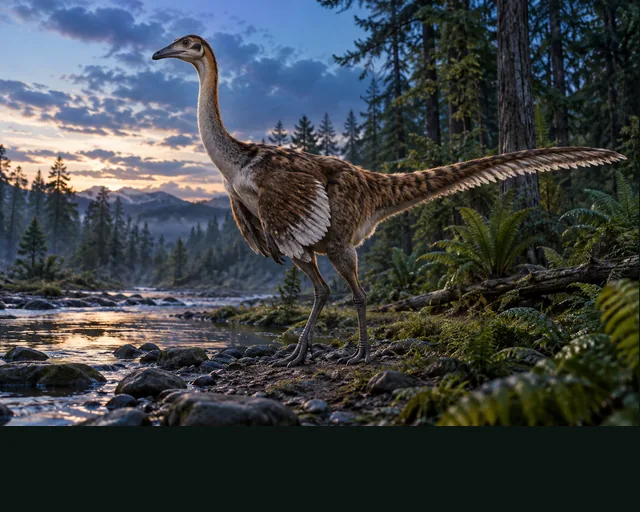
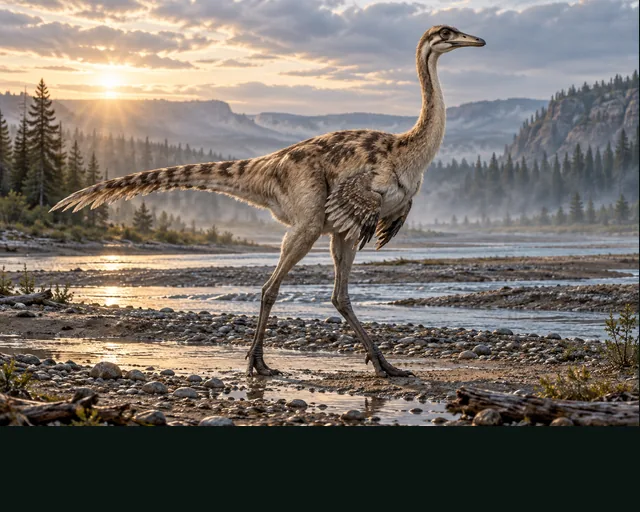
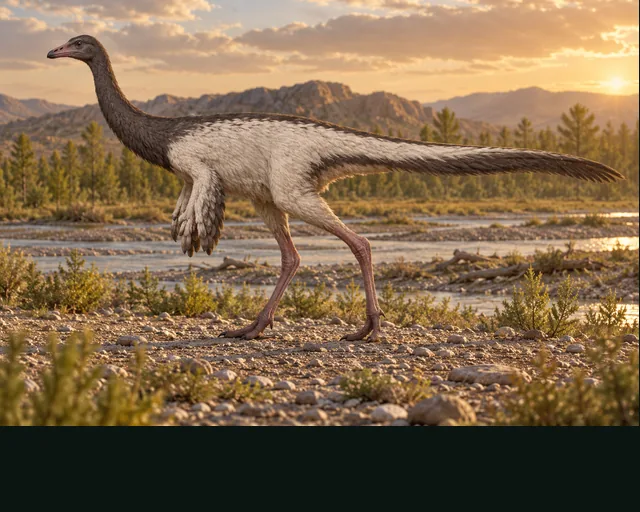
Estimates differ. The Natural History Museum gives about 3.5 metres in length and 100 kilograms, while a separate account gives roughly 135 kilograms. Either way it was a fairly small ornithomimid. The museum describes it as ostrich-like, with a horny beak and no thick coat of feathers, though it may have had some, and as an omnivore that ate plants and possibly insects and small animals. That diet is a general reconstruction for ostrich-mimic dinosaurs, not something shown by preserved stomach contents.
Where and when Dromiceiomimus lived
The fossils come from the Horseshoe Canyon Formation in Alberta, Canada, and date to the early Maastrichtian, the final stage of the Cretaceous. The Natural History Museum gives about 74 to 70 million years ago, whereas the Paleobiology Database lists a few records from about 72 to 66 million years ago. For a better-supported relative from the same group, compare Gallimimus from Mongolia.
Classification and fossil record
The Paleobiology Database taxonomic record catalogues Dromiceiomimus under Ornithomimidae. This is the immediate parent in that catalogue, rather than a complete list of evolutionary relationships.
The corroborated occurrence sample includes Canada; those are modern discovery locations, not a complete ancient geographic range.
Research starting point
The catalogue links Dromiceiomimus to Russell, 1972, published in Canadian Journal of Earth Sciences. This identifies a research starting point; the catalogue’s citation alone does not verify every later reconstruction or species assignment.
For the meaning of taxonomic terms and how evidence is checked, see the glossary and editorial policy.
Quick answers
- Is Dromiceiomimus a dinosaur?
- Yes, if the name is valid. Dromiceiomimus is an ornithomimid, an ostrich-like theropod dinosaur from the Late Cretaceous of Alberta, Canada.
- Is Dromiceiomimus the same as Ornithomimus?
- That is disputed. Some researchers treat it as Ornithomimus edmontonicus, while others, including McDonald and Currie in 2018, think its limb proportions support a separate animal.
- What does Dromiceiomimus mean?
- It means "emu mimic". The name refers to Dromiceius, an old scientific name for the emu, and to the bird-like build of the dinosaur.
- When did Dromiceiomimus live?
- It lived in the early Maastrichtian of the Late Cretaceous. Museum figures give about 74 to 70 million years ago.
- Where was Dromiceiomimus found?
- The fossils come from the Horseshoe Canyon Formation of Alberta, Canada. The first specimen was a partial skeleton without a skull.