Jurassic Dinos editorial · Updated · Source-based review
What is Camarasaurus?
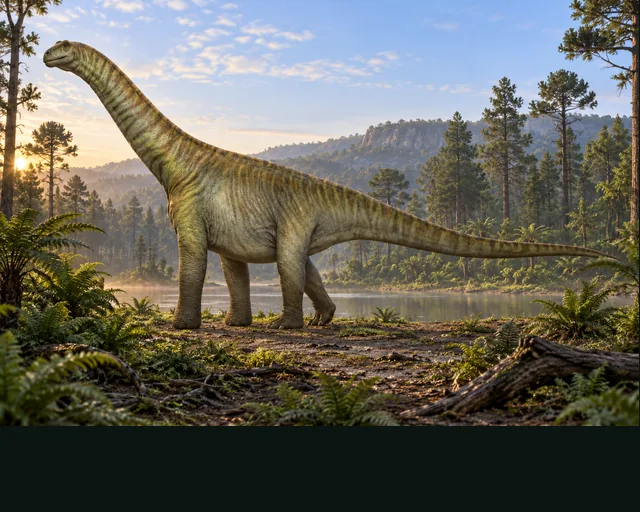
Camarasaurus was a common Morrison Formation sauropod with a broad skull and robust, spoon-shaped teeth.
Distinctive features and evidence
Numerous specimens make its anatomy better documented than that of many giant sauropods. The relatively strong jaws offer a useful comparison with the narrower skull of Diplodocus, while feeding height remains an interpretation rather than a directly observed routine.
Genus overview and research references.
Camarasaurus fossil discoveries
Camarasaurus is one of the best-documented sauropods, with more than 530 specimens known, including about 50 partial skeletons. Cope’s 1877 original material was modest: a few neck, back and tail vertebrae sent by a local teacher, Oramel Lucas, from Garden Park in Colorado. At almost the same time Marsh named a similar animal Morosaurus from Como Bluff in Wyoming, and that name was later folded into Camarasaurus.
The better skeletons came later. From 1909, the Carnegie Quarry, part of today’s Dinosaur National Monument in Utah, yielded several almost complete skeletons. One of them, a young animal excavated in 1919 and 1920 and described by Charles Gilmore in 1925, is still counted among the most complete sauropod skeletons known. Some Camarasaurus bones remain in the quarry wall, where visitors can see them. A Swiss team’s specimen nicknamed “E.T.” even preserves skin impressions with small hexagonal scales.
How big was Camarasaurus?
Camarasaurus was a medium to large sauropod, not the longest of the Morrison giants. C. lentus, the species found most often, measured around 15 metres, and the weight of adult C. grandis has been estimated at roughly 12.6 tonnes on average. The late species C. supremus was bigger, but it is poorly known: scaling up from smaller species gave almost 23 metres in a 2020 estimate, while Gregory Paul suggested about 18 metres in 2024. The Natural History Museum lists 23 metres, which matches the largest species. Treat these as ranges, since sizes come from scaling incomplete specimens.
What did Camarasaurus eat?
Camarasaurus was a plant-eater with a large, strongly built skull and spoon-shaped teeth. Scientists think it browsed at moderate heights of about 2 to 5 metres, and it may have reared up to reach higher foliage. Microscopic scratches on adult teeth suggest it ate tougher food than the contemporary Diplodocus, while young animals seem to have eaten softer plants. A 2016 study estimated a bite force nearly four times that of Diplodocus.
Camarasaurus replaced its teeth continuously, about every 62 days on average, which is slower than Diplodocus. One young skeleton was found with 14 polished stones in its body area, but such stomach stones are rare in sauropods, and they may have been swallowed by accident or for minerals, rather than to grind food.
The Camarasaurus skull on other sauropods
Camarasaurus was one of the few sauropods with good skull material in the early 1900s, which led to a long-running mistake. Museums gave Apatosaurus and Brontosaurus mounts a Camarasaurus-style skull, including the American Museum of Natural History in 1905 and Yale in 1931. These mounts were only corrected after the true Apatosaurus skull was recognised in 1975. If you have seen an old photo of a sauropod with a blunt head, it may be wearing a Camarasaurus skull.
Where and when Camarasaurus lived
Camarasaurus lived in the Late Jurassic, in the Kimmeridgian and Tithonian ages, roughly 155 to 143 million years ago. No other Morrison dinosaur is found as often, and Camarasaurus turns up at more than 100 localities between Montana and New Mexico. The environment is usually interpreted as semi-arid with wet and dry seasons. A 2011 isotope study of Camarasaurus teeth suggested that it may have travelled seasonally between the basin and higher ground to the west, but this is an interpretation. It lived alongside Allosaurus and Stegosaurus.
Classification and fossil record
The Paleobiology Database taxonomic record catalogues Camarasaurus under Camarasauridae. This is the immediate parent in that catalogue, rather than a complete list of evolutionary relationships.
Discovery and naming history
Edward Drinker Cope named Camarasaurus in 1877 from Garden Park material in Colorado. Many later Morrison Formation finds, including nearly complete skeletons, expanded the record beyond the bones that prompted the original name. Historical overview.
The corroborated occurrence sample includes United States; those are modern discovery locations, not a complete ancient geographic range.
Research starting point
The catalogue links Camarasaurus to Cope, 1877, published in Paleontological Bulletin. This identifies a research starting point; the catalogue’s citation alone does not verify every later reconstruction or species assignment.
For the meaning of taxonomic terms and how evidence is checked, see the glossary and editorial policy.
Quick answers
- Is Camarasaurus a dinosaur?
- Yes. Camarasaurus was a plant-eating sauropod dinosaur of Late Jurassic North America, and an early member of the Macronaria group.
- When did Camarasaurus live?
- Camarasaurus lived in the Late Jurassic, in the Kimmeridgian and Tithonian ages, roughly 155 to 143 million years ago.
- How big was Camarasaurus?
- The commonly found species were around 15 metres long. The rarer C. supremus was larger, with published estimates between about 18 and 23 metres, but these are scaled from incomplete bones.
- What did Camarasaurus eat?
- Camarasaurus ate plants. Tooth wear suggests fairly tough vegetation, possibly including conifer and ginkgo leaves, browsed at moderate heights of about 2 to 5 metres.
- Where was Camarasaurus found?
- Camarasaurus fossils come from the Morrison Formation of the western United States, from more than 100 sites between Montana and New Mexico, including Dinosaur National Monument in Utah.