Jurassic Dinos editorial · Updated · Source-based review
What is Barosaurus?
Barosaurus was a long-necked diplodocid sauropod from North America’s Late Jurassic Morrison Formation.
Distinctive features and evidence
The initial discovery consisted of tail vertebrae, followed by further skeletal material. The former African species Barosaurus africanus is now assigned to Tornieria, showing why a genus’s historical distribution should not be copied unchanged.
Genus overview and research references.
Barosaurus fossil discoveries
The first Barosaurus bones were reported by Isabella Ellerman, a postmistress in South Dakota, and Othniel C. Marsh and John Bell Hatcher dug up six tail vertebrae in 1889. Marsh named Barosaurus in 1890. The rest of that skeleton stayed in the ground for about nine years, until Marsh’s assistant George Reber Wieland collected vertebrae, ribs and limb bones in 1898. Richard Swann Lull described the skeleton fully in 1919.
Much better material came from the Carnegie Quarry in Dinosaur National Monument, Utah. The most complete skeleton was dug up there in 1923, and it later went to the American Museum in New York. Another skeleton lay forgotten in storage at the Royal Ontario Museum until a curator rediscovered the reference in 2007. It is roughly 40 per cent complete and stands nearly 27.5 metres long in the museum, but no skull of Barosaurus has ever been found, so the mounted skeleton wears a Diplodocus head.
How big was Barosaurus?
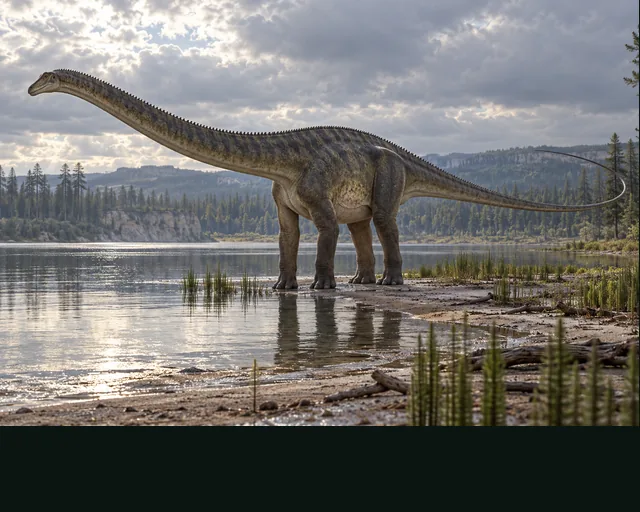
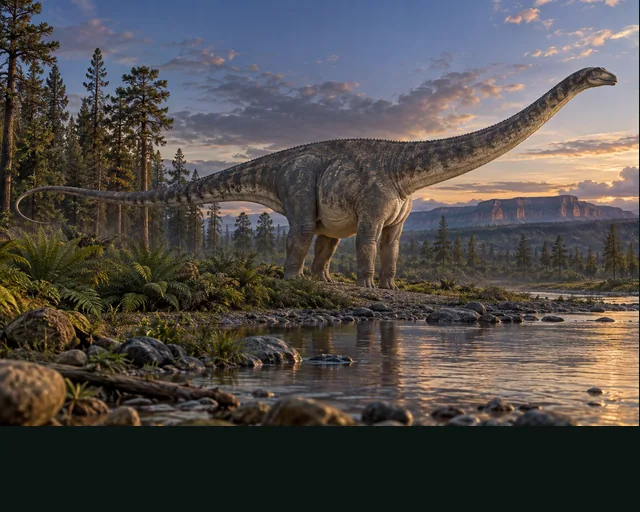
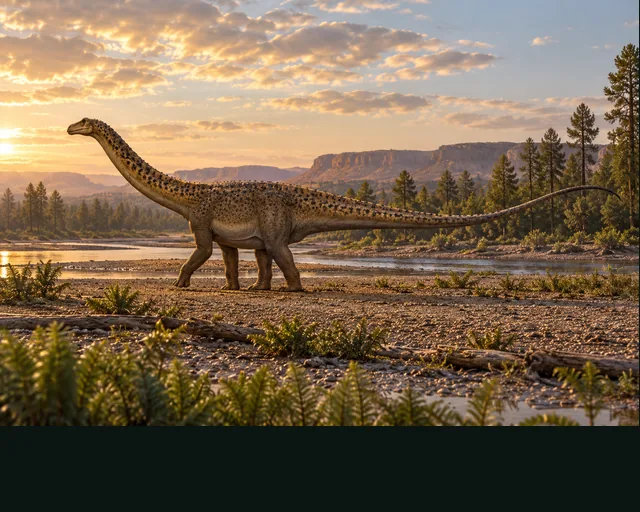
Barosaurus was enormous. The Natural History Museum gives a length of about 24 metres, while another summary puts adults at roughly 25 to 27 metres and about 12 to 20 tonnes. The two sources differ, and estimates are uncertain because no complete skeleton exists. Barosaurus is thought to have been about as long as Diplodocus overall, though built differently: it had a longer neck and a shorter tail.
The neck was its signature. It probably had 16 neck vertebrae, more than Diplodocus or Apatosaurus, and some of them were up to half as long again as those of Diplodocus. Even so, the tail may have made up about half the total body length, probably ending in a whiplash.
How did Barosaurus feed, and how did it hold its neck?
Scientists argue about it. A 2016 preprint by Mike Taylor and Mathew Wedel suggested that Barosaurus necks bent easily from side to side but poorly up and down. They pictured it sweeping its neck in wide arcs close to the ground, like a vacuum cleaner, rather than reaching high into trees. Others, such as Kent Stevens, argued from a different line of study that sauropods such as this held their heads not far above shoulder height. A 2009 study argued that soft tissue may have let some necks be raised higher, so the topic is open.
The long neck also raises the question of blood supply to the head. One 1992 idea proposed extra “hearts” in the neck, but a near-horizontal neck would reduce the problem. These are hypotheses, since soft organs do not fossilise.
Is Barosaurus a diplodocid? And was it found in Africa?
Yes. Barosaurus is a diplodocid sauropod, often grouped with Diplodocus in the subfamily Diplodocinae, and Diplodocus is generally considered its closest relative. The name Seismosaurus, another huge diplodocid, is treated by many palaeontologists as a probable synonym of Diplodocus rather than a separate relative.
An African species, “Barosaurus” africanus, was named from Tendaguru in Tanzania, but a 2006 reanalysis showed it to be a different animal. It is now called Tornieria africana. A possible Zimbabwean find is too poor to confirm. Today the genus contains one valid species, Barosaurus lentus, known only from North America, though older reference works may still list Tanzania.
Where and when Barosaurus lived
Barosaurus lived in the Morrison Formation of the western United States, with fossils from South Dakota, Utah and Montana. They date to roughly 150 million years ago, across the late Kimmeridgian and early Tithonian ages at the end of the Jurassic, although the Natural History Museum gives a broader range of about 155 to 145 million years. The environment was a floodplain near the edge of an inland sea, with a semi-arid climate and seasonal rain. It shared this world with the sauropods Camarasaurus and Brachiosaurus and with predators such as Allosaurus.
Classification and fossil record
The Paleobiology Database taxonomic record catalogues Barosaurus under Diplodocinae. This is the immediate parent in that catalogue, rather than a complete list of evolutionary relationships.
Discovery and naming history
Marsh described Barosaurus in 1890 after tail vertebrae were found in South Dakota in 1889. Later excavation supplied additional body and limb bones, substantially enlarging the evidence beyond the initial discovery. Historical overview.
The corroborated occurrence sample includes United States; those are modern discovery locations, not a complete ancient geographic range.
The sourced length estimate for Barosaurus is 24–27 metres. This is an estimate for the reconstructed animal, not a measurement shared by every individual. See the body-size discussion and linked evidence for context.
Research starting point
The catalogue links Barosaurus to Marsh, 1890, published in The American Journal of Science, series 3. This identifies a research starting point; the catalogue’s citation alone does not verify every later reconstruction or species assignment.
For the meaning of taxonomic terms and how evidence is checked, see the glossary and editorial policy.
Quick answers
- Is Barosaurus a dinosaur?
- Yes. Barosaurus was a large, long-necked sauropod dinosaur in the family Diplodocidae, from the Late Jurassic of North America.
- How big was Barosaurus?
- Sources give about 24 to 27 metres long, among the longest diplodocids, but no complete skeleton is known, so the figures are estimates.
- Is Barosaurus a diplodocid?
- Yes. It belongs to Diplodocidae and is usually considered a close relative of Diplodocus, although it had a longer neck and a shorter tail.
- Was Barosaurus found in Africa?
- No longer. The African species once called Barosaurus africanus was redescribed in 2006 and is now Tornieria africana.
- What did Barosaurus eat?
- It was a plant-eater. Neck studies suggest it may have swept its neck low over the ground rather than browsing high, but this is a hypothesis.