Jurassic Dinos editorial · Updated · Source-based review
What is Neovenator?
Neovenator was an Early Cretaceous English theropod documented by Wessex Formation fossils on the Isle of Wight.
Distinctive features and evidence
The first remains appeared after a coastal collapse at Grange Chine. Multiple skeletal finds are more useful for reconstructing its anatomy than the long list of unrelated dinosaurs also known from the island.
Genus overview and research references.
Neovenator fossil discoveries
In the summer of 1978 a storm caused part of Grange Chine on the Isle of Wight to collapse, and fossil-bearing blocks fell onto the beach of Brighstone Bay. The Henwood family and then geology student David Richards collected bones. At the Natural History Museum, Alan Charig recognised two kinds of animal in the finds, an iguanodontid and a theropod. The theropod bones were few and lacked clear diagnostic features, so they were overlooked until William Blows realised their importance.
Amateur collectors, including Keith and Jenny Simmonds, then searched for more. The holotype eventually included the snout, teeth, front of the lower jaw, most of the backbone and ribs, shoulder, hip and a hind limb. Later finds in 1997 to 2001 added more, bringing the type skeleton to about 70 per cent. Remains of other individuals have since been found, so several partial skeletons exist. The species name salerii honours the Salero family, who owned the land, because so many people took part in the discovery that no single finder could fairly be named.
How big was Neovenator?
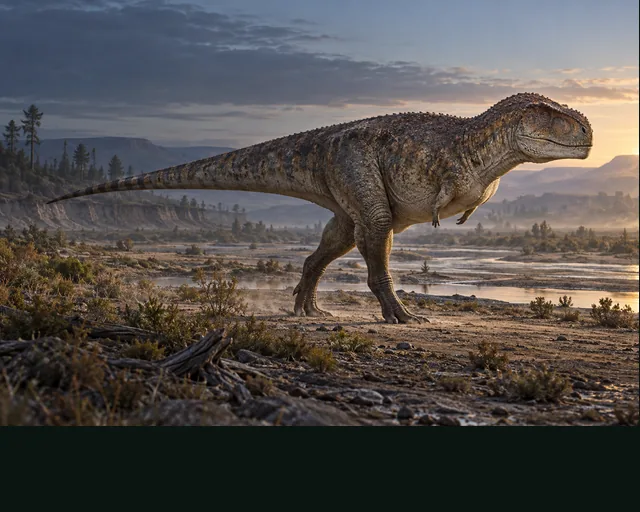
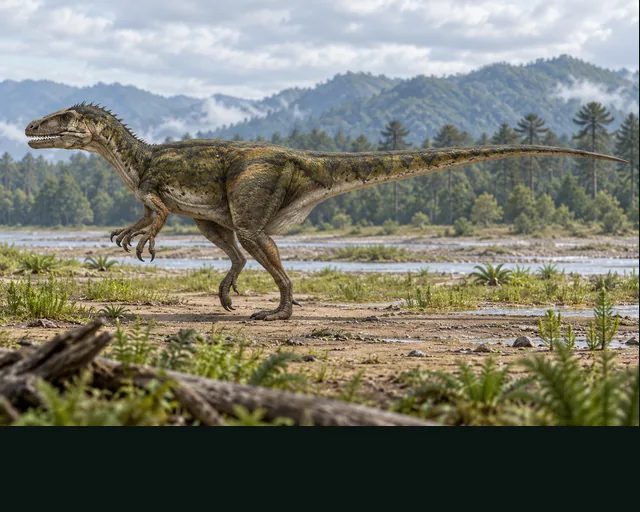
The holotype was about 7 to 7.5 metres long with a hip height of roughly 2 metres, and Gregory Paul estimated its mass at about 1 tonne. The skull was about 70 centimetres long.
The holotype could have been a subadult, but in 2016 Jeremy Lockwood pointed out that most referred bones are about the same size, which suggests adults were similar. One toe bone indicates an animal of perhaps 10 metres, but its identification as Neovenator is doubtful. A footprint made by an animal with a hip height of about 2.5 metres has been suggested as the track of a mature Neovenator, though the trackmaker is uncertain.
What did Neovenator eat?
Tooth marks found on a Mantellisaurus skeleton, a plant-eating iguanodontid, hint that this dinosaur was among its prey. Like other allosauroids, Neovenator had limbs that were not built for high speed, so Darren Naish and colleagues suggested in 2001 that it hunted by ambush, and speculated that it might have ganged up on large prey or that young and adults might have eaten different things. These are hypotheses.
The snout was covered in rough pits and channels that point to many blood vessels or nerves. One group suggested sensory organs on the snout, as in crocodiles and some birds, perhaps for sensing pressure and temperature and for precise biting. A later review found that dense networks of such canals are more typical of aquatic or semi-aquatic animals, and that land-living theropods including Neovenator may have had ordinary facial sensitivity, so the idea remains debated. The same group also noted that tooth wear seems to show it avoided biting into bone.
Is Neovenator a carcharodontosaur?
Probably, but the placement has shifted. The describers in 1996 compared it with Allosaurus and suggested a close link. From 1998 onward, researchers argued that it was an early member of the carcharodontosaur group, which also includes Carcharodontosaurus and Acrocanthosaurus. In 2010 a new family, Neovenatoridae, was created for it and the megaraptorans. Since then, more analyses have placed megaraptorans among the coelurosaurs, in which case Neovenatoridae might contain only Neovenator.
Where and when Neovenator lived
The definite remains of Neovenator all come from the Wessex Formation on the Isle of Wight, laid down in the Barremian, around 125 million years ago. Teeth of the same type from the Berriasian Angeac-Charente bone bed in France may belong to it, but that link is less certain. The Wessex landscape was a floodplain crossed by rivers and lakes, with extreme storms, floods and frequent wildfires. Much of the vegetation was low ferns, with occasional conifers, cycads and tree ferns.
The formation has produced many dinosaurs, including Iguanodon and the armoured Polacanthus.
Classification and fossil record
The Paleobiology Database taxonomic record catalogues Neovenator under Neovenatoridae. This is the immediate parent in that catalogue, rather than a complete list of evolutionary relationships.
Discovery and naming history
The first fossils were found on the Isle of Wight in 1978 after a coastal collapse. Steve Hutt, David Martill and Michael Barker introduced the genus in 1996, separating the event of fossil discovery from formal scientific naming. Historical overview.
The sourced length estimate for Neovenator is 7–7.5 metres. This is an estimate for the reconstructed animal, not a measurement shared by every individual. See the body-size discussion and linked evidence for context.
Research starting point
The catalogue links Neovenator to Hutt and Martill, 1996, published in Neues Jahrbuch für Geologie und Paläontologie Monatshefte. This identifies a research starting point; the catalogue’s citation alone does not verify every later reconstruction or species assignment.
For the meaning of taxonomic terms and how evidence is checked, see the glossary and editorial policy.
Quick answers
- Is Neovenator a dinosaur?
- Yes. Neovenator was a mid-sized meat-eating theropod dinosaur from the Early Cretaceous of southern England.
- When did Neovenator live?
- It lived in the Barremian stage of the Early Cretaceous, around 125 million years ago.
- How big was Neovenator?
- The holotype was about 7 to 7.5 metres long and was estimated at about 1 tonne. One doubtful toe bone suggests a larger animal of perhaps 10 metres.
- Is Neovenator a carcharodontosaur?
- Most analyses place it as an early member of the carcharodontosaur group, in the family Neovenatoridae, though the relationships of that family are still debated.
- Where was Neovenator found?
- The main fossils come from the Wessex Formation on the south-west coast of the Isle of Wight, England. Teeth possibly from the same animal are known from France.