Jurassic Dinos editorial · Updated · Source-based review
What is Abelisaurus?
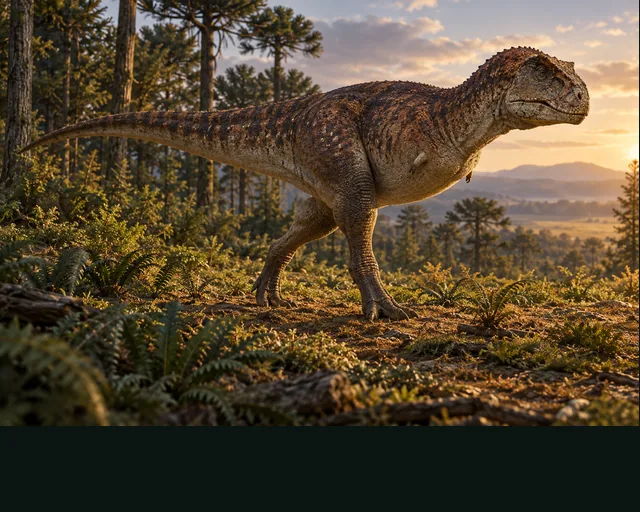
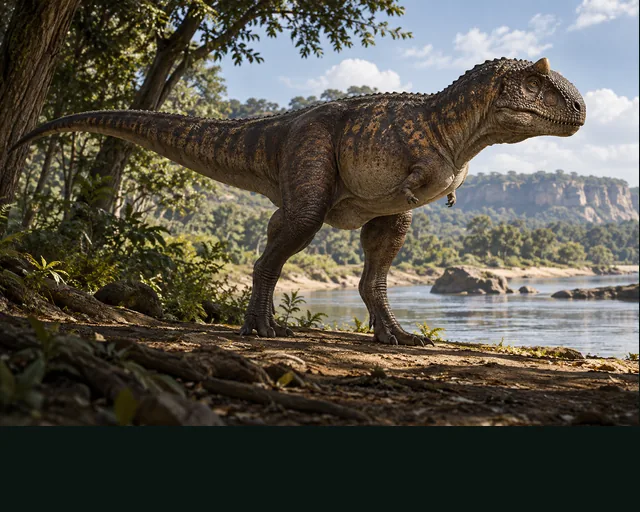
Abelisaurus was a Late Cretaceous abelisaurid predator from South America, identified from a partial skull.
Distinctive features and evidence
A skull can preserve distinctive features without establishing an entire body plan. Reconstructions of its length depend on comparisons with better-known abelisaurids; a precise figure would overstate this specimen’s completeness.
Genus overview and research references.
Abelisaurus fossil discovery
Everything we know about Abelisaurus comes from a single skull. It was uncovered in 1983 in the Lago Pellegrini quarries of Río Negro Province, Argentina, which Roberto Abel had been working since 1975. Abel later directed the provincial museum in Cipolletti, where the specimen (catalogued as MC 11098) is kept, and the genus was named in his honour by José Bonaparte and Fernando Novas in 1985.
The skull is not complete. The lower jaws are missing, the right side is damaged, the snout is largely cut off from the back of the skull, and most of the roof of the mouth is gone. Even so, the skull is estimated to have been more than 85 centimetres long, and no bones from the rest of the body have been described.
How big was Abelisaurus?
No one can measure Abelisaurus directly, because a skull says little about the length of the body behind it. Abelisaurids had unusually short heads for their size, so scaling from a skull is risky. Published estimates therefore differ a good deal.
Gregory Paul suggested about ten metres and three tonnes in 2010, Thomas Holtz offered a possible eleven metres in 2012, and a broad comparison of abelisaur sizes in 2016 gave about 7.4 metres. Another author put it near 7.2 metres and 1.65 tonnes. The Natural History Museum’s directory lists 9 metres. The honest summary is a large predator somewhere between about seven and eleven metres long.
What did the Abelisaurus skull look like?
The skull was relatively deep and had no horns or bony crests like those of Carnotaurus. Roughened bone on the nose and over the eyes may have carried a covering of keratin, the same material as fingernails, though such a covering would not fossilise. The skull roof was thickened, and large openings (fenestrae) lightened the skull, including a big triangular one in front of the eye socket.
The front bone of the upper jaw, the premaxilla, held four fairly small teeth. The maxilla behind it carried at least seven larger teeth, and possibly as many as thirteen.
Is Abelisaurus an abelisaurid?
Yes, and it is the animal the whole family is named after. Bonaparte and Novas created the family Abelisauridae for it in 1985 and first thought it belonged among the carnosaurs, the big-bodied meat-eaters of the day. Later finds of far more complete relatives, such as Aucasaurus, Carnotaurus and Majungasaurus, showed that abelisaurids belong to a different branch, the Neoceratosauria.
Some researchers place Abelisaurus near the base of the family, while others are less sure. Because only a skull is known, it has even been suggested that it might turn out to be a carcharodontosaurid, but that idea is considered unlikely. A proposal that Aucasaurus is the same animal as Abelisaurus has not been accepted.
When and where did Abelisaurus live?
Abelisaurus lived in the Late Cretaceous of Patagonia. Sources disagree on its exact age. The skull was first said to come from the Allen Formation, but later work indicated the Anacleto Formation, an older unit of roughly 83 to 80 million years ago in the early Campanian stage. Local records suggest the quarry lies in the Allen Formation, so the rock layer is still unclear. The Paleobiology Database lists a younger Maastrichtian range, which shows how uncertain the dating is.
Bonaparte and Novas compared its broad skull with tyrannosaurids and assumed it was a top predator. Paul later suggested it may have hunted titanosaur sauropods, but this is a hypothesis, since no direct evidence of its diet has been found.
Classification and fossil record
The Paleobiology Database taxonomic record catalogues Abelisaurus under Abelisaurinae. This is the immediate parent in that catalogue, rather than a complete list of evolutionary relationships.
The corroborated occurrence sample includes Argentina; those are modern discovery locations, not a complete ancient geographic range.
Research starting point
The catalogue links Abelisaurus to Bonaparte, 1984, published in Sulle Orme dei Dinosauri. This identifies a research starting point; the catalogue’s citation alone does not verify every later reconstruction or species assignment.
For the meaning of taxonomic terms and how evidence is checked, see the glossary and editorial policy.
Quick answers
- Is Abelisaurus a dinosaur?
- Yes. Abelisaurus was a meat-eating theropod dinosaur from the Late Cretaceous of Argentina, and it gave its name to the family Abelisauridae.
- How big was Abelisaurus?
- Estimates range from about 7.2 to 11 metres long, because only a skull of roughly 85 centimetres is known and body size has to be scaled from relatives.
- What was found of Abelisaurus?
- A single partial skull without lower jaws, found in 1983 in the Lago Pellegrini quarries of Río Negro Province, Argentina. No other bones have been described.
- Is Abelisaurus an abelisaurid?
- Yes. It was the first abelisaurid named, in 1985, and the family takes its name from it, though its exact position within the family is debated.
- When did Abelisaurus live?
- It lived in the Late Cretaceous, in the Campanian according to most accounts, though the exact rock unit and age are uncertain and some databases list a younger Maastrichtian date.