Jurassic Dinos editorial · Updated · Source-based review
What is Aucasaurus?
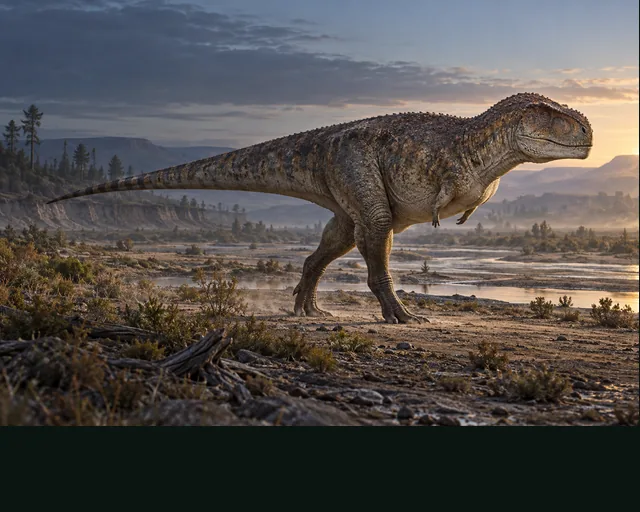
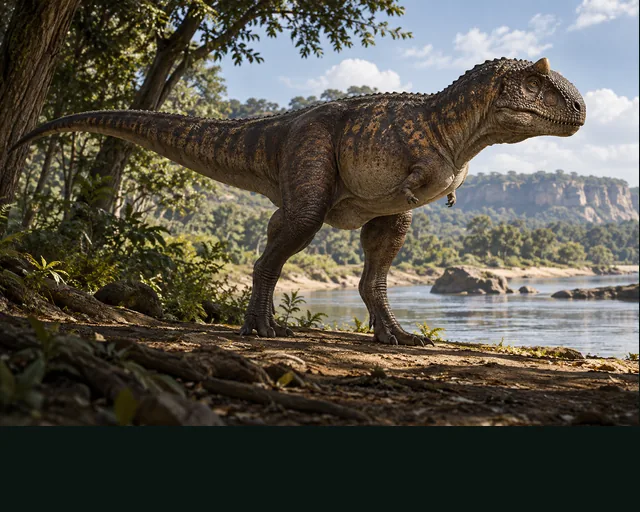
Aucasaurus was a Late Cretaceous Argentine abelisaurid with strongly reduced forelimbs and a comparatively complete skeleton.
Distinctive features and evidence
Its damaged skull has prompted behavioral speculation, but damage does not establish a fatal fight. Comparing its arms with Carnotaurus shows how closely related theropods can differ in anatomical detail.
Genus overview and research references.
Aucasaurus fossil discoveries
The fossils of Aucasaurus come from Patagonia, in the Neuquén Basin of Argentina. The rock unit is the Anacleto Formation, part of a larger group called the Río Colorado Subgroup. The same deposits are also known for large numbers of sauropod eggs, and one translation of the genus name is ‘Auca Mahuevo lizard’, although the museum gives it more simply as ‘Auca lizard’.
The type specimen is a single skeleton that is preserved from the skull back to about the thirteenth tail vertebra. When Coria, Chiappe and Dingus described it in 2002, it was the most complete abelisaurid skeleton known. The animal was an adult: the bones suggest it was at least eleven years old when it died.
How big was Aucasaurus?
Aucasaurus was a medium-sized meat-eating dinosaur, noticeably smaller than its famous relative Carnotaurus. Published figures differ a little. One summary gives a length of about 5.5 to 6.2 metres and a body mass of roughly 700 kilograms, while the Natural History Museum’s directory lists about 5 metres. Body mass for dinosaurs is always an estimate built from limb and body proportions, so the weight is best read as an order of magnitude rather than a measurement.
The skull was less short and deep-snouted than that of Carnotaurus. Instead of the two prominent horns of Carnotaurus, Aucasaurus had only low ridges above each eye.
The tiny arms of Aucasaurus
Like other members of its family, Aucasaurus had very short arms, but they were a little longer in proportion to its body than those of the larger Carnotaurus. The hand is unusual. Four metacarpals, the bones of the palm, were present, but only the second and third carried fingers, and those fingers were short and had no claws.
Nobody knows exactly what these reduced limbs were used for, and the fossil does not settle the question. What the skeleton does show is how much variety there was in the arms of abelisaurids, even between close relatives.
What the brain and tail of Aucasaurus reveal
In 2015 Ariana Paulina-Carabajal and Cecilia Succar scanned the braincase of Aucasaurus with a medical CT machine. The scans allowed them to build virtual models of the brain cavity and the inner ear. The overall layout matched that of other abelisaurids such as Majungasaurus. A brain structure called the flocculus was relatively large and sat in a figure-eight-shaped recess, which led the authors to suggest that the head could have moved through a somewhat wider range than in some relatives.
The tail vertebrae tell a different story. Features of the vertebrae suggest strong tail muscles and a stiff tail, which has been taken as a possible sign that the animal ran well, though this is an interpretation of anatomy and not a measured speed. In 2024 Baiano and colleagues reported that two tail vertebrae, the fifth and sixth, were fused because they failed to separate as the animal grew. They read this as a birth defect, and described it as the earliest known case of that condition in a non-bird theropod.
Is Aucasaurus an abelisaurid?
Yes. Aucasaurus belongs to the family Abelisauridae and is usually placed close to Carnotaurus, with some studies grouping the two in a group called Carnotaurini. Abelisaurus, the family’s namesake, also lived in Patagonia and is a relative.
The exact relationship has been debated. In 2009 Fernando Novas suggested that Aucasaurus might be the same animal as Abelisaurus, and in 2010 Gregory Paul used the combined name Abelisaurus garridoi. Most researchers have kept the two as separate genera, and later analyses indicate that Aucasaurus is nearer to Carnotaurus.
When did Aucasaurus live?
Aucasaurus lived in the Late Cretaceous. The Natural History Museum gives 84 to 71 million years ago, and the Paleobiology Database places the known occurrence in the Campanian, about 83.6 to 72.2 million years ago. Some descriptions of the Anacleto Formation extend its age back into the Santonian, so the exact dating of the rock unit is not completely settled.
Classification and fossil record
The Paleobiology Database taxonomic record catalogues Aucasaurus under Brachyrostra. This is the immediate parent in that catalogue, rather than a complete list of evolutionary relationships.
Discovery and naming history
The genus was described in 2002 from a remarkably informative skeleton preserving much of the body and the early part of the tail. That specimen makes its anatomy better constrained than that of abelisaurids represented only by skull fragments. Historical overview.
The corroborated occurrence sample includes Argentina; those are modern discovery locations, not a complete ancient geographic range.
Research starting point
The catalogue links Aucasaurus to Coria and Chiappe, 2002, published in Journal of Vertebrate Paleontology. This identifies a research starting point; the catalogue’s citation alone does not verify every later reconstruction or species assignment.
For the meaning of taxonomic terms and how evidence is checked, see the glossary and editorial policy.
Quick answers
- Is Aucasaurus a dinosaur?
- Yes. Aucasaurus was a theropod dinosaur from the abelisaurid family, which lived in what is now Argentina during the Late Cretaceous.
- When did Aucasaurus live?
- The Natural History Museum gives about 84 to 71 million years ago, in the Late Cretaceous; the Paleobiology Database places the occurrence in the Campanian.
- How big was Aucasaurus?
- Estimates differ: about 5 metres in the Natural History Museum directory and about 5.5 to 6.2 metres in another summary, which also suggests around 700 kilograms. Both are estimates.
- Is Aucasaurus an abelisaurid?
- Yes. It belongs to Abelisauridae and is generally treated as a close relative of Carnotaurus, although one proposal in 2009 argued it could be Abelisaurus.
- Where was Aucasaurus found?
- It was found in the Anacleto Formation of the Neuquén Basin in Patagonia, Argentina, in deposits that also contain sauropod eggs.