Jurassic Dinos editorial · Updated · Source-based review
What is Saurornitholestes?
Saurornitholestes was a small Late Cretaceous North American dromaeosaurid with an enlarged second-toe claw.
Distinctive features and evidence
Recognized species and reassigned names must be distinguished when compiling its range. The claw supports an anatomical comparison with other raptors but does not establish a universal hunting method.
Genus overview and research references.
Saurornitholestes fossil discoveries
The first specimen was found in 1974 by Irene Vanderloh, a Canadian amateur fossil hunter, in Alberta, close to the place called Steveville. John Storer at the Provincial Museum of Alberta saw it, and Hans-Dieter Sues described it in 1978. The skeleton came from the Dinosaur Park Formation and is dated to the late Campanian. It is fragmentary: it includes teeth, parts of the skull, two vertebrae, ribs, tail pieces and part of a hand.
Later finds are better. Two larger partial skeletons, dozens of isolated bones and a great many teeth have come from Dinosaur Provincial Park in Alberta, though most are still undescribed. A well-preserved skeleton found in 2014 is being prepared by University of Alberta researchers. Teeth and a few bones have also been reported from the eastern United States, which in the Late Cretaceous was a separate landmass called Appalachia. Teeth and a toe claw from South Carolina made this genus the only dromaeosaurid reported with certainty from the East Coast.
How big was Saurornitholestes?
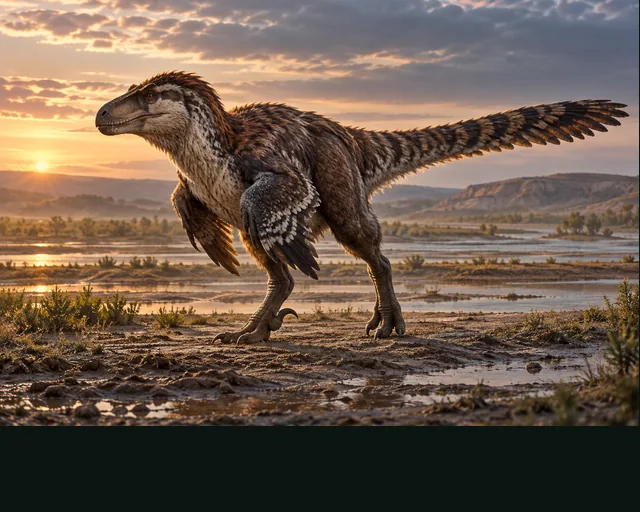
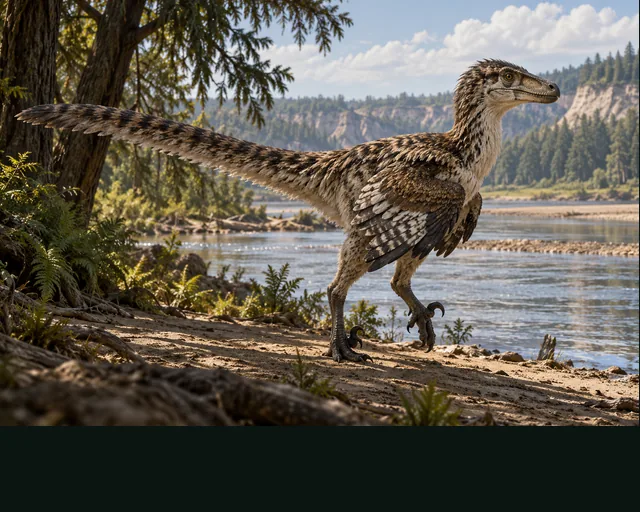
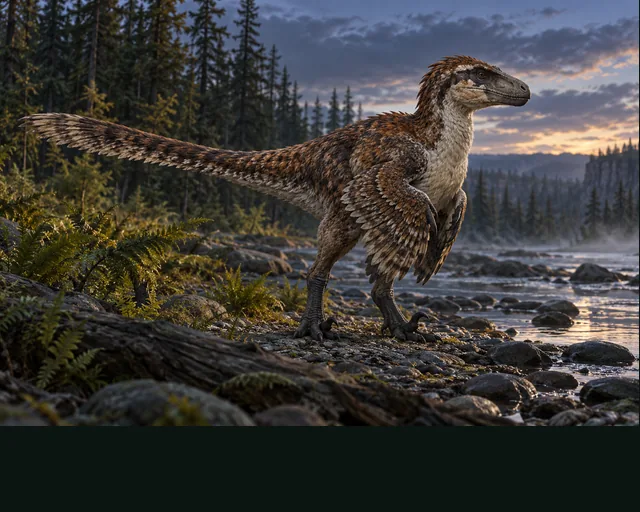
Saurornitholestes was a small dromaeosaurid. The type species, S. langstoni, is estimated at about 1.3 to 1.8 metres long and roughly 5 to 22.5 kilograms, with a hip height around 60 centimetres. These are estimates from incomplete skeletons, so the range is wide. Compared with Velociraptor and Dromaeosaurus it was longer-legged and more lightly built, and like Velociraptor it had large, fang-like teeth at the front of the jaws.
Like other dromaeosaurids it had a long, curved, blade-like claw on the second toe of each foot. A study of the skull of the New Mexico species, S. sullivani, suggests that it had a large olfactory bulb, the part of the brain that handles smell, so a good sense of smell is possible.
What did Saurornitholestes eat?
Saurornitholestes was a meat-eater. A study of tooth wear by Angelica Torices and colleagues found that its feeding style was typical of coelurosaurian theropods, which bite and pull on prey. The wear suggested that it took larger prey than the troodontids that lived alongside it, and that its diet likely included bone. The same study reached a similar conclusion about the related Dromaeosaurus.
One tooth of Saurornitholestes has been found stuck in the wing bone of a large pterosaur, perhaps a young Quetzalcoatlus. Pterosaurs are flying reptiles, not dinosaurs. Because the pterosaur was far larger than the dinosaur, Philip Currie and Aase Roland Jacobsen suggested that the theropod was feeding on an animal that was already dead rather than hunting it.
A separate idea concerns the tooth at the very front of the upper jaw. In Saurornitholestes, Velociraptor and Bambiraptor this tooth may have been shaped for preening feathers. That is a proposal, not a proven behaviour.
Is Saurornitholestes a dromaeosaurid?
Yes. Sues assigned it to the Dromaeosauridae in 1978, and later studies have kept it there. Many analyses placed it among the velociraptorines, the group that includes Velociraptor, but a 2009 analysis by Philip Currie found it in a more basal clade that he called Saurornitholestinae. A 2019 analysis by Currie and David Evans found it as the sister of the genus Atrociraptor.
The name has caused confusion. The genus name refers to Saurornithoididae, a group now regarded as part of the troodontids, because Sues thought the animal resembled that group. A second species, S. robustus, was named in 2006 from a single frontal bone found in New Mexico, but it was later judged to be a troodontid. In 2026 it was moved to other genera by two research teams, one of which gave it the name Dinevenator. Only S. langstoni and S. sullivani are now considered valid species.
Where and when Saurornitholestes lived
Saurornitholestes lived in the Late Cretaceous, mostly in the Campanian. Alberta and Montana material comes from several rock units. Two examples are the Oldman Formation, about 77 million years old, and the younger upper part of the Two Medicine Formation, about 72 million years old. The Paleobiology Database lists occurrences from about 83.6 to 66 million years ago, based on well over a hundred occurrence records, though not every one is confirmed to be the same species.
It lived on both sides of the Western Interior Seaway, a shallow sea that split North America. In Alberta the setting was plains and floodplain swamps. Within Dinosaur Provincial Park, it appears to be the commonest of the small theropods. In the eastern range it shared its world with duck-billed hadrosaurs, large theropods such as Appalachiosaurus and Dryptosaurus, and an unnamed ornithomimosaur.
Classification and fossil record
The Paleobiology Database taxonomic record catalogues Saurornitholestes under Saurornitholestinae. This is the immediate parent in that catalogue, rather than a complete list of evolutionary relationships.
The corroborated occurrence sample includes United States, Canada; those are modern discovery locations, not a complete ancient geographic range.
Research starting point
The catalogue links Saurornitholestes to Sues, 1978, published in Zoological Journal of the Linnean Society. This identifies a research starting point; the catalogue’s citation alone does not verify every later reconstruction or species assignment.
For the meaning of taxonomic terms and how evidence is checked, see the glossary and editorial policy.
Quick answers
- Is Saurornitholestes a dinosaur?
- Yes. Saurornitholestes was a small, meat-eating dromaeosaurid theropod dinosaur from the Late Cretaceous of North America.
- When did Saurornitholestes live?
- It lived in the Late Cretaceous, mostly the Campanian. Key fossils date to roughly 77 and 72 million years ago, and the Paleobiology Database records span about 83.6 to 66 million years ago.
- How big was Saurornitholestes?
- Estimates for S. langstoni are about 1.3 to 1.8 metres long and roughly 5 to 22.5 kilograms, with a hip height around 60 centimetres. They come from incomplete skeletons.
- Is Saurornitholestes a dromaeosaurid?
- Yes. It has been classed as a dromaeosaurid since 1978. Studies disagree on whether it sits with velociraptorines or in its own group, Saurornitholestinae.
- What did Saurornitholestes eat?
- It was a carnivore. Tooth wear suggests it handled larger prey than troodontids and sometimes bone, and one tooth in a pterosaur bone may mean it scavenged.
- Where was Saurornitholestes found?
- Fossils come from Alberta and Saskatchewan in Canada, and from Montana, New Mexico, Alabama and South Carolina in the United States.