Jurassic Dinos editorial · Updated · Source-based review
What is Bambiraptor?
Bambiraptor is a small Late Cretaceous Montana theropod whose name-bearing specimen appears to be immature.
Distinctive features and evidence
Researchers have questioned whether it represents a juvenile Saurornitholestes and whether all bones assigned to the specimen belong together. Its small holotype should not be used as an adult size standard or proof of an undisputed genus.
Genus overview and research references.
Bambiraptor fossil discovery
The Bambiraptor skeleton was found in 1995 by a 14-year-old, Wes Linster, who was out hunting for fossils with his family close to Glacier National Park, Montana. What began as a few bones on a hilltop turned into an excavation that recovered a skeleton described as roughly 95 percent complete, which is extremely rare for a small, lightly built predator.
The specimen was later acquired from a fossil poacher by Michael and Ann Feinberg, who made it available to science; the species name feinbergi honours them. Burnham and colleagues named it in 2000. The skeleton, catalogued as AMNH FR 30556, comes from the Two Medicine Formation and is now kept at the American Museum of Natural History in New York. Researchers at the time compared its completeness to a Rosetta Stone for understanding how dinosaurs and birds are linked.
How big was Bambiraptor?
The holotype is a juvenile. Its preserved length is about 90 centimetres, and the total length has been estimated at about one metre, with a body mass of perhaps two kilograms. That is the size of a young animal, not an adult.
Bones from adults are known too: a set of skeletal pieces from at least two adults was found near the holotype, and a jaw bone was later referred to the species. A 2021 conference abstract reported that the holotype is only 30 to 40 percent the size of that jaw, and simply scaling the skeleton up would give 2.5 to 3.3 metres. That is probably too high, because young animals tend to have relatively long skulls. Gregory S. Paul estimated an adult length of about 1.3 metres in 2010. These numbers disagree, so adult size should be treated as uncertain.
Hands, brain and feathers in Bambiraptor
Bambiraptor had long arms, long hind legs that point to a fast runner, and a well-developed wishbone. Phil Senter’s study of the forelimb suggested that the first and third fingers could oppose each other and that the hand could reach the mouth, so the animal may have been able to hold food in its hands.
The brain of the holotype is large for its body size. David Burnham suggested this could mean greater agility, and proposed that it may have climbed trees or hunted quick prey. Young animals normally have proportionally larger brains, though, so age may explain much of it.
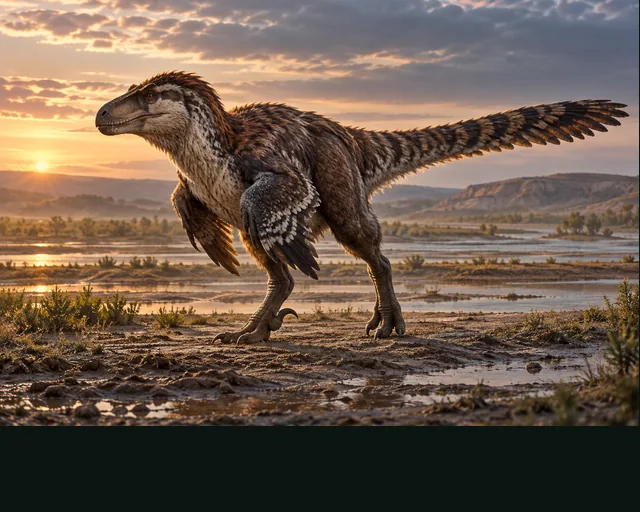
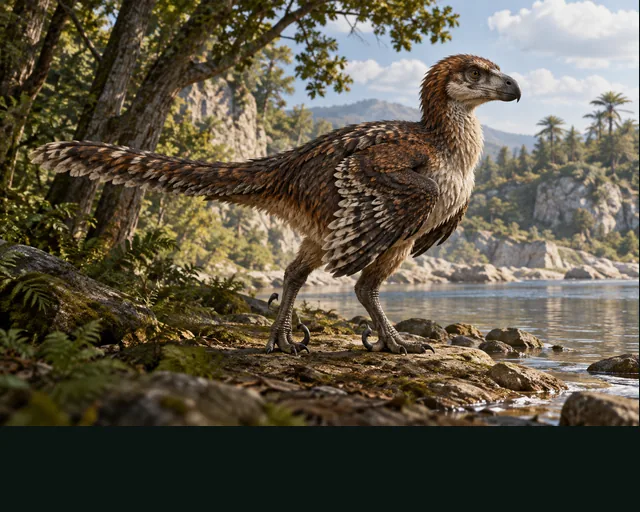
No feathers were found with the skeleton. Artists show it feathered because close relatives in the wider group Paraves, which includes birds, had feathers, and later discoveries showed that small dromaeosaurids were fully feathered.
Is Bambiraptor a dromaeosaurid?
Yes, it was assigned to the family Dromaeosauridae, the “raptors” that also include Achillobator, but its place inside the family is unsettled. Different analyses have placed it among the microraptorians, among the saurornitholestines, or, in the most recent work, as part of or beside Eudromaeosauria.
It has also been suggested that Bambiraptor is just a young Saurornitholestes, and that the type specimen could be a chimera: the holotype includes elements from three similarly sized lower legs, meaning bones from more than one animal may be mixed. Because of this, it is safest to treat Bambiraptor as a useful but debated Montana dromaeosaurid.
Classification and fossil record
The Paleobiology Database taxonomic record catalogues Bambiraptor under Dromaeosauridae. This is the immediate parent in that catalogue, rather than a complete list of evolutionary relationships.
Research starting point
The catalogue links Bambiraptor to Burnham and Derstler, 2000, published in University of Kansas Paleontological Contributions. This identifies a research starting point; the catalogue’s citation alone does not verify every later reconstruction or species assignment.
For the meaning of taxonomic terms and how evidence is checked, see the glossary and editorial policy.
Quick answers
- Is Bambiraptor a dinosaur?
- Yes. Bambiraptor was a small, bird-like theropod dinosaur belonging to the dromaeosaurid family, the group of feathered raptors, though its exact position within that family is debated.
- How big was Bambiraptor?
- The juvenile holotype was about one metre long and perhaps two kilograms. Adults were larger, with estimates such as 1.3 metres from one researcher and over two metres from simple scaling, so adult size is uncertain.
- Where was Bambiraptor found?
- Bambiraptor was found in 1995 near Glacier National Park in Montana, USA, in rock of the Two Medicine Formation that dates to the late Campanian of the Late Cretaceous.
- Did Bambiraptor have feathers?
- No feathers were preserved with the skeleton. Scientists reconstruct it with feathers because its close relatives had them and later finds show small dromaeosaurids were feathered.