Jurassic Dinos editorial · Updated · Source-based review
What is Balaur?
Balaur was a stocky paravian dinosaur from Late Cretaceous Romania, associated with the ancient Hateg island setting.
Distinctive features and evidence
Its evolutionary placement has been debated between dromaeosaurid and avialan interpretations. Two partial skeletons support anatomical study, but its island setting does not by itself establish a particular ecological role or a settled relationship to Elopteryx.
Genus overview and research references.
Balaur fossil discoveries
The first Balaur bones were found in 1997 in Romania by Dan Grigorescu: six bones of the front limbs. Their shape was so odd that scientists could not interpret them correctly and mistook them for part of an oviraptorosaur. The key find came in September 2009, when the geologist Mátyás Vremir found a partial skeleton in the Sebeș Formation near Sebeș. It was described by Zoltán Csiki and colleagues in 2010.
The skeleton includes many vertebrae, much of the shoulder and hip bones and large parts of the limbs. It was described as the most complete predatory dinosaur of the middle to Late Cretaceous in Europe. There is no skull, so the teeth and head are unknown. The 1997 arm bones come from a larger individual, estimated at about 45 per cent longer than the main specimen.
What was strange about Balaur?
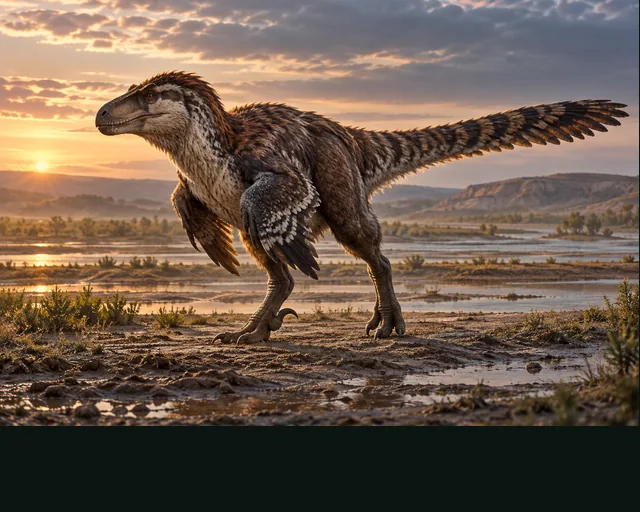
Balaur had an unusual body plan. Its bones were short and heavy, its foot was stubby and wide, and parts of its hand and lower leg were fused together, which is a bird-like condition. Most early paravians held one large sickle claw off the ground on the second toe, but Balaur had large, hyperextensible claws on both the first and second toes. Its third finger was tiny and probably useless.
Its length is estimated at about 1.8 to 2.5 metres and its weight at around 15 kilograms, about the size of Velociraptor. These are estimates from an incomplete skeleton, and the name “stocky” refers to its strong build for its size. The describing team called it a dramatic example of odd anatomy in island animals.
Is Balaur a dromaeosaurid or a bird? The classification debate
Scientists disagree. The 2010 description placed Balaur among the dromaeosaurids, close to Velociraptor. In 2013, a study with a wider range of dinosaurs instead found it to be a basal avialan, a group that includes living birds. In 2015, Cau, Brougham and Naish did not rule out the dromaeosaurid option but thought the bird position more likely, because features such as the bone fusion and a functional first toe are typical of avialans. Other researchers kept it as a dromaeosaurid: two studies in 2021 placed it in the velociraptorines and a 2025 analysis among the unenlagiines.
A further question is whether it is a distinct genus. Some researchers suggest that Balaur might be a junior synonym of Elopteryx, another animal from the Cretaceous islands of Europe, and in 2024 Stoicescu and colleagues called this probable. Others say more work is needed. Until new fossils appear, the honest answer is that Balaur’s relationships and even its name are unsettled.
What did Balaur eat?
Nobody knows for certain. Without a skull or teeth, diet cannot be read from the head. The original authors assumed a predator because of its supposed dromaeosaurid relatives and noted that no larger theropods are known from Romanian rocks of the time. Later work on claw anatomy of related paravians pictured claws used to grip prey, and a 2024 study found the claws of Balaur more consistent with cutting and tearing.
In contrast, Andrea Cau proposed that Balaur’s short limbs, tiny third finger and weight-bearing foot might fit an omnivore or plant-eater, and later suggested that, if it was an avialan, its relatives such as Sapeornis and Jeholornis point to a diet that was not strictly carnivorous. Both views remain possible.
Balaur and the Hațeg island
Balaur lived about 70 million years ago on Hațeg Island, part of a subtropical archipelago in the Tethys Sea, in what is now Romania. The island is known for dwarf dinosaurs. Balaur, however, was not a dwarf, and its size was comparable to related paravians. Its strong, stocky build and possible reduced flight ability are thought to reflect life on an island, similar to the way some island birds lose flight today.
Classification and fossil record
The Paleobiology Database taxonomic record catalogues Balaur under Dromaeosauridae. This is the immediate parent in that catalogue, rather than a complete list of evolutionary relationships.
Discovery and naming history
The genus was first described in 2010 from Romanian material. Its unusual anatomy prompted different interpretations of its relationship to other paravians; the original classification is part of the debate rather than its final resolution. Historical overview.
Research starting point
The catalogue links Balaur to Csiki and Vremir, 2010, published in Proceedings of the National Academy of Sciences. This identifies a research starting point; the catalogue’s citation alone does not verify every later reconstruction or species assignment.
For the meaning of taxonomic terms and how evidence is checked, see the glossary and editorial policy.
Quick answers
- Is Balaur a dinosaur?
- Yes. Balaur was a small paravian theropod dinosaur from Late Cretaceous Romania. Whether it was a dromaeosaurid or an early bird-line relative is debated.
- Is Balaur a dromaeosaurid?
- It was first described as one, but later studies often placed it among early avialans instead. Some recent analyses again favour a dromaeosaurid position, so the question is not settled.
- What does Balaur mean?
- Balaur is a dragon of Romanian folklore, and the species name bondoc means stocky, so Balaur bondoc means "stocky dragon".
- How big was Balaur?
- Estimated at about 1.8 to 2.5 metres long and about 15 kilograms, roughly Velociraptor-sized. These are estimates, since the skeleton is incomplete and has no skull.
- When did Balaur live?
- Balaur lived in the Maastrichtian stage of the Late Cretaceous, roughly 70 million years ago, on an island in what is now Romania.