Jurassic Dinos editorial · Updated · Source-based review
What is Nemegtosaurus?
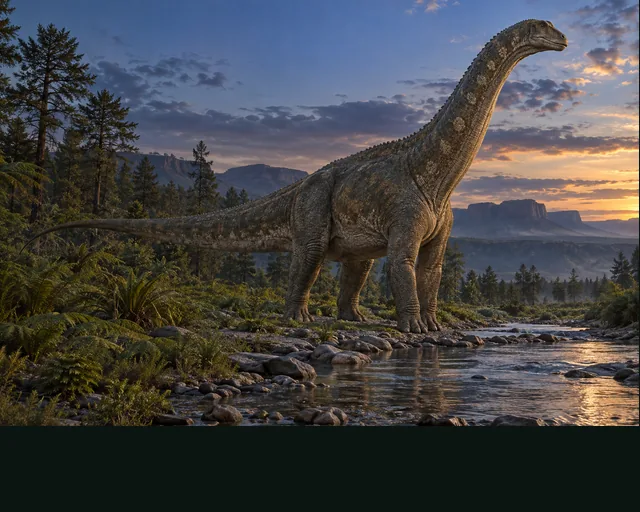
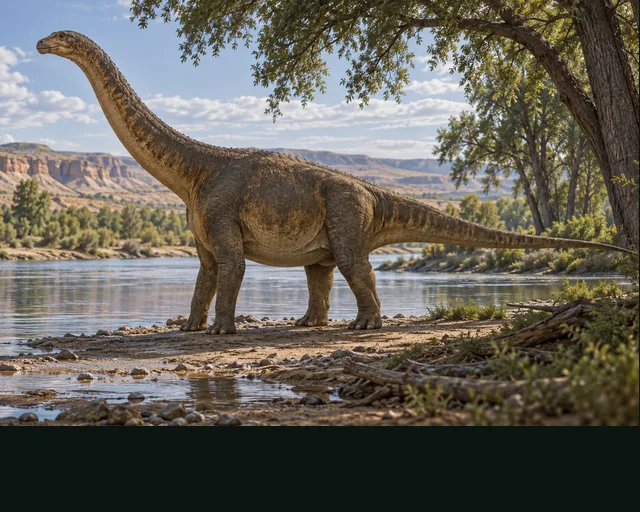
Nemegtosaurus was a Late Cretaceous Mongolian titanosaur initially known from a single elongated skull.
Distinctive features and evidence
Its low head and slender teeth once suggested diplodocoid affinities. Later analyses placed it among titanosaurs, illustrating that a similar skull outline can occur in different sauropod branches.
Genus overview and research references.
Nemegtosaurus fossil discoveries
Nowinski named Nemegtosaurus in 1971 from one skull found in the Nemegt Basin of Mongolia. The type species is Nemegtosaurus mongoliensis. A second species, N. pachi, was proposed by Dong in 1977 from teeth found in the Subashi Formation, but it is now regarded as a nomen dubium, a name that cannot be tied to distinctive features.
More material has been described since then. In 2019 Alexander Averianov and Alexey Lopatin described new specimens, and reported that the type locality had been relocated and that bones from the body were found near where the skull was found. The Natural History Museum entry still says it is known only from a skull and jaw, so reconstructions of the rest of the animal are speculative.
How big was Nemegtosaurus?
Estimates are about 12 to 13 metres long, with a weight of around 20 tonnes. Because the type fossil is a skull, these figures come from comparing it with better-known relatives and should be treated as rough.
Is Nemegtosaurus the same animal as Opisthocoelicaudia?
That question has been debated. The Nemegtosaurus skull and the skeleton of Opisthocoelicaudia, which lacks a neck and skull, were found in the same set of rock layers, and both are now regarded as advanced titanosaurs. That made scientists wonder whether the skull and the skeleton belonged to one animal. Body bones found at the skull locality that are comparable to the Opisthocoelicaudia skeleton added weight to the idea. In 2019 Averianov and Lopatin reviewed the argument and decided the two are not the same genus, because the shared features were hard to judge or relied on comparisons with a specimen that actually belonged to Nemegtosaurus.
Is Nemegtosaurus a titanosaur or a diplodocoid?
Both labels appear in the literature. The skull is long and low with pencil-shaped teeth, like the skulls of diplodocoids such as Diplodocus, and the Natural History Museum lists it in Diplodocoidea. More recent work, however, has shown it to be a titanosaur, closer to Saltasaurus, Alamosaurus and Rapetosaurus. The Paleobiology Database catalogue places it in its own family, Nemegtosauridae. Similar skulls can evolve in different branches of the sauropod family tree, so skull shape alone is not a safe guide to relationships.
What did Nemegtosaurus eat?
The diet is unknown. Titanosaur teeth are slender and pencil-like, and wear to a sharp angle to give a chisel-like tip. There are no plant fossils from the Gobi beds, and while flowering plants were becoming more varied in the Late Cretaceous, ferns and conifers were still common in many places. It is also unclear whether Nemegtosaurus browsed high in trees or fed low, because related titanosaurs include long-necked browsers like Rapetosaurus and short-necked forms like Bonitasaura. A comparison of the bony rings that supported the eyes with those of living reptiles and birds suggests it may have been active at short intervals through the day and night.
Where and when Nemegtosaurus lived
The Nemegt Formation is Maastrichtian in age, roughly 72 to 66 million years old, which makes Nemegtosaurus one of the last sauropods on Earth. The landscape has been described as a lush river delta crossing the ancient Gobi sands, shared with the ornithomimid Gallimimus, the alvarezsaurid Mononykus, the giant-clawed therizinosaur Therizinosaurus and the tyrannosaur Tarbosaurus.
Classification and fossil record
The Paleobiology Database taxonomic record catalogues Nemegtosaurus under Nemegtosauridae. This is the immediate parent in that catalogue, rather than a complete list of evolutionary relationships.
The corroborated occurrence sample includes Mongolia; those are modern discovery locations, not a complete ancient geographic range.
The sourced length estimate for Nemegtosaurus is 12–13 metres. This is an estimate for the reconstructed animal, not a measurement shared by every individual. See the body-size discussion and linked evidence for context.
Research starting point
The catalogue links Nemegtosaurus to Nowinski, 1971, published in Palaeontologia Polonica. This identifies a research starting point; the catalogue’s citation alone does not verify every later reconstruction or species assignment.
For the meaning of taxonomic terms and how evidence is checked, see the glossary and editorial policy.
Quick answers
- Is Nemegtosaurus a dinosaur?
- Yes. Nemegtosaurus was a long-necked sauropod dinosaur from the Late Cretaceous of Mongolia.
- When did Nemegtosaurus live?
- It lived in the Maastrichtian, at the very end of the Cretaceous, roughly 72 to 66 million years ago, making it one of the last sauropods.
- How big was Nemegtosaurus?
- Estimates are about 12 to 13 metres long and perhaps 20 tonnes. The estimate is rough because the type fossil is a skull.
- Is Nemegtosaurus a titanosaur?
- Recent work places it with the titanosaurs, though its long, low skull once led scientists to compare it with diplodocoids.
- What was found of Nemegtosaurus?
- The original fossil is a single skull from the Nemegt Basin, Mongolia. Newer specimens were described in 2019, but much of the animal is still unknown.