Jurassic Dinos editorial · Updated · Source-based review
What is Alamosaurus?
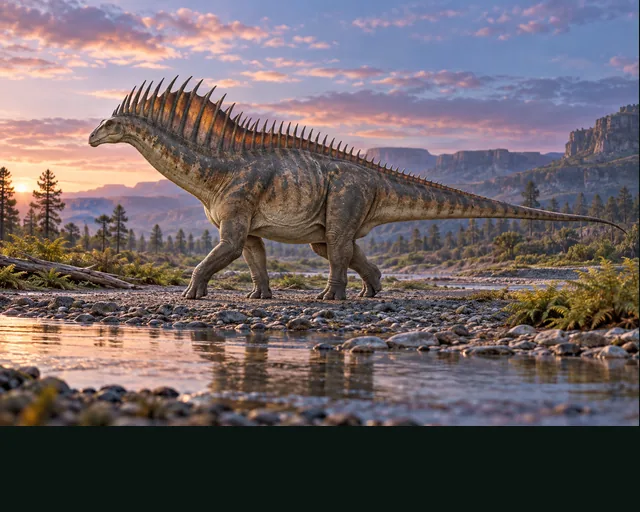
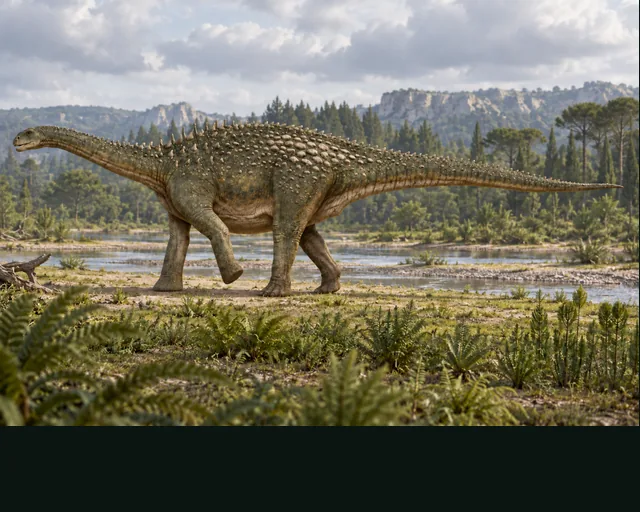
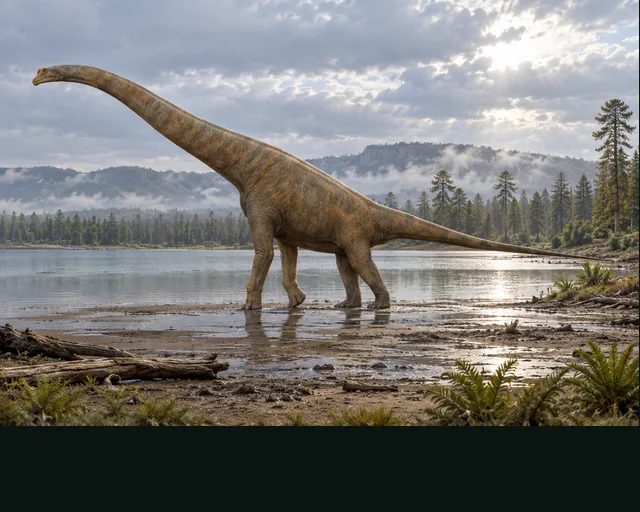
Alamosaurus was a titanosaur sauropod that lived in southwestern North America near the end of the Cretaceous.
Distinctive features and evidence
Its presence is significant because sauropods are scarce in earlier parts of the continent’s Late Cretaceous record. Large isolated bones suggest substantial size, but they do not provide a complete skeleton of a record-setting individual.
Genus overview and research references.
Alamosaurus fossil discoveries
The first Alamosaurus bones, a shoulder blade and a hip bone, were found in 1921 in New Mexico and described by Charles Gilmore in 1922. The name does not come from the Alamo in San Antonio. It comes from the Ojo Alamo rock formation, which in turn takes its name from a local trading post, and from the Spanish word for poplar.
A far more complete find came in 1937 from North Horn Mountain in Utah, with a full tail, a forelimb and both hip bones. Hundreds of other pieces from Texas, New Mexico and Utah have since been assigned to the genus, often with little description. Alamosaurus bones are among the commonest Late Cretaceous dinosaur fossils of the southwestern United States, yet no skull has ever been found.
How big was Alamosaurus?
Published estimates for a typical adult are around 21 to 26 metres long. One study put a well-known adult specimen at about 26 metres, 5 metres tall at the shoulder, and up to 30 to 35 tonnes. Some fragmentary leg and vertebra bones suggest larger animals, and Scott Hartman estimated 28 to 30 metres from a huge incomplete tibia, while stressing that it may not belong to Alamosaurus at all.
Most of the more complete skeletons come from young or small adults. For this reason, the very large figures are less certain than the smaller ones.
Is Alamosaurus a titanosaur?
Yes. Alamosaurus is a titanosaur, one of the long-necked sauropods that were widespread in the Cretaceous, especially in the southern continents. Gilmore himself was unsure about its relationships in 1922, and later studies disagree about its closest relatives: some link it to Opisthocoelicaudia, some to South American titanosaurs such as Pellegrinisaurus, and a 2016 analysis placed it near the lognkosaurs, the group that includes Futalognkosaurus.
In 2025, Gregory Paul suggested that the more complete Utah specimen and other fossils from the North Horn, Black Peaks and possibly Javelina formations belong to a separate genus, Utetitan. If accepted, the name Alamosaurus would then cover mostly the New Mexico material.
Why was Alamosaurus in North America?
Alamosaurus is the only known sauropod from North America after a gap of roughly 30 million years in which no definite sauropod fossils are known. Three explanations have been offered: it came from South America, it came from Asia, or titanosaurs lived in the continent’s uplands all along and are missing only because those habitats rarely fossilise. Several studies favour a South American origin, partly because it appears at about the same time that duck-billed dinosaurs reached South America.
Compare it with the South American giant Argentinosaurus or the Early Cretaceous Amargasaurus to see how varied sauropods of this region were.
Where and when did Alamosaurus live?
Alamosaurus lived at the very end of the Cretaceous, in the Maastrichtian stage. Dated layers in the Ojo Alamo Formation give ages of about 66.9 and 66.4 million years, and the youngest Texas locality lies a few tens of metres below the layer that marks the end of the Cretaceous. Scientists describe an “Alamosaurus fauna” of semi-arid inland plains shared with giant pterosaurs, and Wyoming material suggests it lived alongside Triceratops.
Classification and fossil record
The Paleobiology Database taxonomic record catalogues Alamosaurus under Saltasaurinae. This is the immediate parent in that catalogue, rather than a complete list of evolutionary relationships.
The corroborated occurrence sample includes United States, Mexico; those are modern discovery locations, not a complete ancient geographic range.
The sourced length estimate for Alamosaurus is 21–26 metres. This is an estimate for the reconstructed animal, not a measurement shared by every individual. See the body-size discussion and linked evidence for context.
Research starting point
The catalogue links Alamosaurus to Gilmore, 1922, published in Smithsonian Miscellaneous Collections. This identifies a research starting point; the catalogue’s citation alone does not verify every later reconstruction or species assignment.
For the meaning of taxonomic terms and how evidence is checked, see the glossary and editorial policy.
Quick answers
- Is Alamosaurus a dinosaur?
- Yes. Alamosaurus was a huge plant-eating sauropod dinosaur, a titanosaur, that lived in what is now the southwestern United States at the end of the Cretaceous.
- When did Alamosaurus live?
- In the Maastrichtian stage, roughly 70 to 66 million years ago, among the last dinosaurs before the end of the Cretaceous.
- How big was Alamosaurus?
- Estimates for adults range from about 21 to 26 metres long, with one estimate of 30 to 35 tonnes. Some fragments hint at larger animals, but those are uncertain.
- Is Alamosaurus a titanosaur?
- Yes, it is a titanosaurian sauropod, though scientists disagree about which titanosaurs are its closest relatives, and some fossils may belong to a separate genus, Utetitan.
- Is Alamosaurus named after the Alamo?
- No. It is named after the Ojo Alamo rock formation in New Mexico, where the first bones were found, and Alamo is the Spanish word for poplar.