Jurassic Dinos editorial · Updated · Source-based review
What is Rapetosaurus?
Rapetosaurus was a latest Cretaceous Madagascan titanosaur represented by the species Rapetosaurus krausei.
Distinctive features and evidence
Its island setting offers a comparison with the Madagascan predator Majungasaurus. Adult dimensions are reconstructions, and a shared regional formation does not establish a specific interaction between the two animals.
Genus overview and research references.
Rapetosaurus fossil discoveries
Rapetosaurus was found in the Mahajanga basin of northwestern Madagascar, close to the port town of the same name, by a field team from Stony Brook University working with the University of Antananarivo. The team leader, David Krause, had been digging at the site since 1993. Kristina Curry Rogers and Catherine Forster published the find in 2001 and named the species Rapetosaurus krausei in his honour.
What makes the discovery important is completeness. The best specimen is a young animal missing only a few tail vertebrae, and it still has its skull attached. It is described as the most complete titanosaur skeleton recovered so far and the only one with the head still joined to the body. Partial remains of three other individuals were also recovered, and the skeleton has helped clarify long-standing questions about how titanosaurs are related.
How big was Rapetosaurus?
The nearly complete skeleton belonged to a juvenile about 8 metres long, which the describers compared to an elephant in weight. An adult is thought to have been roughly twice as long, around 15 metres. A 2020 estimate for a probable adult known from a thigh bone gave about 16.5 metres and 10.3 tonnes, so figures vary, and the adult size is partly a scaled estimate.
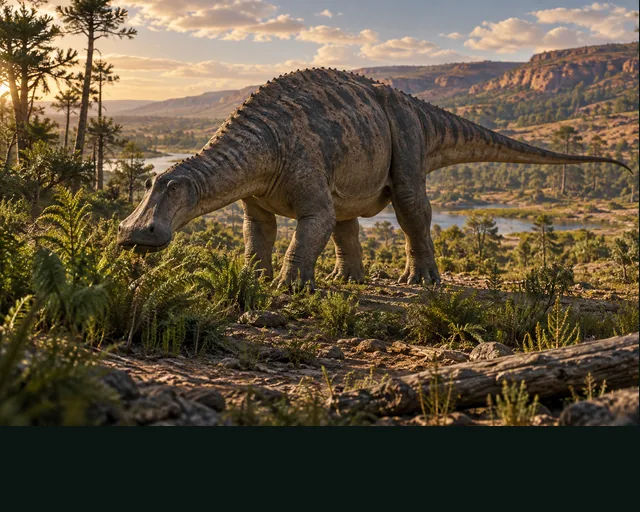
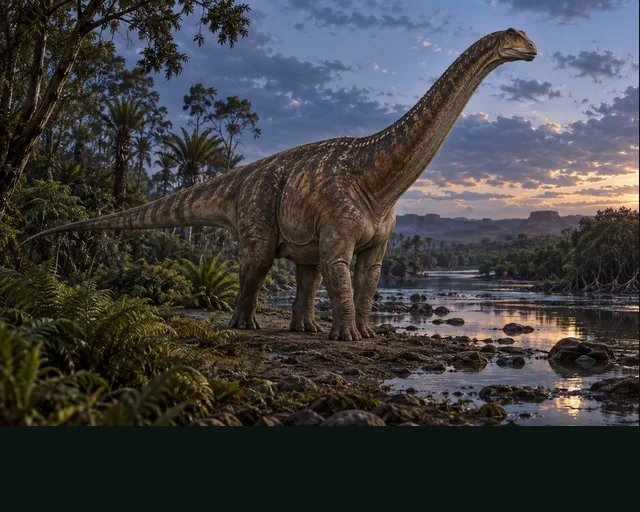
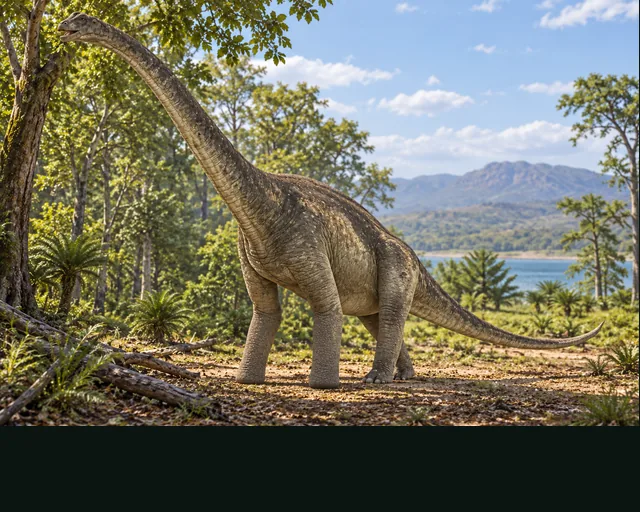
Even so, it was modest for a titanosaur, since giants such as Argentinosaurus were more than twice as long. It had a long neck, a bulky body, a fairly short, slender tail and a long, narrow snout with the nostrils on top of the skull. Its teeth were small and pencil-like, good for stripping leaves from plants but not for chewing.
How did a young Rapetosaurus grow?
A rare juvenile found in a museum collection offers a glimpse of early life. It was estimated at about 40 kilograms and probably between 39 and 77 days old when it died, after hatching at around 3.4 kilograms. Bone remodelling suggests that the young animal could have survived with little or no parental care. The study also concluded that it likely starved during one of the harsh droughts of Cretaceous Madagascar.
Rapetosaurus and Majungasaurus in Madagascar
Madagascar was already an island in the Maastrichtian, having separated from the Indian subcontinent within the previous 20 million years. The climate was semi-arid with strong seasons, and the area was a coastal floodplain crossed by sandy rivers. Floods at the start of the wet season buried animals that had died in the dry season, which helped preserve fossils so well.
The top predator was the abelisaurid Majungasaurus. Its tooth marks on Rapetosaurus bones show that it fed on these sauropods, though they do not show whether it killed them. Other animals in the same formation included Masiakasaurus, birds, crocodile relatives, mammals and fish. Unlike many titanosaur habitats, this one had no large ornithischian dinosaurs, and only one other big plant eater, another titanosaur.
Where and when Rapetosaurus lived
Rapetosaurus lived at the very end of the Cretaceous, in the Maastrichtian age. One source gives 70 to 66 million years ago, and the rock layer holding the bones is about 70 million years old.
Classification and fossil record
The Paleobiology Database taxonomic record catalogues Rapetosaurus under Saltasauroidea. This is the immediate parent in that catalogue, rather than a complete list of evolutionary relationships.
The corroborated occurrence sample includes Madagascar; those are modern discovery locations, not a complete ancient geographic range.
Research starting point
The catalogue links Rapetosaurus to Curry Rogers and Forster, 2001, published in Nature. This identifies a research starting point; the catalogue’s citation alone does not verify every later reconstruction or species assignment.
For the meaning of taxonomic terms and how evidence is checked, see the glossary and editorial policy.
Quick answers
- Is Rapetosaurus a dinosaur?
- Yes. Rapetosaurus was a titanosaur, a long-necked, plant-eating sauropod dinosaur that lived on the island of Madagascar.
- When did Rapetosaurus live?
- Rapetosaurus lived in the Maastrichtian age at the end of the Cretaceous, roughly 70 to 66 million years ago.
- How big was Rapetosaurus?
- Adults are estimated at around 15 metres, with one 2020 estimate of 16.5 metres and 10.3 tonnes. The best skeleton is a juvenile about 8 metres long.
- Is Rapetosaurus a titanosaur?
- Yes. Rapetosaurus is a titanosaurian sauropod, and its nearly complete skeleton has helped scientists understand how other, more fragmentary titanosaurs were built.
- Where was Rapetosaurus found?
- It was found in the Maevarano Formation of the Mahajanga basin in northwestern Madagascar, near the city of Mahajanga.