Jurassic Dinos editorial · Updated · Source-based review
What is Masiakasaurus?
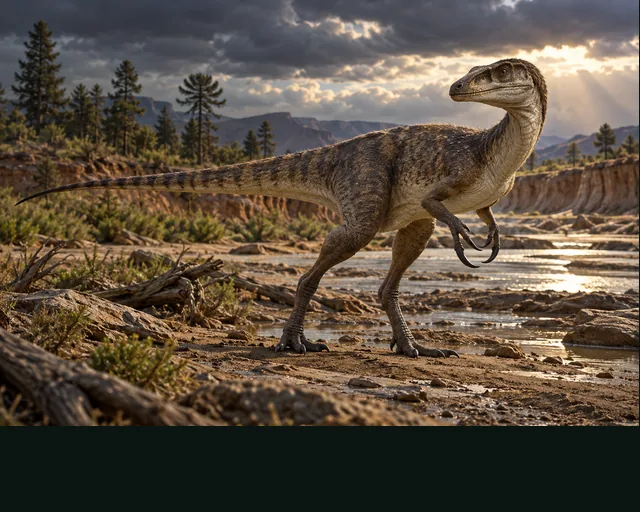
Masiakasaurus was a small Late Cretaceous Madagascan theropod with forward-projecting front teeth.
Distinctive features and evidence
That unusual dentition supports discussion of specialized prey handling. Fish and other small prey have been suggested, but a proposed feeding adaptation should not be transformed into a completely known diet.
Genus overview and research references.
Masiakasaurus fossil discoveries
Masiakasaurus was first described in the journal Nature in 2001 by Scott Sampson, Matthew Carrano and Catherine Forster, from the Maevarano Formation of north-western Madagascar. The first fragments, collected near the village of Berivotra, made up about 40% of the skeleton and included parts of the skull with the distinctive teeth. The species name knopfleri honours the musician Mark Knopfler, an inspiration for the field team.
A 2011 study described extra specimens, adding the braincase, the front of the upper jaw, ribs, parts of the hands and much of the neck and back. About 65% of the skeleton is now known, and the new material clarified many details of noasaurid anatomy.
Why did Masiakasaurus have forward-pointing teeth?
The front teeth of both jaws pointed forward rather than down, a feature called procumbent. In the lower jaw the first four teeth were long, hooked and spoon-shaped, and the first tooth sat only about 10 degrees above horizontal. Behind them, the teeth were the usual curved, flattened blades seen in meat-eating dinosaurs.
Scientists think the front teeth worked as grasping tools for small prey rather than for tearing large pieces apart, while the back teeth could cut and slice. Small vertebrates, invertebrates and possibly even fruit have been suggested. That list is an interpretation of the teeth, not a record of what the animal really ate.
How big was Masiakasaurus?
Masiakasaurus was small for a theropod, roughly 1.8 to 2.1 metres long, and an estimate of its weight is about 20 kilograms. A 2013 growth study of the bones concluded that adults were fully grown at a small size rather than being juveniles of a bigger animal. It took about 8 to 10 years to reach the size of a large dog, slower than similar-sized theropods but faster than crocodilians.
Unlike the deep, short skulls of abelisaurids, its skull was long and low. Its arms were longer than those of abelisaurids, and its stout neck ribs would have made the neck fairly stiff.
Is Masiakasaurus a noasaurid?
Yes. In 2001 it was thought to be an early abelisauroid, and in 2002 it was placed with Noasaurus and Laevisuchus in the family Noasauridae. Noasaurids are small ceratosaurs, mostly known from South America. Noasaurus is a related genus that shares the family name, while abelisaurids such as Majungasaurus and Carnotaurus had deep skulls and extremely reduced arms, unlike Masiakasaurus.
Specimens fall into a sturdier and a more slender form. This might reflect differences between males and females, or two different populations; the evidence cannot yet say which.
Where and when Masiakasaurus lived
Masiakasaurus lived in the final few million years of the Cretaceous, about 72 to 66 million years ago, in a seasonal, semi-arid part of Madagascar. Other animals in the Maevarano Formation include Majungasaurus, the sauropod Rapetosaurus and the bird-like Rahonavis. A shoulder bone of Masiakasaurus has holes that might be bite punctures from a predator or scavenger such as Majungasaurus, but they could also come from an infection.
Classification and fossil record
The Paleobiology Database taxonomic record catalogues Masiakasaurus under Noasaurinae. This is the immediate parent in that catalogue, rather than a complete list of evolutionary relationships.
The corroborated occurrence sample includes Madagascar; those are modern discovery locations, not a complete ancient geographic range.
The sourced length estimate for Masiakasaurus is 1.8–2.1 metres. This is an estimate for the reconstructed animal, not a measurement shared by every individual. See the body-size discussion and linked evidence for context.
Research starting point
The catalogue links Masiakasaurus to Sampson and Carrano, 2001, published in Nature. This identifies a research starting point; the catalogue’s citation alone does not verify every later reconstruction or species assignment.
For the meaning of taxonomic terms and how evidence is checked, see the glossary and editorial policy.
Quick answers
- Is Masiakasaurus a dinosaur?
- Yes. Masiakasaurus was a small theropod dinosaur from Madagascar, belonging to the ceratosaur family Noasauridae.
- What does Masiakasaurus mean?
- The name means 'vicious lizard', from the Malagasy word masiaka for vicious and the Greek word for lizard. The species name honours the musician Mark Knopfler.
- How big was Masiakasaurus?
- Masiakasaurus was about 1.8 to 2.1 metres long, with an estimated weight of around 20 kilograms, comparable to a large dog.
- What did Masiakasaurus eat?
- Its forward-pointing front teeth suggest it grabbed small prey such as small vertebrates and invertebrates. Fruit has also been suggested, but its real diet is not known.
- When did Masiakasaurus live?
- It lived in the Maastrichtian stage, about 72 to 66 million years ago, at the very end of the Cretaceous.