Jurassic Dinos editorial · Updated · Source-based review
What is Noasaurus?
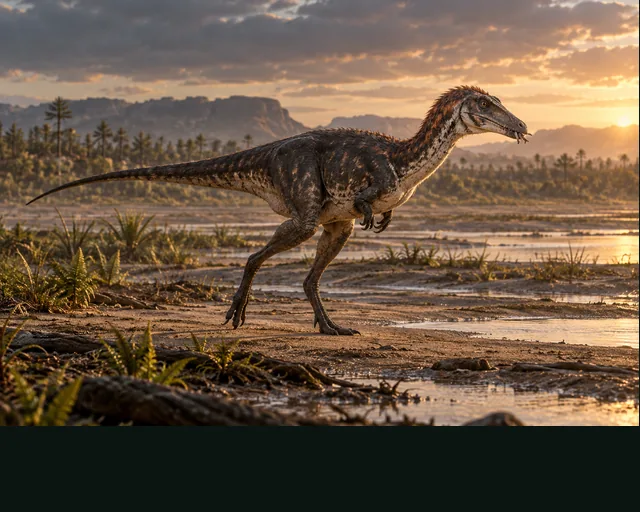
Noasaurus was a small Late Cretaceous Argentine theropod based on a fragmentary Lecho Formation specimen.
Distinctive features and evidence
Its family, Noasauridae, was retained even as its higher classification shifted from a coelurosaur interpretation to Ceratosauria. That history makes the limited original bones and later anatomical comparisons important to explain.
Genus overview and research references.
Noasaurus fossil discoveries
In April 1975 a team of students and palaeontologists from the Miguel Lillo Foundation, led by José Bonaparte, began digging at El Brete in Salta Province, Argentina. They uncovered a bone bed of jumbled bones from several kinds of dinosaur. Among the bones of the titanosaur Saltasaurus was a partial theropod skeleton found by Bonaparte’s student Jaime Powell.
That specimen, PVL 4061, is small: a maxilla (upper jaw bone), a quadrate (a bone of the jaw joint), two neck vertebrae and ribs, one back vertebra, two claws, a finger bone and one foot bone. Bonaparte and Powell named Noasaurus leali in 1980, and the species name honours Juan Carlos Leal, who found the site. After a brief description there was little further study until a detailed 2024 redescription led by Christophe Hendrickx.
What was the Noasaurus claw mystery?
The two strongly curved claws were first identified as a foot claw, like the “sickle claw” of dromaeosaurid dinosaurs. For years Noasaurus was imagined as a South American counterpart of those hunters. In 2004 the claws were recognised as belonging to the hand. That removed the foot-claw comparison, and the 2024 study suggested the hand claws may have been used to snag fish, a role compared with the big thumb claw of Baryonyx. This is a hypothesis based on shape.
How big was Noasaurus?
Noasaurus was small, but the figures disagree. Gregory Paul estimated about 1.5 metres and 15 kilograms. The 2024 team estimated 1.6 metres from the skull and 2 metres from the foot bone, and declined to give a weight because key limb bones were missing and the animal might have been a juvenile. The Natural History Museum gives only about 1 metre. A study of bone growth rings was not allowed, so its age at death is unknown.
What kind of theropod is Noasaurus?
Noasaurus is a ceratosaur and a member of the family Noasauridae, which Bonaparte created for it. Bonaparte first thought it related to small coelurosaurs such as Compsognathus. Later analyses consistently found noasaurids to be close relatives of abelisaurids, the group of Abelisaurus and Carnotaurus, within a larger group called Abelisauroidea. In 2024 Noasaurus came out in a small tangle of relationships with other small noasaurids, including Laevisuchus and Masiakasaurus, which may show a Late Cretaceous radiation of small animals. Masiakasaurus is a better-known noasaurid with a similar proposed lifestyle.
The teeth were laterally flattened, curved and finely serrated, and at least eleven were present in the upper jaw in life. None of the preserved crowns exceeded about 10 millimetres.
Where and when Noasaurus lived
The Lecho Formation is Maastrichtian, at the very end of the Cretaceous, with the El Brete layers dated to roughly 70 to 68 million years ago. The environment was a hot, humid coastal plain with ponds and lagoons, probably supporting tropical forest. Other known animals include Saltasaurus, enantiornithine birds such as Enantiornis, and a large abelisaurid known from teeth.
Classification and fossil record
The Paleobiology Database taxonomic record catalogues Noasaurus under Noasaurinae. This is the immediate parent in that catalogue, rather than a complete list of evolutionary relationships.
Discovery and naming history
The fragmentary name-bearing material was recovered from Argentina’s Lecho Formation in 1975 and described in 1980. Its classification and interpretation of the associated claws changed with subsequent comparisons. Historical overview.
The corroborated occurrence sample includes Argentina; those are modern discovery locations, not a complete ancient geographic range.
Research starting point
The catalogue links Noasaurus to Bonaparte and Powell, 1980, published in Mémoires de la Société Géologique de France, Nouvelle Série. This identifies a research starting point; the catalogue’s citation alone does not verify every later reconstruction or species assignment.
For the meaning of taxonomic terms and how evidence is checked, see the glossary and editorial policy.
Quick answers
- Is Noasaurus a dinosaur?
- Yes. Noasaurus was a small theropod dinosaur, a ceratosaur in the family Noasauridae, from Late Cretaceous Argentina.
- When did Noasaurus live?
- It lived in the Maastrichtian, at the end of the Cretaceous. The layers at its site are dated to roughly 70 to 68 million years ago.
- How big was Noasaurus?
- Estimates range from about 1 to 2 metres long. The 2024 team gave 1.6 to 2 metres and no weight, because the specimen is fragmentary and may be a juvenile.
- What was found of Noasaurus?
- A fragmentary skeleton of a handful of bones: part of the upper jaw, a jaw-joint bone, neck and back vertebrae, two hand claws and a foot bone.
- What did Noasaurus eat?
- It was a meat eater. A 2024 study suggested a small opportunistic hunter that may have taken small vertebrates, including fish, but no prey remains are known.