Jurassic Dinos editorial · Updated · Source-based review
What is Alvarezsaurus?
Alvarezsaurus was a small Late Cretaceous theropod from Argentina’s Bajo de la Carpa Formation.
Distinctive features and evidence
The species Alvarezsaurus calvoi was named in 1991. Its importance lies in the evolutionary history of alvarezsaurids; specialized feeding claims based on later relatives should not be presented as direct evidence for this animal’s own diet.
Genus overview and research references.
Alvarezsaurus fossil discovery
Alvarezsaurus is known from an incomplete skeleton found in Patagonia, Argentina, in the Bajo de la Carpa Formation. José Bonaparte described it in 1991 and named the species Alvarezsaurus calvoi. At the same time he created a new family, Alvarezsauridae, to hold it. This was the first member of the family to be described.
Bonaparte thought the animal might be closest to the ornithomimosaurs, the ostrich-like theropods. The name honours Gregorio Álvarez, a historian and physician, not the physicist Luis Alvarez who proposed the asteroid-impact explanation for the end of the Cretaceous.
How big was Alvarezsaurus?
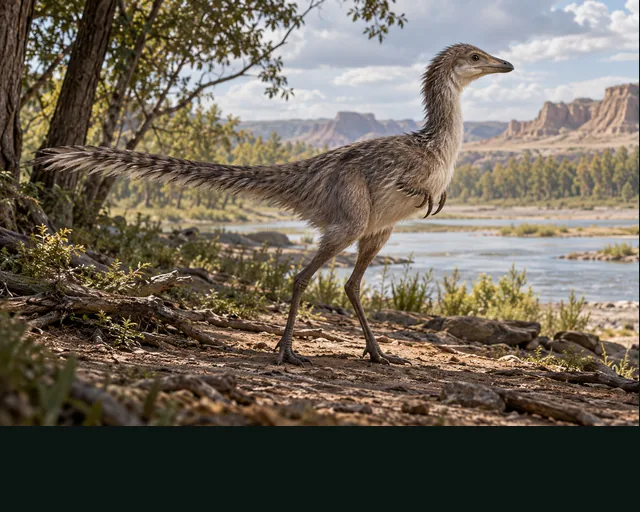
Alvarezsaurus was small. One published figure is about 1 to 1.4 metres long and roughly 3 kilograms, while the Natural History Museum’s directory gives 2 metres, so published sizes disagree. It was a two-legged theropod with a long tail, and its leg proportions suggest a fast runner.
One odd feature is the foot: the third metatarsal, a long bone of the foot, was the longest, followed by an unusually long fourth. Unlike some of its relatives, it did not have a fused astragalus and calcaneum, two ankle bones.
Is Alvarezsaurus a bird?
Not in the usual sense. Alvarezsaurids were once thought to be flightless birds, because of bird-like features of the later Mongolian members such as Mononykus. Today most scientists treat them as an early branch of maniraptoran theropods, close to but outside the bird line, although the question has been argued both ways.
Alvarezsaurus itself is regarded as a primitive member of its family. It was once assumed that the Patagonian members were the most primitive of all, but the Chinese Haplocheirus, which has even earlier traits, showed otherwise. Feathery coverings are known from a Mongolian relative, Shuvuuia, so scientists expect them in the family, but none are preserved with Alvarezsaurus.
What did Alvarezsaurus eat?
Nobody knows for sure. Some summaries say it may have eaten insects, but that is an inference from its family and not a finding from the fossil itself. Later alvarezsaurids had short, stout arms with a strong claw, and these have been compared to the tools of termite-eating mammals, though nest-raiding for eggs has also been proposed. Because no stomach contents or bite marks are known for Alvarezsaurus, its own diet remains an open question.
Classification and fossil record
The Paleobiology Database taxonomic record catalogues Alvarezsaurus under Alvarezsauridae. This is the immediate parent in that catalogue, rather than a complete list of evolutionary relationships.
Discovery and naming history
José Bonaparte named the genus in 1991 from Bajo de la Carpa Formation material. The name honors the historian Gregorio Alvarez; it is not a description of the animal’s feeding behavior. Historical overview.
The corroborated occurrence sample includes Argentina; those are modern discovery locations, not a complete ancient geographic range.
Research starting point
The catalogue links Alvarezsaurus to Bonaparte, 1991, published in Revista del Museo Argentino de Ciencias Naturales “Bernardino Rivadavia” e Instituto Nacional de Investigación de las Ciencias Naturales: Paleontología. This identifies a research starting point; the catalogue’s citation alone does not verify every later reconstruction or species assignment.
For the meaning of taxonomic terms and how evidence is checked, see the glossary and editorial policy.
Quick answers
- Is Alvarezsaurus a dinosaur?
- Yes. Alvarezsaurus was a small two-legged theropod dinosaur from the Late Cretaceous of Argentina, and the first member of the family Alvarezsauridae to be named.
- How big was Alvarezsaurus?
- Small. Published figures range from about 1 to 1.4 metres long, with roughly 3 kilograms in weight, up to 2 metres in the museum directory.
- When did Alvarezsaurus live?
- In the Santonian stage of the Late Cretaceous, roughly 86 to 83 million years ago, in what is now Patagonia, Argentina.
- Is Alvarezsaurus an alvarezsaurid?
- Yes. It is the type genus of the family Alvarezsauridae and is considered a primitive member compared with Mononykus and Shuvuuia.