Jurassic Dinos editorial · Updated · Source-based review
What is Mononykus?
Mononykus was a small Late Cretaceous Mongolian alvarezsaurid with highly specialized forelimbs.
Distinctive features and evidence
The reduced arms and prominent claw have been interpreted as adaptations for accessing insect colonies. That hypothesis should be described as an interpretation, and feather coverage should not be reconstructed solely from better-preserved relatives.
Genus overview and research references.
Mononykus fossil discoveries
The type specimen of Mononykus was collected in 1987 at the Bügiin Tsav locality in the Gobi Desert of Mongolia. It is a partial skeleton with no tail and only small pieces of the skull, although the braincase is complete. A second specimen, a set of seven tail vertebrae with part of a hind leg, was found in 2008 by a Korean-Mongolian expedition at Altan Uul III and was assigned to the genus in 2019.
The name itself changed in the year it was published. It was first spelt Mononychus in 1993, but that spelling had already been used for a beetle, so the dinosaur was renamed Mononykus.
Are pictures of Mononykus really Shuvuuia?
Often they are. Several later finds, including skulls with almost no teeth and specimens with long, thin tails, were first classified as Mononykus. They were later moved to a separate genus, Shuvuuia. Early reconstructions drawn from those fossils gave Mononykus a very short tail. Because of this reassignment, many illustrations and museum mounts labelled Mononykus are actually based mainly on Shuvuuia. Mononykus itself is known from far less material.
How big was Mononykus?
Mononykus was tiny, an estimated 1 to 1.2 metres long and about 3.5 kilograms in weight (a single published estimate). It was lightly built, with long, thin legs.
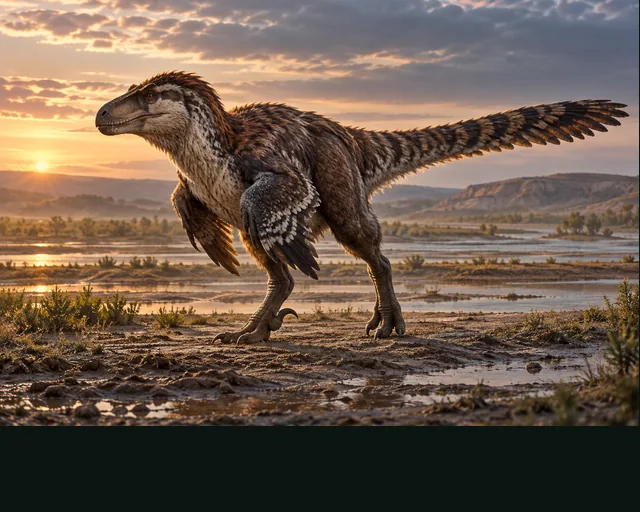
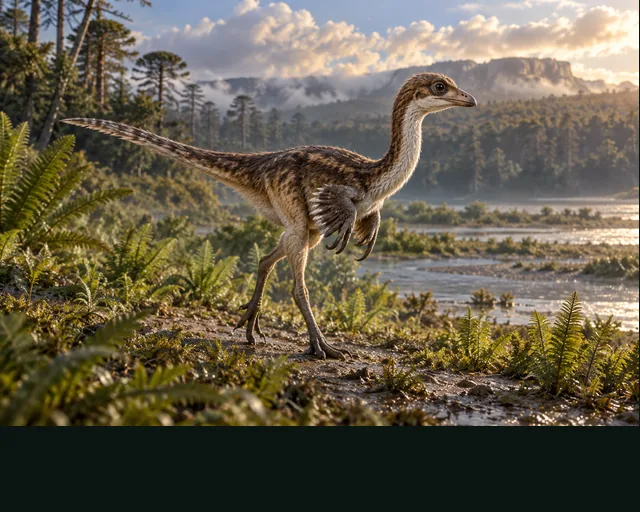
Feathers have not been found on Mononykus itself. Its relative Shuvuuia preserves traces of them, so Mononykus is thought to have had a feathery covering too. The inner ear of this family resembles that of barn owls, which has led to the suggestion of a facial disc of feathers that helped to focus sound. This is a possibility, not a fossil observation.
What was the single claw of Mononykus for?
The forelimbs were short, stubby and very specialised, ending in one large claw about 7.5 centimetres long, and the other two claws had disappeared. Its relative Shuvuuia kept two tiny claws as well as the big one. What the arms were for is still a mystery. Some scientists have proposed that they were used to break open termite mounds or other insect colonies, as modern anteaters do, which would mean a mainly insect diet. This is an interpretation of the anatomy, and the Natural History Museum lists the diet as unknown.
Is Mononykus an alvarezsaurid?
Yes. Mononykus belongs to the Alvarezsauridae, a family of small theropods. It has some bird-like features, including fused wrist bones and a keeled breastbone, but it is classified as a non-bird theropod dinosaur. It differs from the close relatives Shuvuuia and Parvicursor in details such as the shape of the pubic bone and the proportions of its toes. For an early, better-known family member, see Alvarezsaurus.
Where and when Mononykus lived
Mononykus lived in the Late Cretaceous in the Nemegt Formation of Mongolia. Ages differ between sources: the Natural History Museum gives about 81 to 68 million years ago, and the Paleobiology Database lists Campanian to Maastrichtian occurrences from about 83.6 to 66 million years ago. The museum also lists China as a place where it was found, but the fossils described in detail come from Mongolia.
Classification and fossil record
The Paleobiology Database taxonomic record catalogues Mononykus under Parvicursorinae. This is the immediate parent in that catalogue, rather than a complete list of evolutionary relationships.
The corroborated occurrence sample includes Mongolia; those are modern discovery locations, not a complete ancient geographic range.
The sourced length estimate for Mononykus is 1–1.2 metres. This is an estimate for the reconstructed animal, not a measurement shared by every individual. See the body-size discussion and linked evidence for context.
Research starting point
The catalogue links Mononykus to Perle and Norell, 1993, published in Nature. This identifies a research starting point; the catalogue’s citation alone does not verify every later reconstruction or species assignment.
For the meaning of taxonomic terms and how evidence is checked, see the glossary and editorial policy.
Quick answers
- Is Mononykus a dinosaur?
- Yes. Mononykus was a small, bird-like theropod dinosaur in the family Alvarezsauridae, found in Mongolia.
- What does Mononykus mean?
- Mononykus means 'one claw', referring to the single large claw on each of its stubby forelimbs.
- How big was Mononykus?
- About 1 to 1.2 metres long, with one estimate of around 3.5 kilograms, so it was roughly the size of a large bird.
- What did Mononykus eat?
- It is not known. Its strong single claw led some scientists to suggest it opened insect nests such as termite mounds, but that remains an interpretation.
- Where was Mononykus found?
- The best-documented fossils come from the Nemegt Formation in the Gobi Desert of Mongolia.