Jurassic Dinos editorial · Updated · Source-based review
What is Segnosaurus?
Segnosaurus was a Late Cretaceous Mongolian therizinosaur known from several incomplete skeletons.
Distinctive features and evidence
The lower jaw, vertebrae and limb material support anatomical comparison with Erlikosaurus. Some material has been lost or damaged, so the state of the surviving specimens matters when assessing a reconstruction’s certainty.
Genus overview and research references.
Segnosaurus fossil discoveries
The first Segnosaurus bones were found in 1973 by a joint Soviet-Mongolian expedition working in the Bayan Shireh Formation, at a site called Amtgay in the Gobi Desert of southeastern Mongolia. More remains came from Amtgay and a second site, Khara-Khutul, in 1974 and 1975. None of the skeletons are complete, but the bones are well preserved. Altangerel Perle described them in 1979.
The holotype, the specimen that anchors the name, includes the lower jaws, parts of an arm, an almost complete pelvis, an incomplete thigh bone, six fused hip vertebrae and a series of tail vertebrae. Two other skeletons added leg bones, a shoulder girdle and more arm and claw bones.
The collection has not aged well. When Lindsay Zanno studied it in 2010, some bones had been damaged since collection, parts of the holotype had gone missing and some specimen numbers were shared by more than one individual. By the time the lower jaw was redescribed in 2016, most tooth crowns had lost their tips.
How big was Segnosaurus?
A commonly given estimate puts Segnosaurus at about 6 to 7 metres long and around 1.3 tonnes. A 2020 study by Campione and Evans calculated a much heavier body mass of about 4.2 tonnes, so the weight depends heavily on the method. The Natural History Museum’s directory lists a shorter length of 4 metres. Because the skeletons are incomplete, every whole-body figure is a reconstruction rather than a measurement.
Some bones can be measured directly. The upper arm bone is about 56 centimetres long, the thigh bone about 84 centimetres, and the best-preserved half of the lower jaw close to 38 centimetres.
What did Segnosaurus look like?
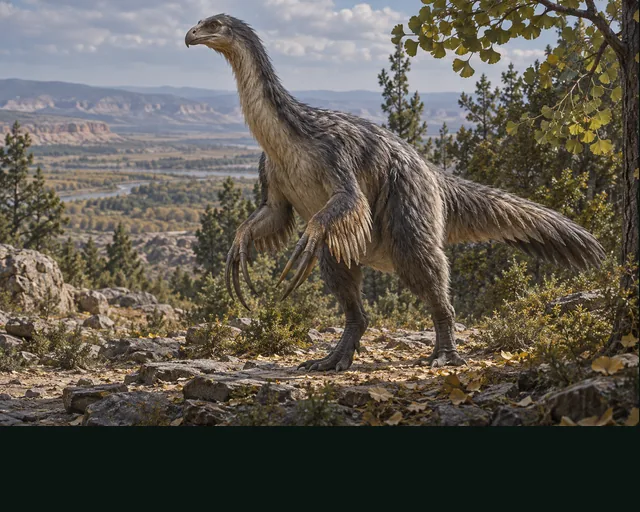
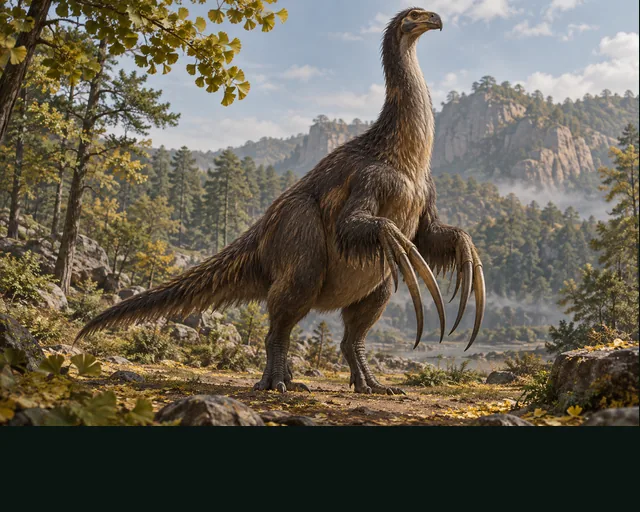
Segnosaurus walked on two legs with its body tilted upwards. It had a small head, a long, slim neck and a horny beak at the tip of the jaws. The hands had three fingers with large claws, and the feet had four toes that supported the animal, whereas nearly all other theropods had three.
The lower jaw was unusual. Its front tip turned sharply downward, the rear of the tooth row was toothless, and there were only 24 tooth sockets in each half, but the teeth were the largest known among therizinosaurs. Some teeth had extra rows of small serrations, and a few of the rearmost ones had a third cutting edge, a feature described as unique among theropods.
Some early members of the group, such as Beipiaosaurus, are known to have had simple feather-like coverings. Nothing like that has been reported for Segnosaurus, so its body covering is not known.
Is Segnosaurus a theropod?
Yes, though it took scientists years to agree. Perle gave Segnosaurus its own family, Segnosauridae, and tentatively treated it as a theropod. In the 1980s other researchers argued that it was instead a late-surviving relative of the early long-necked dinosaurs known as prosauropods, because its pelvis, jaws and feet looked so unlike those of meat-eating theropods.
The argument faded in the 1990s as better relatives were found. Alxasaurus, described in 1993, linked segnosaurs to Therizinosaurus, and Beipiaosaurus in 1999 confirmed the group among the coelurosaurian theropods. Segnosauridae is now treated as another name for Therizinosauridae. One feature fits this picture: the pubic bone points backward, as it does in birds and their closest relatives.
What did Segnosaurus eat?
There is no direct evidence of what Segnosaurus ate, such as stomach contents or feeding marks. Most scientists think the group was herbivorous or somewhere between omnivore and herbivore, because of the beak, small head, long neck and a belly broad enough for a large gut. The Natural History Museum’s directory still lists a meat-eating diet, which reflects older ideas.
The 2016 study of the jaw suggested Segnosaurus processed food in its mouth more than other therizinosaurs did. In the same rocks lived Erlikosaurus, a lighter relative with simpler teeth. A 2017 computer study suggested the two had different bite strengths and feeding styles, which may be why they could share one landscape.
Where and when Segnosaurus lived
Segnosaurus comes from the Bayan Shireh Formation of Mongolia, dated to roughly 102 to 86 million years ago, spanning the Cenomanian and Turonian ages. Other dates differ: the Natural History Museum’s directory gives about 97 to 88 million years ago, and the Paleobiology Database lists occurrences from about 100 to 84 million years ago.
The rocks were laid down by meandering rivers and lakes on a flat plain with a semi-arid climate. Therizinosaurs were the most diverse theropods there, including Erlikosaurus and Enigmosaurus. Other animals included the dromaeosaur Achillobator, the ornithomimosaur Garudimimus and the ankylosaur Talarurus. In 2025, some Japanese bones first called Allosaurus were reassigned to an unspecified species of Segnosaurus, a recent reinterpretation.
Classification and fossil record
The Paleobiology Database taxonomic record catalogues Segnosaurus under Therizinosauridae. This is the immediate parent in that catalogue, rather than a complete list of evolutionary relationships.
Discovery and naming history
Gobi Desert specimens recovered in the 1970s led to the 1979 description of Segnosaurus galbinensis. More complete relatives in the 1990s helped resolve the unusual group’s theropod identity and its connection to Therizinosauridae. Historical overview.
The corroborated occurrence sample includes Japan, Mongolia; those are modern discovery locations, not a complete ancient geographic range.
Research starting point
The catalogue links Segnosaurus to Perle, 1979, published in Trudy - Sovmestnaya Sovetsko-Mongol’skaya Paleontologicheskaya Ekspeditsiya. This identifies a research starting point; the catalogue’s citation alone does not verify every later reconstruction or species assignment.
For the meaning of taxonomic terms and how evidence is checked, see the glossary and editorial policy.
Quick answers
- Is Segnosaurus a dinosaur?
- Yes. Segnosaurus was a therizinosaurid, a type of theropod dinosaur with a beak and big hand claws that is now thought to have been mostly plant-eating.
- When did Segnosaurus live?
- It lived in the Late Cretaceous, roughly 102 to 86 million years ago in the Bayan Shireh Formation, although other sources give slightly different age ranges.
- How big was Segnosaurus?
- A common estimate is 6 to 7 metres long and about 1.3 tonnes, though a 2020 study calculated around 4.2 tonnes. The skeletons are incomplete, so all sizes are estimates.
- Is Segnosaurus a theropod?
- Yes, although it took until the 1990s to confirm. Better relatives such as Alxasaurus and Beipiaosaurus showed that segnosaurs belong inside the theropods as therizinosaurs.
- What did Segnosaurus eat?
- Probably mostly plants, as its beak, small head, and large gut suggest. There is no direct evidence such as stomach contents, so the diet is an inference.
- Where was Segnosaurus found?
- In the Gobi Desert of southeastern Mongolia, mainly at the Amtgay and Khara-Khutul sites in the Bayan Shireh Formation. Some Japanese fossils were reassigned to it in 2025.