Jurassic Dinos editorial · Updated · Source-based review
What is Nothronychus?
Nothronychus was a Late Cretaceous North American therizinosaur with species from the southwestern United States.
Distinctive features and evidence
Nothronychus mckinleyi and Nothronychus graffami come from different geological units. Their records support regional comparison, while burial in marine shale does not by itself establish an aquatic lifestyle.
Genus overview and research references.
Nothronychus fossil discoveries
The first bone was found by a team working at Haystack Butte in New Mexico’s Zuni Basin. A hip bone from a therizinosaur was at first mistaken for part of the skull crest of the horned dinosaur Zuniceratops. Further digging showed that it was something quite different, and James Kirkland and Douglas Wolfe named Nothronychus mckinleyi in 2001. The species name honours rancher Bobby McKinley, on whose land the fossils lay. The holotype, MSM P2106, is sparse: skull fragments, a braincase and bits of the vertebrae, shoulder, arm, hip and leg.
A second, more complete skeleton was found in 2000 near Big Water, Utah, by Merle Graffam, who first noticed a large toe bone. It came as a surprise, because the rock is the Tropic Shale, laid down in a sea, and this was a land animal. At the time the site would have been nearly 100 kilometres from the shore. It was described as Nothronychus graffami in 2009 by Lindsay Zanno and colleagues, and its mounted skeleton was displayed at the Museum of Northern Arizona in 2007. This species has no skull. It was the first therizinosaur found in the Americas, as earlier ones came from China and Mongolia.
How big was Nothronychus?
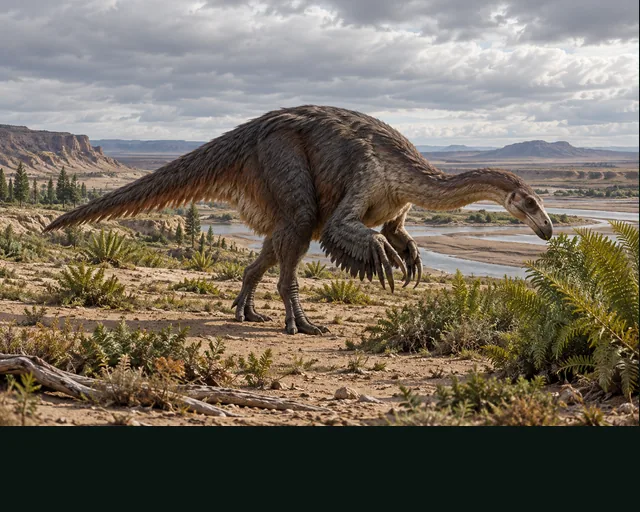
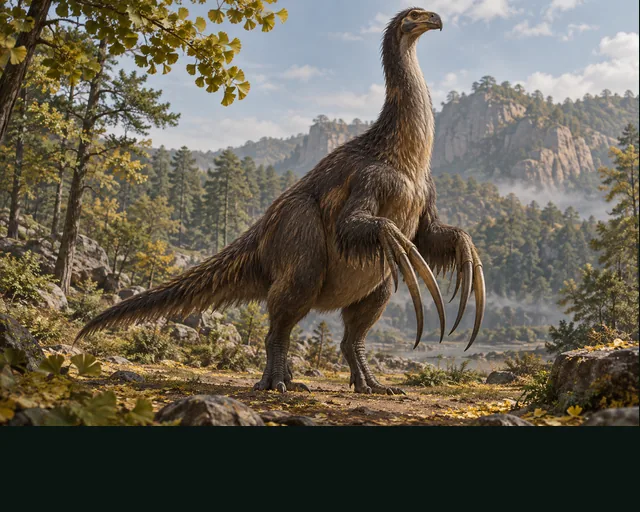
Nothronychus is estimated at roughly 4.2 to 5.3 metres long, with a weight of about 800 to 1,200 kilograms. It had a pot-bellied body, a long neck, stocky hind legs with four-toed feet and a short but flexible tail. Its hands carried curved claws up to 30 centimetres long. The two species were similar in size, but N. graffami was a little sturdier.
What did Nothronychus eat?
Therizinosaurs are theropods, a group of mostly meat eaters, but most researchers think they ate plants. Zanno and colleagues pointed to coarse serrated teeth, a horny beak, a long neck, a very large gut, and legs unsuited to running. A 2014 test of therizinosaur claws found that the hands worked better for hooking and pulling vegetation than for digging, though it could not rule out use in display or self-defence. The Natural History Museum lists Nothronychus as omnivorous, so the diet is not fully settled.
What do we know about the senses and body of Nothronychus?
A 2012 study of braincases found well-developed smell, hearing and balance in therizinosaurs. A 2018 study of the Nothronychus braincase suggested good reception of low-frequency sounds, but the authors thought their hearing estimates might be somewhat exaggerated. A 2023 study suggested a waddling walk with most movement at the knee. A 2021 study of air spaces in the bones of the skull base, neck, back and tail base suggested that Nothronychus may have had a bird-like breathing system. All of these are interpretations drawn from a few skeletons.
Is Nothronychus related to Therizinosaurus?
Yes. Nothronychus is a therizinosaurid, in the same family as Therizinosaurus and relatives such as Segnosaurus, and belongs to the maniraptoran theropods. An analysis by Zanno in 2010 found the two Nothronychus species to be each other’s closest relatives. The genus is considered one of the most complete and best-known therizinosaurids, after a major re-study of both species in 2015.
It lived in the Turonian stage of the Late Cretaceous, around 94 million years ago, with the Utah species roughly half a million to a million years older than the New Mexico one. The Moreno Hill beds record a humid world with volcanic activity, and neighbours included Zuniceratops and Suskityrannus.
Classification and fossil record
The Paleobiology Database taxonomic record catalogues Nothronychus under Therizinosauridae. This is the immediate parent in that catalogue, rather than a complete list of evolutionary relationships.
The corroborated occurrence sample includes United States; those are modern discovery locations, not a complete ancient geographic range.
Research starting point
The catalogue links Nothronychus to Kirkland and Wolfe, 2001, published in Journal of Vertebrate Paleontology. This identifies a research starting point; the catalogue’s citation alone does not verify every later reconstruction or species assignment.
For the meaning of taxonomic terms and how evidence is checked, see the glossary and editorial policy.
Quick answers
- Is Nothronychus a dinosaur?
- Yes. Nothronychus was a bulky theropod dinosaur, a therizinosaurid, that probably ate plants despite belonging to a mostly meat-eating group.
- When did Nothronychus live?
- It lived in the Turonian stage of the Late Cretaceous, roughly 94 million years ago.
- How big was Nothronychus?
- It is estimated at about 4.2 to 5.3 metres long and 800 to 1,200 kilograms, with claws up to about 30 centimetres long.
- What did Nothronychus eat?
- Most researchers think it ate plants, based on its beak, teeth, long neck and large gut. The Natural History Museum lists it as an omnivore, so this is an inference.
- Where was Nothronychus found?
- Fossils come from the Moreno Hill Formation of New Mexico and the Tropic Shale of Utah, in the southwestern United States.