Jurassic Dinos editorial · Updated · Source-based review
What is Therizinosaurus?
Therizinosaurus was a large Late Cretaceous Asian therizinosaur best known for enormous hand claws.
Distinctive features and evidence
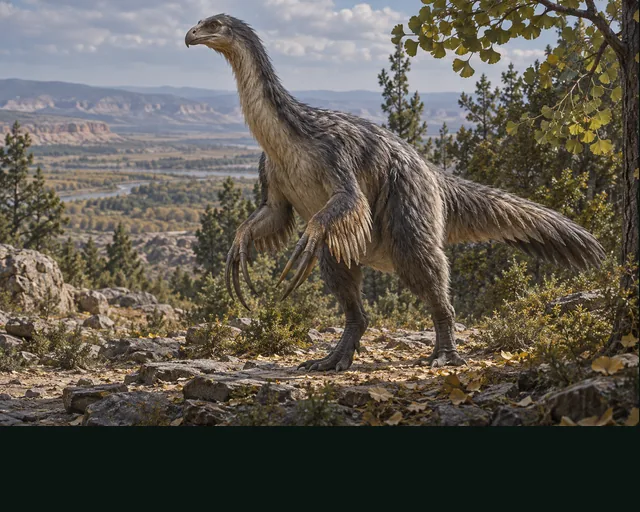
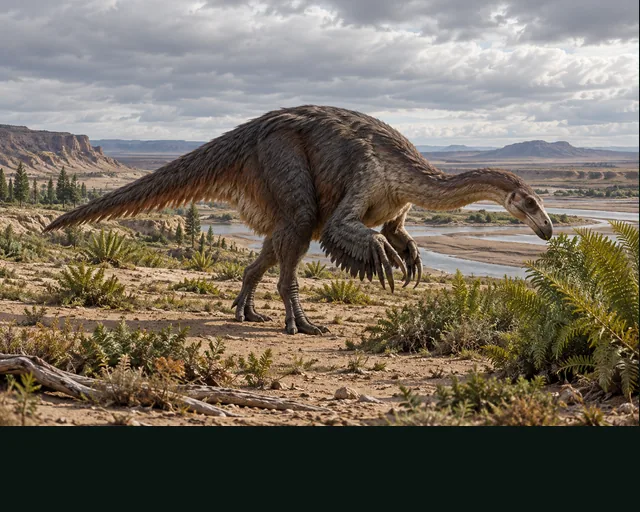
Its name-bearing record is much less complete than a full-body illustration suggests. Body proportions and feeding interpretations draw on related therizinosaurs as well as its own limb fossils, a distinction that belongs alongside the reconstruction.
Genus overview and research references.
Therizinosaurus fossil discoveries
Therizinosaurus is known from only a few bones. In 1948 a Soviet and Mongolian expedition working in the Nemegt Formation of the Gobi Desert collected three huge claw bones from one quarry, along with some rib fragments. Evgeny Maleev named the animal in 1954. With so little to go on, he imagined a big turtle-like reptile, about 4.5 metres long, that harvested seaweed with its claws. That is where the species name cheloniformis, ‘turtle-shaped’, comes from.
Other finds soon showed the idea was wrong. More claw fragments turned up in 1968 and 1972, and in 1973 an expedition recovered a far more complete pair of arms, including the shoulder girdles, upper arm bones and a complete second finger with its claw. Rinchen Barsbold described them in 1976 and concluded that Therizinosaurus was a theropod dinosaur. The ribs from the first quarry are now thought to come from a sauropod, not from Therizinosaurus.
A 1973 hind limb with four toes was linked to Therizinosaurus because it came from the same area and rock unit. Researchers have disagreed over that link, and Lindsay Zanno concluded in 2010 that it was likely correct. Parts of the body, including the skull, remain unknown.
How big was Therizinosaurus?
Estimates put Therizinosaurus at about 9 to 10 metres long and 4 to 5 metres tall, and the Natural History Museum gives a length of 10 metres. Weight is much less certain. In one popular guide Gregory Paul first estimated about 3 tonnes, and later revised his figure to 5 to 10 tonnes, while Zanno and Peter Makovicky proposed about 6.6 tonnes in 2013. Because the skeleton is so incomplete, these figures are reconstructions based on better-known relatives, not measurements of a complete animal.
Some parts can be measured directly. The most complete arm covers roughly 2.4 metres, the upper arm bone is about 76 centimetres long, and the longest claw bones reached about 50 centimetres. Those hand claws are regarded as the longest of any known land animal. Therizinosaurus is considered the largest known therizinosaur.
What were the claws of Therizinosaurus for?
Nobody knows for certain, and proposals have changed with each study. Besides Maleev’s seaweed idea, researchers have suggested opening termite mounds, digging, defence against predators and a role in display. In 2014 Stephan Lautenschlager tested digital models of therizinosaur claws and found that digging put the most strain on them, while a hook-and-pull action, as when pulling branches towards the mouth, was the most likely use. That is a feeding style compared with living anteaters and extinct ground sloths. He found no evidence that the claws were used as weapons, though they might have helped to scare off a threat.
A 2018 study found the arm bones of therizinosaurs resistant to bending, which fits a robust, strong use of the arms. A 2023 comparison of claw shapes, however, found no clear mechanical function for the claws of Therizinosaurus and suggested that they may have grown so long as a by-product of large body size. This question is still open.
Is Therizinosaurus a theropod?
Yes, although it took decades to settle. Because the first fossils looked so odd, scientists placed it first among turtles and later with the long-necked plant-eating dinosaurs known as sauropodomorphs. Relatives with stocky feet and broad hips, once grouped as segnosaurs such as Segnosaurus, kept the debate going. The break came with more complete skeletons: Alxasaurus, described in 1993, and the small feathered Beipiaosaurus, described in 1999, showed that these animals were theropods within the bird-line group called maniraptorans.
Theropods were mostly meat-eaters, but therizinosaurs were an exception. Therizinosaurus is placed in the family Therizinosauridae, and its other relatives include Nothronychus from North America. Family members are thought to have had small heads with beaks, long necks, large guts and sparse feathers, but those details come from relatives, not from Therizinosaurus itself.
Where and when Therizinosaurus lived
All Therizinosaurus fossils come from the Nemegt Formation of Mongolia. The rocks have not been dated directly, so the Maastrichtian age, roughly 69 to 66 million years ago, comes from the animals found in them; the museum gives about 70 million years.
The region was a landscape of large rivers with forests of conifers, and the climate is reconstructed as temperate with monsoons. Therizinosaurus shared it with the tyrannosaurid Tarbosaurus, the large Deinocheirus, duck-billed hadrosaurs, long-necked titanosaurs and armoured ankylosaurs. Because it was so tall, it may have fed above other plant-eaters, and researchers have speculated that a Tarbosaurus could not easily reach an upright adult above the thighs or belly. That is a reconstruction, not something preserved in a fossil.
Therizinosaurus in the game
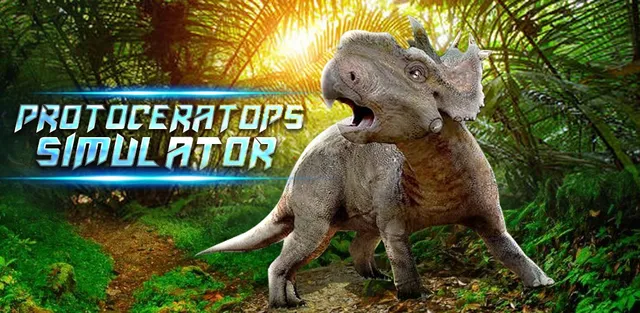
Therizinosaurus is listed as a possible enemy in Protoceratops: Dino Survival, a ceratopsian survival game set in Gobi-inspired landscapes. Its store listing describes nest defence, battles with Velociraptor and building a dinosaur family. The animations and abilities in the game are entertainment, not scientific evidence, and the real fossil record is described in the sections above.
Classification and fossil record
The Paleobiology Database taxonomic record catalogues Therizinosaurus under Therizinosauridae. This is the immediate parent in that catalogue, rather than a complete list of evolutionary relationships.
Discovery and naming history
A Mongolian expedition found the first remains in 1948, and Evgeny Maleev described them in 1954. He initially interpreted them as a turtle-like animal; later comparisons established the unusual theropod identity. Historical overview.
The corroborated occurrence sample includes Mongolia; those are modern discovery locations, not a complete ancient geographic range.
The sourced length estimate for Therizinosaurus is 9–10 metres. This is an estimate for the reconstructed animal, not a measurement shared by every individual. See the body-size discussion and linked evidence for context.
Research starting point
The catalogue links Therizinosaurus to Maleev, 1954, published in Priroda. This identifies a research starting point; the catalogue’s citation alone does not verify every later reconstruction or species assignment.
For the meaning of taxonomic terms and how evidence is checked, see the glossary and editorial policy.
Quick answers
- Is Therizinosaurus a dinosaur?
- Yes. Therizinosaurus was a very large two-legged theropod dinosaur from the Late Cretaceous of Mongolia, famous for the longest hand claws known on any land animal.
- How big was Therizinosaurus?
- Estimates are about 9 to 10 metres long and 4 to 5 metres tall, with weight estimates from about 5 to over 6 tonnes. These figures rely on relatives because the skeleton is incomplete.
- How long were the claws of Therizinosaurus?
- The longest claw bones were about 50 centimetres, reaching an estimated 52 centimetres. These hand claws are the longest known from any land animal.
- What were the claws of Therizinosaurus used for?
- It is unknown. Studies suggest pulling vegetation within reach, and defence or display are possible, but a 2023 study found no clear mechanical function.
- Did Therizinosaurus eat meat?
- Probably not. Therizinosaurus is thought to have been a plant-eater like its relatives, which had small beaked heads and large guts, although its own skull is unknown.