Jurassic Dinos editorial · Updated · Source-based review
What is Beipiaosaurus?
Beipiaosaurus was an Early Cretaceous therizinosauroid from China’s Yixian Formation with directly preserved feather structures.
Distinctive features and evidence
Its relatively small body and three-toed feet offer a comparison with later therizinosaurids. Feather evidence comes from the fossils themselves; interpretations of color and function still depend on the specimens and analytical methods used.
Genus overview and research references.
Beipiaosaurus fossil discoveries
A farmer, Li Yinxian, found the first partial skeleton in 1996 near the village of Sihetun in Liaoning. The following year it was confirmed to come from the lower Yixian Formation and to belong to one animal. Xu Xing, Tang Zhilu and Wang Xiaolin named it in 1999. The species name inexpectus means unexpected, a nod to the surprising features of the fossil. The bones and skin impressions are kept in Beijing at the Institute of Vertebrate Paleontology and Paleoanthropology.
The type specimen is a largely disarticulated skeleton of a sub-adult, with parts of the skull, jaw, backbone, shoulder, arms, hips and legs. Hip and tail bones were added when the quarry was re-excavated. A second skeleton described in 2009 has a complete skull and well-preserved feathers, and a third, reported in 2014, has feather traces around the neck. Only three specimens are known.
What did Beipiaosaurus look like?
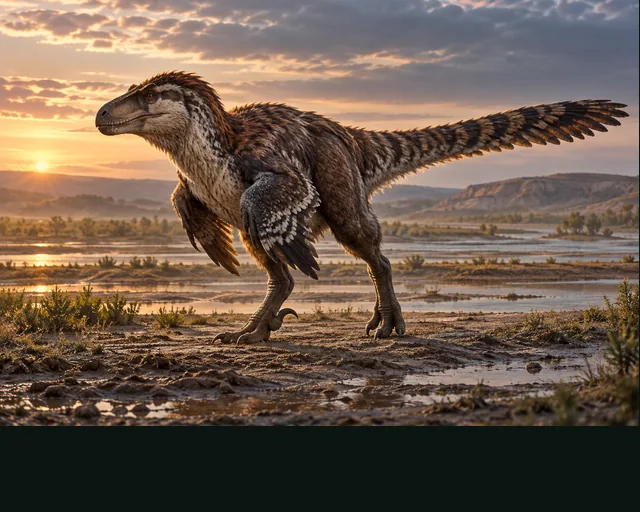
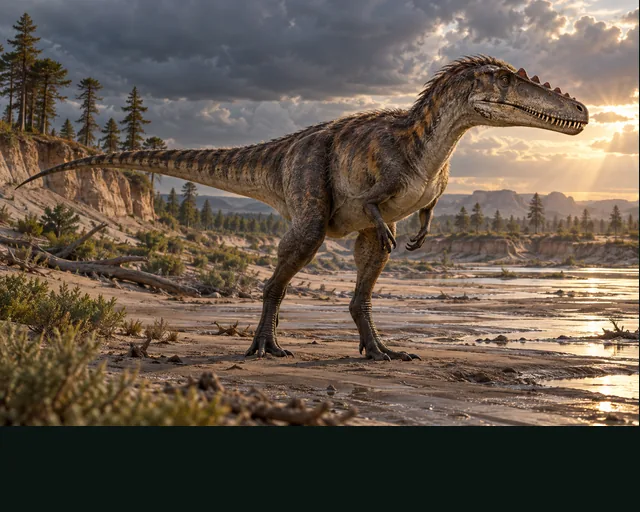
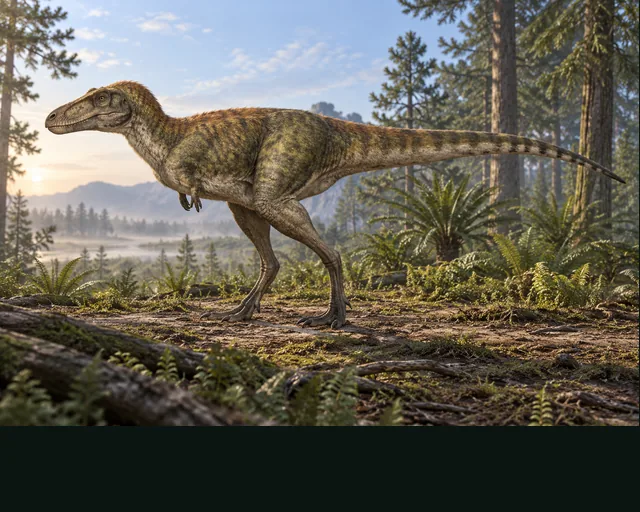
Beipiaosaurus was a small therizinosaur. The largest specimen is estimated at about 2.2 metres long, and body-mass estimates include about 27 kilograms (Zanno and Makovicky, 2013) and about 50 kilograms (Gregory Paul, 2024). That gap shows how uncertain the figures are. The head was large compared with other therizinosaurs, and the lower jaw was slender, with probably more than 37 leaf-shaped teeth on each side.
Its neck was shorter than in later relatives such as Therizinosaurus, and its feet had three functional toes rather than four. That is useful, because it suggests that the four-toed foot of later therizinosaurs evolved from a three-toed ancestor.
What feathers did Beipiaosaurus have?
The fossils preserve more than one kind of feather. Short, thin, downy fibres covered the body, and the tail bore short parallel filaments. A second coat of much longer feathers rose out of the down. These “elongated broad filamentous feathers” were single unbranched filaments, roughly 10 to 15 centimetres long and stiff rather than floppy. They were quite different from the feather types seen in many other early feathered dinosaurs. The researchers who found them suggested that they may have been used for display, and the same kind of feather is also known from another therizinosaur from the same formation.
Colour is only partly known. A 2014 study of microscopic pigment structures in one specimen’s neck feathers found round structures that suggest a brownish colour, but this applies to those neck feathers only, not to the whole animal.
Is Beipiaosaurus a therizinosaur?
Yes. It is a therizinosauroid, and it is usually treated as a very early branch of that group. Therizinosaurs were once puzzling because their teeth and bodies looked like those of plant-eating sauropodomorphs rather than typical theropods. Beipiaosaurus, with its feather impressions and theropod skeleton, helped to show that they are theropods within the feathered maniraptoran group.
One recent suggestion is that a related Chinese genus, Jianchangosaurus, is a younger individual of Beipiaosaurus, but that idea is recent and not settled. What these animals ate is not clear either: the Natural History Museum lists Beipiaosaurus as an omnivore, whereas therizinosaurs in general are described as mostly plant-eaters.
Where and when Beipiaosaurus lived
Beipiaosaurus lived in the Aptian stage of the Early Cretaceous, about 125 million years ago, in what is now Liaoning. The museum gives a slightly wider range of 127 to 121 million years. The climate of the Yixian Formation was seasonal and fairly cool, with an average yearly temperature of about 10 °C, and the plants included conifers, ferns, cycads and horsetails. Other animals from the same formation include the feathered Caudipteryx, the ceratopsian Psittacosaurus, early birds such as Confuciusornis, and many insects and fish.
Classification and fossil record
The Paleobiology Database taxonomic record catalogues Beipiaosaurus under Therizinosauroidea. This is the immediate parent in that catalogue, rather than a complete list of evolutionary relationships.
Discovery and naming history
The first remains were recovered in 1996 and described in 1999. The fossils added direct feather evidence to the therizinosaur story, rather than merely extending a reconstruction based on larger relatives. Historical overview.
The corroborated occurrence sample includes China; those are modern discovery locations, not a complete ancient geographic range.
The sourced length estimate for Beipiaosaurus is 2–2.2 metres. This is an estimate for the reconstructed animal, not a measurement shared by every individual. See the body-size discussion and linked evidence for context.
Research starting point
The catalogue links Beipiaosaurus to Xu and Tang, 1999, published in Nature. This identifies a research starting point; the catalogue’s citation alone does not verify every later reconstruction or species assignment.
For the meaning of taxonomic terms and how evidence is checked, see the glossary and editorial policy.
Quick answers
- Is Beipiaosaurus a dinosaur?
- Yes. Beipiaosaurus was a feathered theropod dinosaur, an early member of the therizinosaur group, from the Early Cretaceous of China.
- How big was Beipiaosaurus?
- About 2 to 2.2 metres long for the largest specimen. Weight estimates range from about 27 to 50 kilograms, so the figure is uncertain.
- Did Beipiaosaurus have feathers?
- Yes. Fossils preserve short downy filaments plus a layer of long, stiff, single-filament feathers. The long feathers may have been for display, but that is an interpretation.
- When did Beipiaosaurus live?
- In the Early Cretaceous, in the Aptian stage about 125 million years ago, according to the age of the Yixian Formation.
- What did Beipiaosaurus eat?
- That is uncertain. The Natural History Museum lists it as an omnivore, while therizinosaurs in general are usually described as plant-eaters.