Jurassic Dinos editorial · Updated · Source-based review
What is Caudipteryx?
Caudipteryx was a feathered Early Cretaceous Chinese oviraptorosaur with a compact body and long legs.
Distinctive features and evidence
Its bird-like appearance stimulated discussion of bird origins. Preserved feathers establish plumage, but plumage does not necessarily establish powered flight or the animal’s exact running performance.
Genus overview and research references.
Caudipteryx fossil discoveries
Several well-preserved skeletons were collected in 1997 at the Sihetun locality in Liaoning Province, north-eastern China. They were described in 1998 as two new dinosaurs, Caudipteryx and Protarchaeopteryx. The holotype of the first species, Caudipteryx zoui, is a nearly complete skeleton with clear feather impressions and a cluster of gizzard stones. A second species, C. dongi, was described in 2000 from a headless skeleton found at the nearby Zhangjiagou locality, also with feather traces.
Other finds added skulls and more feather detail. Two specimens described in 2000 preserved nearly complete skulls, and one of them showed a skin fold along the arm. In 2021 a team led by Xiaoting Zheng described another articulated skeleton, from the Yixian Formation near Chaoyang, which includes a piece of cartilage that was reported to preserve cell traces called chondrocytes.
What did Caudipteryx look like?
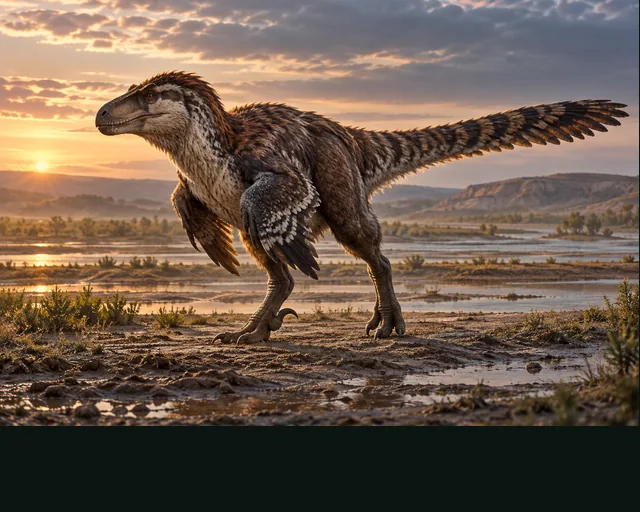
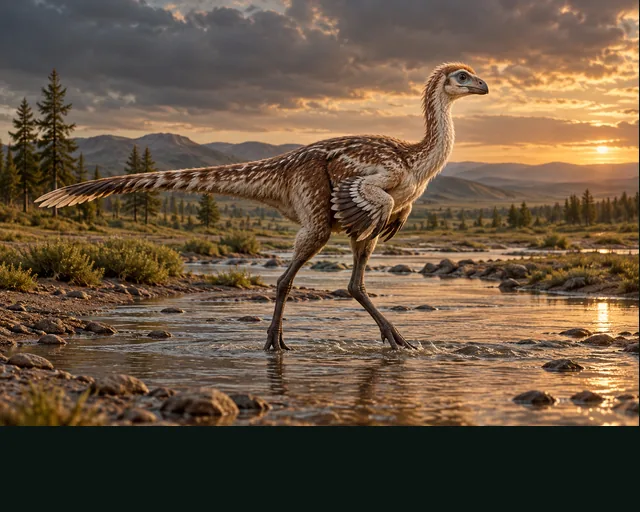
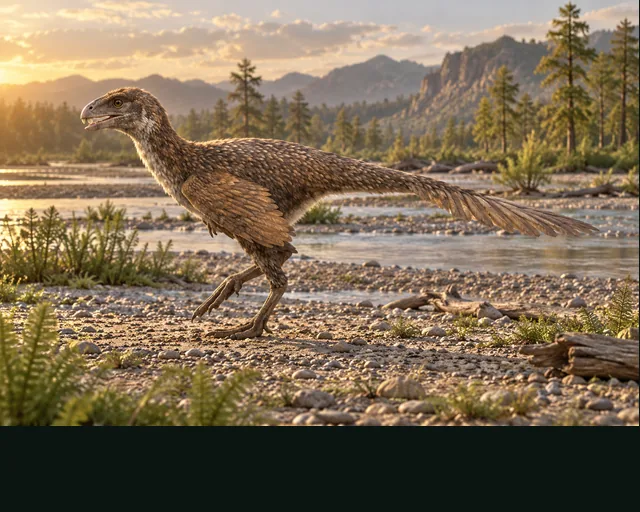
Caudipteryx was a small theropod with a stout body and long legs, and it was probably a swift runner. Sources give different size estimates: the Natural History Museum lists about one metre and two kilograms, while other work gives roughly 72 to 89 centimetres and about five kilograms based on thigh-bone length.
The skull was short and boxy with a beak-like snout and a few small teeth only at the front of the upper jaw. The tail was short and stiffened near the tip. The third finger of the hand was reduced, as in early birds.
Feathers were its most striking feature. Symmetrical feathers with a central shaft and branching barbs, 15 to 20 centimetres long, sat in a wing-like fan along the second finger, and another fan of feathers grew from the tail. A study of the number of flight feathers concluded that it could not fly and was secondarily flightless, meaning its ancestors may have been able to fly.
What did Caudipteryx eat?
Scientists think Caudipteryx was an omnivore. At least two specimens still hold gizzard stones (gastroliths) in the position where the stomach would have been. Some plant-eating dinosaurs, some early birds and many living birds also carry such stones. The Natural History Museum notes the small, weak teeth and suggests insects and perhaps some plants. As with every diet inference for an extinct animal, this comes from anatomy and stone positions rather than from direct evidence of a meal.
Is Caudipteryx a bird?
The usual view, based on several analyses, is that Caudipteryx is an early oviraptorosaur, a non-avian theropod dinosaur. Only Incisivosaurus is considered more primitive in that group. Its better-known relatives in the group include the oviraptorids Oviraptor and Citipati, and Avimimus is another oviraptorosaur in the catalogue.
Not everyone agrees. A 2004 analysis led by Halszka Osmólska argued that oviraptorosaurs were flightless birds, which would make Caudipteryx both an oviraptorosaur and a bird. Alan Feduccia has argued it was a flightless bird that did not descend from theropods, and Jones and colleagues used body proportions in 2000 to argue that it was a bird, a method Dyke and Norell criticised in 2005. When it was named, the combination of clear feathers with a theropod skeleton was seen by many scientists as especially strong evidence that birds descend from dinosaurs.
Where and when Caudipteryx lived
All known fossils come from the Yixian Formation of Liaoning, mostly from a small area of the Jianshangou Bed. The animals seem to have been fairly common there. The same area has produced other feathered dinosaurs, including Dilong. The Paleobiology Database places the genus in the Barremian to Aptian ages of the Early Cretaceous, about 125.8 to 119.6 million years ago, while one summary gives about 124.6 million years ago. The Natural History Museum notes that it lived after Archaeopteryx.
Classification and fossil record
The Paleobiology Database taxonomic record catalogues Caudipteryx under Oviraptorosauria. This is the immediate parent in that catalogue, rather than a complete list of evolutionary relationships.
The corroborated occurrence sample includes China; those are modern discovery locations, not a complete ancient geographic range.
The sourced length estimate for Caudipteryx is 0.7–1 metres. This is an estimate for the reconstructed animal, not a measurement shared by every individual. See the body-size discussion and linked evidence for context.
Research starting point
The catalogue links Caudipteryx to Ji and Currie, 1998, published in Nature. This identifies a research starting point; the catalogue’s citation alone does not verify every later reconstruction or species assignment.
For the meaning of taxonomic terms and how evidence is checked, see the glossary and editorial policy.
Quick answers
- Is Caudipteryx a dinosaur?
- Yes. Caudipteryx was a small feathered theropod dinosaur, generally classified as an early oviraptorosaur, although a few researchers have argued it was a flightless bird.
- When did Caudipteryx live?
- Caudipteryx lived during the Early Cretaceous. The Paleobiology Database gives about 125.8 to 119.6 million years ago, and one summary puts it near 124.6 million years ago.
- How big was Caudipteryx?
- It was small. Sources vary between roughly 0.7 and 1 metre long and between about 2 and 5 kilograms, depending on how the estimate was made.
- Could Caudipteryx fly?
- No. It had feathers on its arms and tail, but a study of its flight feathers concluded that it was secondarily flightless, so it could not fly.
- What did Caudipteryx eat?
- Scientists think it was an omnivore, probably eating insects and perhaps plants. Gizzard stones found in two specimens suggest it ground food in a muscular stomach.