Jurassic Dinos editorial · Updated · Source-based review
What is Avimimus?
Avimimus was a bird-like oviraptorosaur theropod from Late Cretaceous Mongolia.
Distinctive features and evidence
Its name refers to bird resemblance, but it remains a non-avian dinosaur in the classifications summarized here. Compare the genus with Citipati and other oviraptorosaurs to investigate similarities without assuming identical feeding habits.
Genus overview and research references.
Avimimus fossil discoveries
Avimimus was described by Sergei Kurzanov in 1981 from fossils recovered by Russian expeditions in Mongolia. The first find had no tail, so Kurzanov wrongly concluded that the animal lacked one. Later specimens with tail vertebrae proved him wrong. He also named the rock as the Djadokhta Formation, but a 2006 study judged that it more likely came from the younger Nemegt Formation.
A second, nearly complete skeleton was found in 1996 and described in 2000, together with small theropod footprints from the same area that were attributed to Avimimus. In 2006 researchers led by Phil Currie reported a bonebed in the Nemegt Formation with the bones of at least ten individuals. In 2018 this material was named as a second species, Avimimus nemegtensis.
Did Avimimus live in groups?
The bonebed was interpreted as hinting at group living, but the evidence is indirect. All the animals in it were adults or nearly grown, and the adults varied little in size, which suggests that growth stopped at a fixed size. Because they were found together, the team suggested that the animals were sociable and perhaps formed groups separated by age, for display or flocking. The bones were buried quickly, washed out by flowing water and then buried again nearby. Scientists treat such a bonebed as a clue, not proof, since water can also gather bodies from a wide area.
What did Avimimus look like?
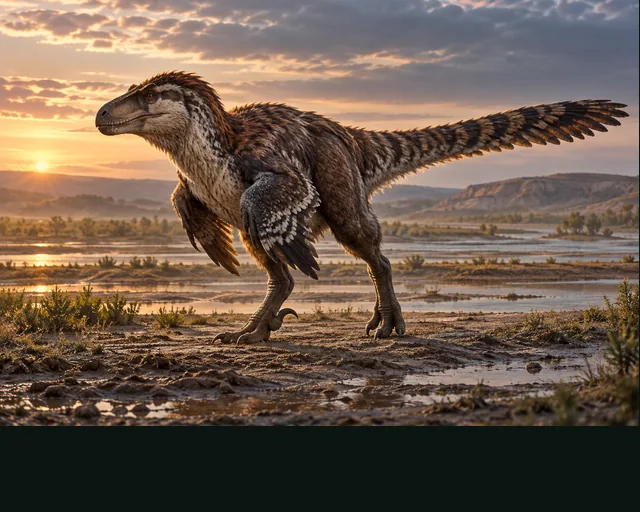
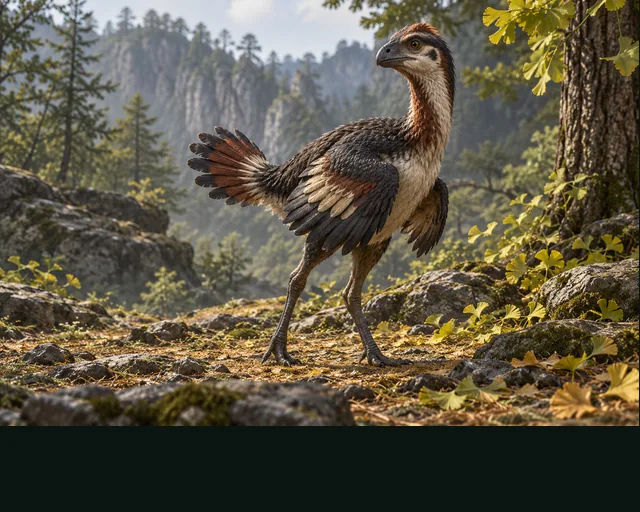
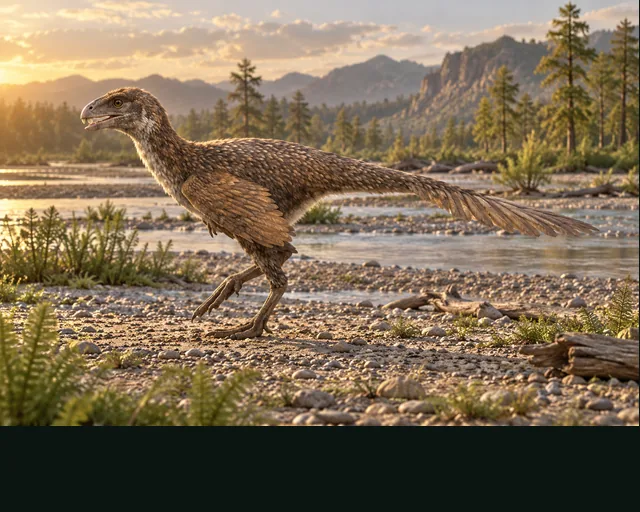
Avimimus was a small, light animal about 1.5 metres long. Its skull was small compared with the body, but its brain case and eyes were large. It had a long, slender neck, short arms and very long, slender legs with narrow three-toed feet, a build that suggests a fast runner. The hand bones were fused together, as in living birds. The hips were unusually broad.
A ridge on the forearm was once read as the anchor point of feather quills, and Kurzanov thought the animal might have flown weakly. Feathers are now widely accepted, but most palaeontologists do not think Avimimus could fly.
Is Avimimus a bird?
No. Kurzanov once argued that Avimimus, not Archaeopteryx, was close to the ancestor of modern birds, but later analyses did not support him. Most scientists place it among the oviraptorosaurs, a bird-like group of non-avian dinosaurs. Opinions differ on the details: it was first given a family of its own, Avimimidae, but some recent studies place it inside the oviraptorids. Compare it with Caudipteryx, another feathered oviraptorosaur.
The diet is also uncertain. Its small teeth, or perhaps lack of them, suggest it ate plants or both plants and animals, though Kurzanov believed it ate insects.
Where and when Avimimus lived
The Nemegt Formation is Maastrichtian in age, near the end of the Cretaceous. It preserves a floodplain, with seasonal rain, that has been compared with the Okavango Delta today. There Avimimus shared its world with the tyrannosaurid Tarbosaurus and the hadrosaurid Saurolophus. The two species come from different layers of the formation.
Classification and fossil record
The Paleobiology Database taxonomic record catalogues Avimimus under Oviraptorosauria. This is the immediate parent in that catalogue, rather than a complete list of evolutionary relationships.
The corroborated occurrence sample includes Mongolia; those are modern discovery locations, not a complete ancient geographic range.
The sourced length estimate for Avimimus is about 1.5 metres. This is an estimate for the reconstructed animal, not a measurement shared by every individual. See the body-size discussion and linked evidence for context.
Research starting point
The catalogue links Avimimus to Kurzanov, 1981, published in Fossil Reptiles of Mongolia. Sovmestnaya Sovetsko-Mongol’skaya Paleontologicheskaya Ekspeditsiya, Trudy [The Joint Soviet-Mongolian Paleontological Expedition, Transactions]. This identifies a research starting point; the catalogue’s citation alone does not verify every later reconstruction or species assignment.
For the meaning of taxonomic terms and how evidence is checked, see the glossary and editorial policy.
Quick answers
- Is Avimimus a dinosaur?
- Yes. Avimimus was a small, bird-like theropod dinosaur, but it was not a bird. It belongs to the oviraptorosaurs and lived in what is now Mongolia.
- What does Avimimus mean?
- The name means "bird mimic", because Avimimus had many bird-like features, such as fused hand bones and long, slender legs.
- How big was Avimimus?
- About 1.5 metres long, according to both the Natural History Museum and other published descriptions. It was lightly built with long legs.
- Could Avimimus fly?
- Probably not. Kurzanov thought it might fly weakly, based on a ridge on the forearm, but most palaeontologists now doubt that, although feathers are widely accepted.
- What did Avimimus eat?
- Uncertain. Its small teeth, or lack of teeth, suggest plants or a mixed diet, while the describer thought it ate insects.