Jurassic Dinos editorial · Updated · Source-based review
What is Erlikosaurus?
Erlikosaurus was a Late Cretaceous Mongolian therizinosaur known especially from an informative skull.
Distinctive features and evidence
The skull from the Bayan Shireh Formation helps investigate beak and tooth function in a group often represented by incomplete heads. Body reconstructions require comparisons because much of its postcranial skeleton remains poorly documented.
Genus overview and research references.
Erlikosaurus fossil discoveries
Erlikosaurus is known from one specimen, found in 1972 by a Soviet-Mongolian expedition at the Bayshin Tsav locality in the Bayan Shireh Formation of Mongolia’s Ömnögovi Province. The specimen, catalogued as MPC-D 100/111, includes an exceptionally well-preserved skull, an almost complete right foot, an almost complete left upper arm bone and a few neck vertebrae that were never illustrated.
The genus was named in 1980 by Altangerel Perle and Rinchen Barsbold, after the demon king Erlik of Turko-Mongolian mythology. The species name andrewsi honours the explorer Roy Chapman Andrews. Perle published the name again in 1981 with the spelling Erlicosaurus, but the original spelling is the one widely accepted. At the time, it was the only known therizinosaur with a complete skull, and it is still the most completely known skull in the group.
How big was Erlikosaurus?
Because most of the skeleton is missing, any size is an estimate. The skull is about 25 centimetres long, which points to a small member of its family, and the estimated length is nearly 3.4 metres, the figure the Natural History Museum also uses. For body mass, Stephan Lautenschlager and colleagues estimated in 2012 a range of 150 to 250 kilograms, using regression because the thigh bone is unknown.
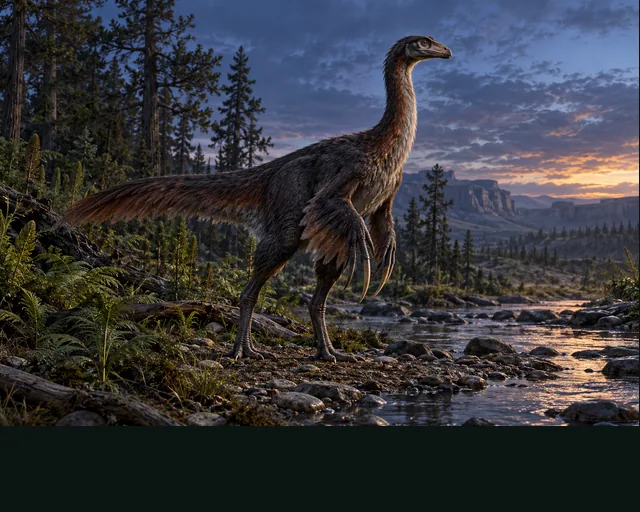
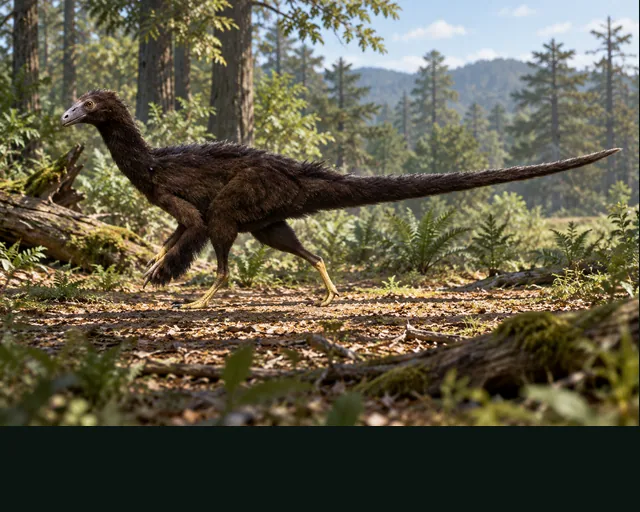
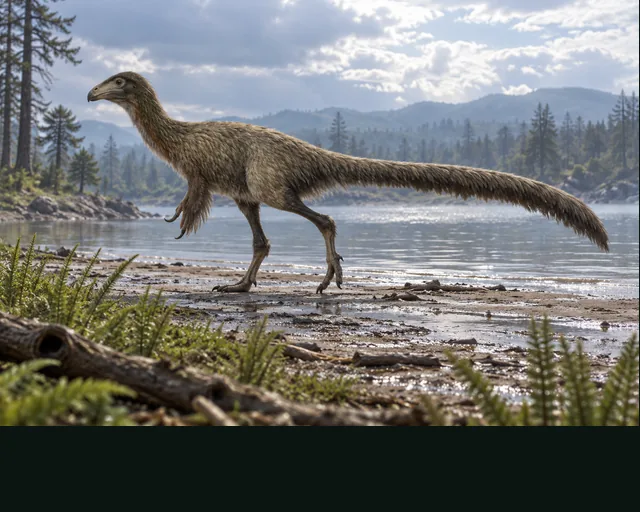
Other estimates are higher, up to about 4.5 metres and 500 kilograms, and one suggestion reached 6 metres. So the animal’s true size is uncertain. Feathers have been found on some relatives, so scientists think Erlikosaurus was probably feathered too, but none have been found on it.
What did Erlikosaurus eat?
Erlikosaurus is interpreted as a plant-eater, although the Natural History Museum lists it as an omnivore. Its snout bore a horny beak, inferred from small channels in the skull bone that supplied blood and nerves, and behind it the jaws held small teeth with coarse serrations, sockets for 24 teeth in the upper jaw bone and 31 in the lower.
Bite-force models gave a weak bite, roughly 50 to 120 newtons in a 2016 study. Researchers think it stripped soft leaves and plant matter with the beak and neck muscles, then relied on a large gut, which therizinosaurs are thought to have had, to digest it. Its mouth could open to about 43 degrees, a narrow gape compared with meat-eating theropods. These are model-based inferences, not direct evidence of meals.
Is Erlikosaurus a therizinosaur?
Yes. Erlikosaurus is a therizinosaurid, a plant-eating theropod. Early therizinosaur finds were so strange that they were read as turtle-like animals or as relatives of prosauropods, until the skull of Erlikosaurus and newly found genera such as Alxasaurus, and the feathered Beipiaosaurus, made the theropod link clear. A 2019 analysis placed it near Nothronychus.
It shared its habitat with the larger Segnosaurus, but their jaws differ, which suggests the two species used different food sources. A 2010 proposal that Erlikosaurus was the same animal as Enigmosaurus, known only from the hip, was disputed, partly because the two come from different levels of the formation.
Where and when Erlikosaurus lived
Erlikosaurus lived in Mongolia in the Late Cretaceous. Dating of the Bayan Shireh Formation, using minerals in the rock, gave roughly 96 to 90 million years ago with wide error margins, and the Natural History Museum gives 99 to 89 million years ago. The specimen came from near the top of the formation.
The area was a semi-arid landscape of meandering rivers and lakes. It was home to other theropods such as Achillobator and Garudimimus, armoured dinosaurs such as Talarurus, and turtles and crocodile relatives.
Classification and fossil record
The Paleobiology Database taxonomic record catalogues Erlikosaurus under Therizinosauria. This is the immediate parent in that catalogue, rather than a complete list of evolutionary relationships.
The corroborated occurrence sample includes Mongolia; those are modern discovery locations, not a complete ancient geographic range.
The sourced length estimate for Erlikosaurus is about 3.4 metres. This is an estimate for the reconstructed animal, not a measurement shared by every individual. See the body-size discussion and linked evidence for context.
Research starting point
The catalogue links Erlikosaurus to Barsbold and Perle, 1980, published in Acta Palaeontologica Polonica. This identifies a research starting point; the catalogue’s citation alone does not verify every later reconstruction or species assignment.
For the meaning of taxonomic terms and how evidence is checked, see the glossary and editorial policy.
Quick answers
- Is Erlikosaurus a dinosaur?
- Yes. Erlikosaurus was a therizinosaur, a plant-eating theropod dinosaur from the Late Cretaceous of Mongolia.
- What does Erlikosaurus mean?
- It means "Erlik's lizard", after Erlik, a demon king in Turko-Mongolian mythology. The species name honours the explorer Roy Chapman Andrews.
- How big was Erlikosaurus?
- It was a small therizinosaur, estimated at nearly 3.4 metres long and 150 to 250 kilograms. Other estimates are larger because most of the skeleton is missing.
- What did Erlikosaurus eat?
- Studies of its beak, teeth and jaw strength suggest it stripped and cropped plants, but the Natural History Museum lists it as an omnivore, so the diet is an interpretation.
- What has been found of Erlikosaurus?
- One specimen from Mongolia: an excellent skull, an almost complete foot and upper arm bone, and a few neck vertebrae. It has the most complete known therizinosaur skull.