Jurassic Dinos editorial · Updated · Source-based review
What is Falcarius?
Falcarius was an early therizinosaur from Utah’s Early Cretaceous Cedar Mountain Formation.
Distinctive features and evidence
Specimens at different growth stages help trace anatomical variation. It contributes to the transition toward specialized therizinosaurs; recent species reassignment claims need to be linked to the actual supporting studies before being treated as settled.
Genus overview and research references.
Falcarius fossil discoveries
Falcarius is known from an unusually rich pair of bone beds. In 1999 a commercial fossil collector, Lawrence Walker, found bones at the Crystal Geyser Quarry in Grand County, Utah, and told palaeontologist James Kirkland. From 2001 a Utah Geological Survey team began excavating an area of about two acres in the Cedar Mountain Formation.
The quarry held two extensive bone beds with the remains of hundreds, perhaps thousands, of animals. By 2005 more than 2,000 specimens had been dug up, mostly separated bones, and by 2010 the number from the original quarry exceeded 2,700. A minimum of 300 individuals was estimated in 2006. They range from juveniles to fully grown adults. The holotype, the specimen that defines the name, is a partial braincase, and the animal was formally named in Nature in 2005.
How big was Falcarius?
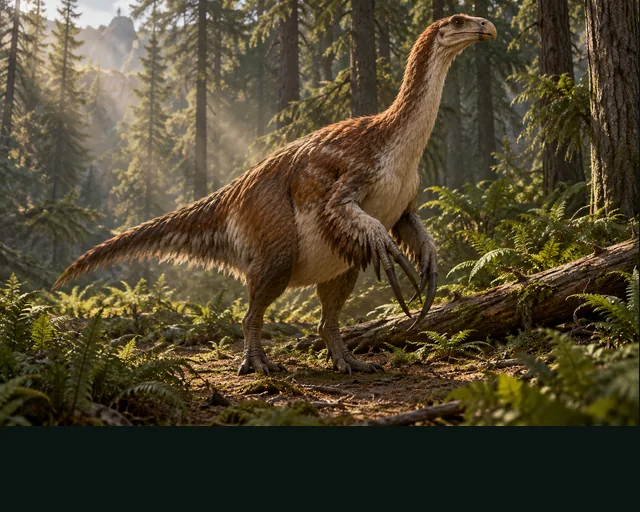
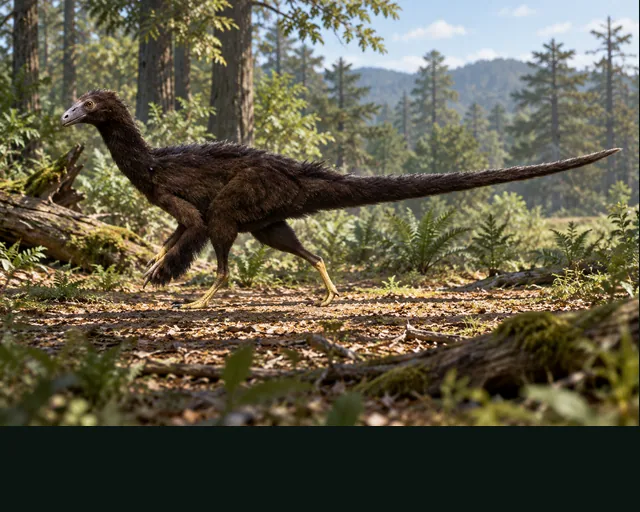
Falcarius was a two-legged plant-eater with a small head and a long neck and tail. Average adults were about 4 to 5 metres long and weighed approximately 100 kilograms, while the smallest known individual was under a metre long. The long neck let it reach about 1.5 metres off the ground, possibly higher.
The hand claws were 10 to 13 centimetres long and are thought to have been used in self-defence, though this is an inference. The legs were relatively long and suited to running. No feathers have been found with Falcarius, but some of its Asian relatives had quill-like ones, so scientists assume it was feathered too.
What did Falcarius eat?
Mostly plants, scientists think. The cheek teeth in the upper jaw were small, leaf-shaped and finely serrated, a shape linked with plant-eating. The five frontmost teeth of the lower jaw were different: longer, straighter and more pointed. These teeth might show a partly omnivorous diet that included small animals, such as lizards, though that remains a suggestion.
The lower jaw held 28 teeth, and the upper jaw at least 16. The 2005 describers saw Falcarius as documenting an early stage in the shift from meat-eating ancestors to plant-eating therizinosaurs.
Why is Falcarius important?
Falcarius is the most basal definite therizinosaur known, meaning it branches off near the base of the group. When it was described in 2005, it provided the first documentation of therizinosaurs in North America during the Early Cretaceous, a group previously known mostly from Asia. It came soon after the feathered Beipiaosaurus from China, named in 1999, which is itself poorly represented.
The skeleton mixes old and new traits. Like typical theropods, it had a long tail, a forward-pointing pubis, a long lower leg and a first toe that did not reach the ground. It also resembled later therizinosaurs, such as Therizinosaurus, in its elongated neck, small head with teeth for plants, sturdier arms with big claws and more upright posture. This is why it is treated as a transitional form.
Is Falcarius suarezarum the same animal as Geminiraptor?
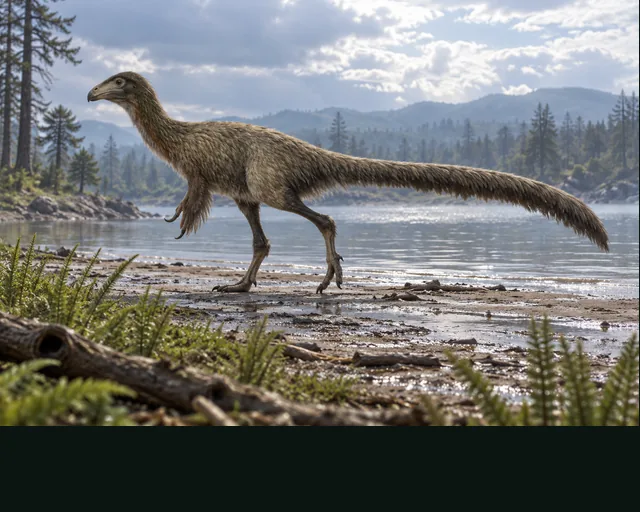
A second species, Falcarius suarezarum, has a complicated history. Phil Senter and colleagues named it Geminiraptor suarezarum in 2010, calling it a troodontid on the basis of a single upper jaw bone from the Cedar Mountain Formation. The name honours twin geologists Marina and Celina Suarez, who found the site. A 2026 reassessment by Freimuth, Lively and Zanno argued, from CT scans showing leaf-shaped replacement teeth and other similarities, that the bone belongs in Falcarius, and the thousands of bones from the Suarez bone bed were tentatively assigned to it.
This is a recent proposal, so it may be tested further. Falcarius utahensis remains the well-established species.
Classification and fossil record
The Paleobiology Database taxonomic record catalogues Falcarius under Therizinosauria. This is the immediate parent in that catalogue, rather than a complete list of evolutionary relationships.
The corroborated occurrence sample includes United States; those are modern discovery locations, not a complete ancient geographic range.
Research starting point
The catalogue links Falcarius to Kirkland and Zanno, 2005, published in Nature. This identifies a research starting point; the catalogue’s citation alone does not verify every later reconstruction or species assignment.
For the meaning of taxonomic terms and how evidence is checked, see the glossary and editorial policy.
Quick answers
- Is Falcarius a dinosaur?
- Yes. Falcarius was an early therizinosaur, a plant-eating theropod dinosaur from the Early Cretaceous of Utah, USA.
- What does Falcarius mean?
- It means "sickle cutter", from the Latin falcarius. The name refers to the large, sickle-like claws on its hands.
- How big was Falcarius?
- Adults were about 4 to 5 metres long and about 100 kilograms. The smallest known individual was under one metre long.
- Why is Falcarius important?
- It is the most basal definite therizinosaur and was the first of the group documented from North America in the Early Cretaceous. It shows features between typical theropods and later therizinosaurs.
- Where was Falcarius found?
- In the Cedar Mountain Formation of eastern Utah. The main site is the Crystal Geyser Quarry in Grand County, where hundreds of individuals have been found.