Jurassic Dinos editorial · Updated · Source-based review
What is Rugops?
Rugops was a Late Cretaceous Nigerien abelisaurid described from a partial skull.
Distinctive features and evidence
Surface pits and skull structure inform interpretations of facial covering. They do not preserve its exact external appearance, and the incomplete material provides a weak basis for a precise full-body size claim.
Genus overview and research references.
Rugops fossil discoveries
Rugops is known from one skull. A University of Chicago expedition led by Paul Sereno collected it in 2000 from sandstone outcrops in Niger, at a site called In-Abangharit beside the Ténéré Desert. The skull is incomplete, lacking parts of the palate and the skull roof, and it is kept at the national museum of Niger.
Sereno, Jeffrey Wilson and Jack Conrad described it in 2004 and gave the species the name Rugops primus. The species name, Latin for first, refers to the animal being among the earliest abelisaurids with a textured skull. Its small size and unfused nasal bones suggest the individual may not have been fully grown, so adults might have looked somewhat different.
How big was Rugops?
The skull is about 31.5 centimetres long, but there is no skeleton, so the body size is an estimate. Published figures range from about 4.4 metres to 6 metres long, and the Natural History Museum lists about 7 metres. Weight estimates are also uncertain, from around 410 to 750 kilograms in different studies.
The spread is a reminder that scientists are scaling from a single skull. Treat all of them as rough guides rather than measurements.
What did the wrinkled skull of Rugops look like?
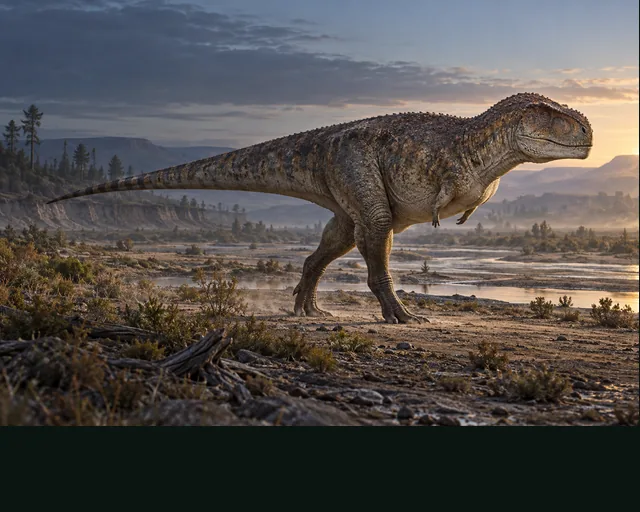
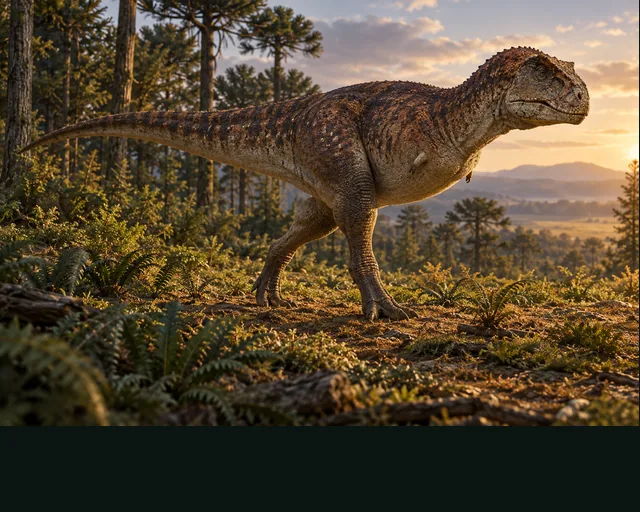
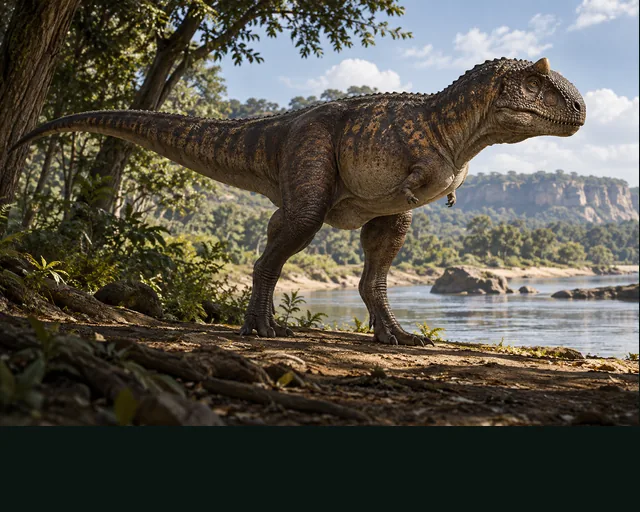
The top of the snout carries a row of pits, with channels that led blood vessels into them. The original description proposed that they anchored sensory tissue or display structures, and the museum notes the holes may point to some kind of crest. A later study by Delcourt in 2018 read them differently, as marks left by a covering of scales, like those on living crocodiles and lizards.
The very tip of the snout has a bumpy texture that suggests a tough, armour-like skin. Delcourt even suggested this could be linked to low-impact head-butting, as seen in marine iguanas, but that is a hypothesis, not an observed behaviour.
Is Rugops an abelisaurid?
Yes. Rugops belongs to Abelisauridae, a group of short-faced, often horned or crested theropods that includes Carnotaurus and Majungasaurus. The original study placed it as the most primitive known abelisaurid, and several later analyses agree. Others put it a little higher in the family tree, so its exact position is still debated.
A jaw bone from Morocco shares some traits with Rugops, but it cannot be assigned to it, because the features that define the genus are on other parts of the skull. A jaw from Patagonia also shows a very similar pattern of surface ornament.
Where and when Rugops lived
Rugops comes from the Echkar Formation of Niger, a river and lake deposit laid down in humid to semi-arid conditions. Authors disagree on whether the formation is early Cenomanian, around 95 million years old, or late Albian, about 100 million years old. Neighbours included the huge predators Spinosaurus and a relative of Carcharodontosaurus, plus a rebbachisaurid and a titanosaur sauropod, none of which have been named.
Classification and fossil record
The Paleobiology Database taxonomic record catalogues Rugops under Abelisauridae. This is the immediate parent in that catalogue, rather than a complete list of evolutionary relationships.
Discovery and naming history
Paul Sereno, Jeffery Wilson and Jack Conrad described Rugops in 2004. Its skull supplies the anatomical basis of the account; behaviors inferred from the skull’s surface texture remain interpretations rather than directly preserved actions. Historical overview.
The corroborated occurrence sample includes Niger; those are modern discovery locations, not a complete ancient geographic range.
Research starting point
The catalogue links Rugops to Sereno and Wilson, 2004, published in Proceedings of the Royal Society of London B. This identifies a research starting point; the catalogue’s citation alone does not verify every later reconstruction or species assignment.
For the meaning of taxonomic terms and how evidence is checked, see the glossary and editorial policy.
Quick answers
- Is Rugops a dinosaur?
- Yes. Rugops was a theropod dinosaur belonging to the abelisaurid family, known from a single partial skull found in Niger.
- When did Rugops live?
- Rugops lived in the Late Cretaceous during the Cenomanian age, roughly 95 to 100 million years ago, though the exact age of its rock formation is debated.
- How big was Rugops?
- Estimates range from about 4.4 to 6 metres long, with the Natural History Museum listing about 7 metres. The skull is only about 31.5 centimetres long, so size is uncertain.
- Is Rugops an abelisaurid?
- Yes. Most analyses place Rugops as a very early abelisaurid, though its exact position within the family varies from study to study.
- Where was Rugops found?
- It was found in the Echkar Formation near In-Abangharit on the edge of the Ténéré Desert in Niger, by a University of Chicago expedition in 2000.