Jurassic Dinos editorial · Updated · Source-based review
What is Pelecanimimus?
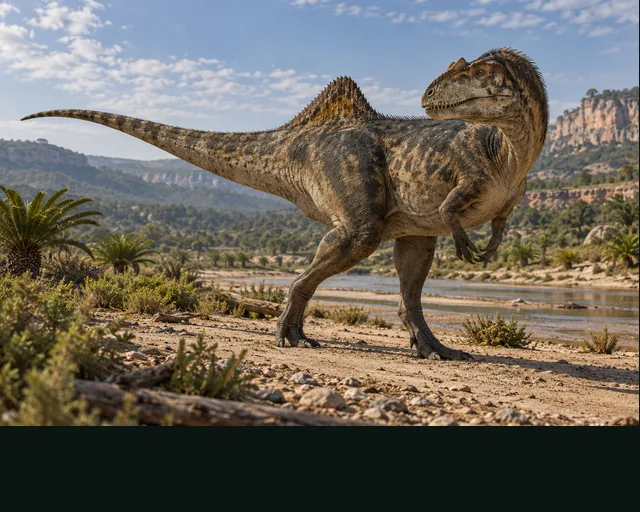
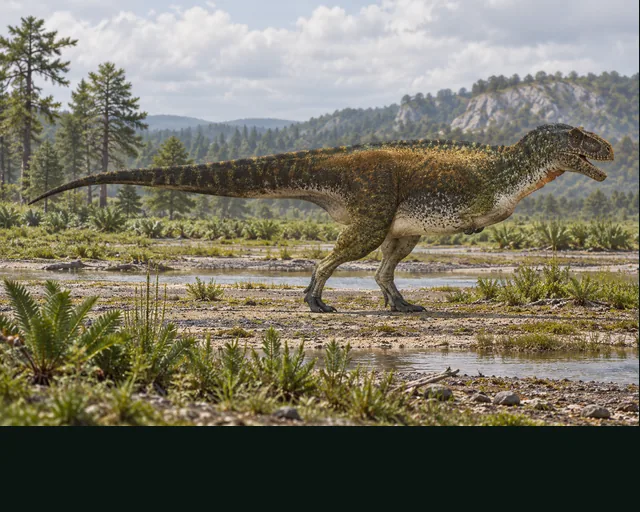
Pelecanimimus was an Early Cretaceous Spanish ornithomimosaur notable for retaining numerous teeth.
Distinctive features and evidence
Its dentition contrasts with the toothless condition familiar in later bird-mimic dinosaurs. This anatomical difference is more informative than assuming a pelican-like lifestyle from the translated name.
Genus overview and research references.
Pelecanimimus fossil discoveries
Armando Díaz Romeral found the only known skeleton in July 1993 at the Las Hoyas fossil site in Cuenca Province, Spain. A team led by Bernardino Pérez-Moreno named it the following year, and the original report in the journal Nature called it the first ornithomimosaur found in Europe.
The specimen, kept at the Museo de Cuenca, is the front half of the animal. It includes the skull and lower jaws, all the neck vertebrae, most of the back vertebrae, ribs, the breastbone, the shoulder girdle and almost all of both arms. It lay in fine-grained limestone at a site famous for exceptional preservation, and traces of skin and other soft parts are visible around the back of the skull, the neck and the arms.
How big was Pelecanimimus?
Pelecanimimus was a small dinosaur. One set of published estimates puts it at roughly 1.9 to 2.5 metres long and 17 to 30 kilograms, and the Natural History Museum gives 2.5 metres. Because only the front half of one animal is known, the tail and legs are reconstructed from relatives, so these figures are approximate.
The skull was long and narrow, about four and a half times as long as it was tall.
Why did Pelecanimimus have so many teeth?
Teeth are the reason Pelecanimimus is famous. The describing team counted more than 200 very small teeth, far more than in any other ornithomimosaur and more than in most theropods. A published breakdown lists about seven teeth in the premaxilla (the front bone of the upper jaw), about thirty in the maxilla behind it and about seventy-five in the dentary (the main bone of the lower jaw). The front teeth were broad, those further back were blade-like, and none had serrations.
Most later members of the group had no teeth at all. Only one other ornithomimosaur, Harpymimus, is known to have teeth, and it had just eleven, all in the lower jaw. Pérez-Moreno and colleagues proposed that a crowd of tightly packed teeth, with no gaps between them, could work like the cutting edge of a beak. On that view the toothless beak of later relatives may have grown out of this arrangement, though this is an interpretation of one skeleton.
Did Pelecanimimus have a throat pouch?
The soft-tissue traces suggest it did. Researchers interpret the impressions around the neck as a pouch of skin under the jaw, similar in kind to a pelican’s but much smaller, and the same fossil shows a small crest of skin or keratin on the back of the head. Some skin patches looked wrinkled, without scales or feathers, and thread-like structures first read as body covering have partly been reinterpreted as muscle fibres.
Reconstructions that give Pelecanimimus a pelican-like or crane-like life, catching fish in shallow water, are suggestions only. The Natural History Museum lists it as a meat-eater, but no stomach contents or direct feeding evidence have been reported.
Is Pelecanimimus an ornithomimosaur?
Yes. Pelecanimimus belongs to Ornithomimosauria, the “bird-mimic” dinosaurs that include Gallimimus and Ornithomimus. Analyses by Kobayashi and Lü in 2003 and by Makovicky and colleagues in 2005 placed it as the most primitive member of the group, even earlier on the family tree than Harpymimus. The name “pelican mimic” refers only to the throat pouch, not to any relationship with pelicans.
Where and when Pelecanimimus lived
Pelecanimimus lived in the Early Cretaceous, in the Barremian stage, in what is now central Spain. The Natural History Museum gives a range of about 127 to 121 million years ago. Las Hoyas is a lagerstätte, a site famous for exceptional preservation, and it has produced many other animals from the same ecosystem: small early birds such as Iberomesornis, an early mammal called Spinolestes, lizards, salamanders and a pterosaur named Europejara.
Among the other dinosaurs found there are Concavenator, another theropod known from Las Hoyas, bones of Iguanodon from coarser sediments, and a few fragments of a sauropod.
Classification and fossil record
The Paleobiology Database taxonomic record catalogues Pelecanimimus under Ornithomimosauria. This is the immediate parent in that catalogue, rather than a complete list of evolutionary relationships.
The corroborated occurrence sample includes Spain; those are modern discovery locations, not a complete ancient geographic range.
Research starting point
The catalogue links Pelecanimimus to Pérez-Moreno and Sanz, 1994, published in Nature. This identifies a research starting point; the catalogue’s citation alone does not verify every later reconstruction or species assignment.
For the meaning of taxonomic terms and how evidence is checked, see the glossary and editorial policy.
Quick answers
- Is Pelecanimimus a dinosaur?
- Yes. Pelecanimimus was a small theropod dinosaur, an early member of the ornithomimosaurs, or bird-mimic dinosaurs, from the Early Cretaceous of Spain.
- When did Pelecanimimus live?
- Pelecanimimus lived in the Barremian stage of the Early Cretaceous, roughly 127 to 121 million years ago according to the Natural History Museum.
- How big was Pelecanimimus?
- It was small, with published estimates of roughly 1.9 to 2.5 metres in length and 17 to 30 kilograms. Only the front half of one skeleton is known.
- Is Pelecanimimus an ornithomimosaur?
- Yes. Analyses place it as the most primitive known ornithomimosaur, earlier on the family tree than Harpymimus and the toothless ornithomimids.
- Why is Pelecanimimus called a pelican mimic?
- The name refers to a throat pouch that researchers interpret from soft-tissue impressions on the fossil. It does not mean Pelecanimimus was related to pelicans.
- Where was Pelecanimimus found?
- Pelecanimimus was found at the Las Hoyas fossil site in Cuenca Province, Spain, in limestone of the La Huérguina Formation.