Jurassic Dinos editorial · Updated · Source-based review
What is Harpymimus?
Harpymimus was an Early Cretaceous Mongolian ornithomimosaur that retained teeth in its lower jaw.
Distinctive features and evidence
Its dentition contrasts with the toothless beaks of more specialized bird-mimic dinosaurs. That contrast helps trace anatomical change without making every ornithomimosaur follow the same diet.
Genus overview and research references.
Harpymimus fossil discoveries
A Soviet-Mongolian expedition found the Harpymimus skeleton in the Gobi Desert in 1981. Rinchen Barsbold and Altangerel Perle named it in 1984 and gave a short description. The species name, okladnikovi, honours the Soviet archaeologist Alexey Okladnikov. The type specimen, catalogued as IGM 100/29, is an almost complete and articulated skeleton that was flattened by burial. Missing parts include portions of the shoulder girdle, the hips and the hindlimbs, and the skull is nearly complete but badly crushed.
It was recovered in the Dundgovi province of eastern Mongolia from the Shinekhudag Formation, now regarded as part of the Khuren Dukh Formation and dated to the middle to late Albian. Another dinosaur collected from that formation is the ceratopsian Psittacosaurus mongoliensis. A full description came much later, in a dissertation by Yoshitsugu Kobayashi in 2004 and a paper by Kobayashi and Barsbold in 2005.
Why does Harpymimus matter? Teeth in a bird-mimic
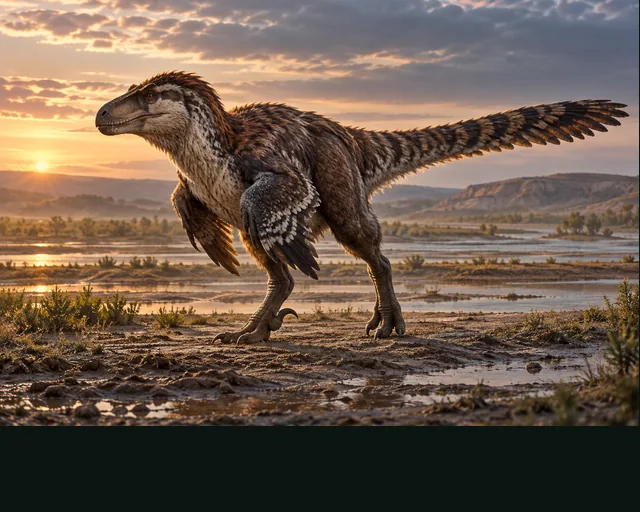
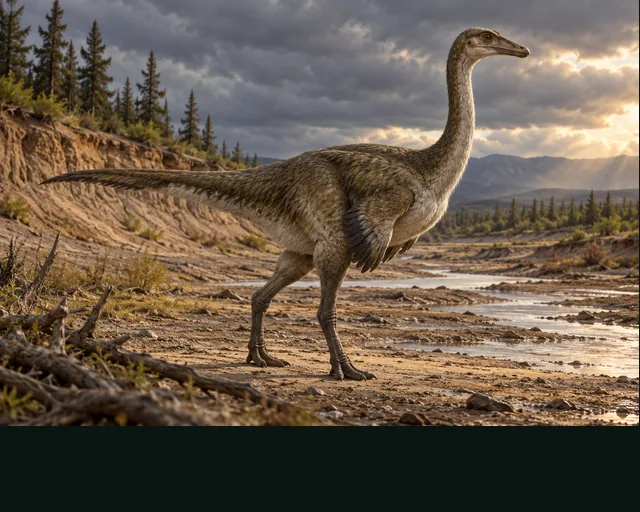
Most ornithomimosaurs, the group of bird-mimic theropods, had no teeth. Harpymimus did, and only one other known member of the group, Pelecanimimus, shares that trait. In Harpymimus the teeth were small, cylindrical and confined to the lower jaw, with at least ten and perhaps eleven on each side, separated by bony plates. Pelecanimimus had many more, about 75 in each lower jaw plus extra teeth in the upper jaw. Harpymimus probably used its teeth just for grasping and holding food rather than for slicing or piercing prey.
There was probably also a beak on the upper jaw. Overall the body looked much like that of its later relatives: a long neck, long limbs and sharp claws on the hands for grasping. Primitive features include a very short first hand bone and a foot whose middle bone was not squeezed out of the front of the foot. The skull was about 26 centimetres long, and one estimate puts the body weight above about 146 kilograms.
How is Harpymimus related to other ornithomimosaurs?
Harpymimus was first placed in its own family, Harpymimidae. In their 2005 analysis, Kobayashi and Barsbold found it to be a primitive ornithomimosaur: more advanced than Pelecanimimus but earlier in the family tree than a branch containing Garudimimus and the ornithomimids. They also suggested that ornithomimosaurs began in eastern Asia or Europe before the Barremian and later spread to North America.
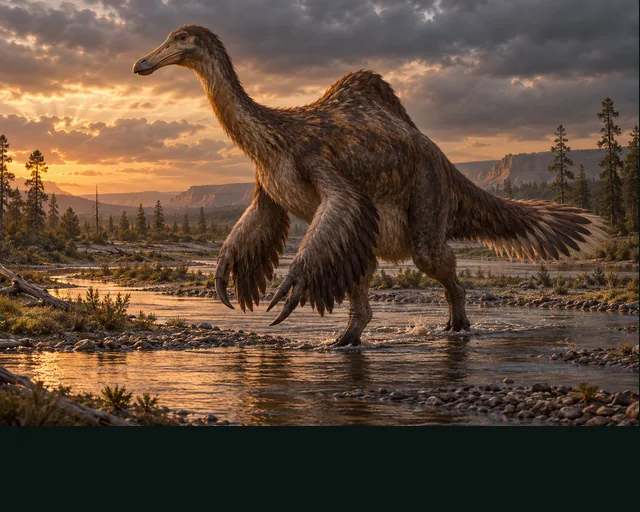
A 2020 analysis that included the new genus Paraxenisaurus instead recovered Harpymimus as an early member of Deinocheiridae, the family that includes Deinocheirus, which is how the Paleobiology Database catalogues it. Where it sits therefore depends on which analysis is used, and the question is not fully settled.
Where and when Harpymimus lived
Harpymimus is an Early Cretaceous dinosaur, from the Albian stage. Date ranges in sources differ: the Paleobiology Database places it at roughly 110 to 100.5 million years ago, while the Natural History Museum gives a broader span from about 121 to 99 million years ago, so no single date is claimed here. The only known specimen comes from eastern Mongolia.
Classification and fossil record
The Paleobiology Database taxonomic record catalogues Harpymimus under Deinocheiridae. This is the immediate parent in that catalogue, rather than a complete list of evolutionary relationships.
The corroborated occurrence sample includes Mongolia; those are modern discovery locations, not a complete ancient geographic range.
Research starting point
The catalogue links Harpymimus to Barsbold and Perle, 1984, published in Paleontological Journal. This identifies a research starting point; the catalogue’s citation alone does not verify every later reconstruction or species assignment.
For the meaning of taxonomic terms and how evidence is checked, see the glossary and editorial policy.
Quick answers
- Is Harpymimus a dinosaur?
- Yes. Harpymimus was a theropod dinosaur, a primitive ornithomimosaur or bird-mimic dinosaur from the Early Cretaceous of Mongolia.
- Did Harpymimus have teeth?
- Yes, small ones, but only in the lower jaw. Most later ornithomimosaurs lost their teeth and had beaks instead, Harpymimus is one of only two known members of the group that kept teeth.
- How big was Harpymimus?
- The Natural History Museum lists about 2 metres in length, and one published estimate puts the weight above roughly 146 kilograms. Both come from a single skeleton.
- Is Harpymimus a deinocheirid?
- Possibly. A 2020 study placed it in Deinocheiridae, but earlier analysis put it on a separate branch, so its exact position is unsettled.
- Where was Harpymimus found?
- In the Dundgovi province of eastern Mongolia, in rocks now assigned to the Khuren Dukh Formation, from an expedition in 1981.