Jurassic Dinos editorial · Updated · Source-based review
What is Garudimimus?
Garudimimus was a Late Cretaceous Mongolian ornithomimosaur initially described from a single specimen.
Distinctive features and evidence
A comprehensive redescription reconsidered several earlier anatomical interpretations. The distinction between published material and additional undescribed remains matters when judging how complete the genus’s record actually is.
Genus overview and research references.
Garudimimus fossil discoveries
Garudimimus is known from one skeleton. A Soviet-Mongolian expedition found it in 1981 at Bayshin Tsav, a site in the Gobi region of southeastern Mongolia, and Rinchen Barsbold described it briefly in the same year. The specimen is catalogued as MPC-D 100/13 and is fairly complete for a theropod: it includes the whole skull, vertebrae from the neck, back, hips and tail, parts of the pelvis, the leg bones and a nearly complete left foot.
The bones show that this animal was still growing. Several vertebrae had not yet fused, so the skeleton is probably from a sub-adult, and a fully grown Garudimimus could have looked somewhat different.
Other ornithomimosaur bones come from the same area, including a bone bed with at least five individuals at Bayshin Tsav, but these have not been fully described. They may include more Garudimimus, though that has not been shown.
How big was Garudimimus?
Estimates differ. One published estimate puts the single skeleton at nearly 3.5 metres long, while the Natural History Museum’s Dino Directory lists 4.7 metres. Since both come from one sub-adult skeleton, it is safest to say that Garudimimus was a medium-sized, long-legged theropod of roughly three to five metres.
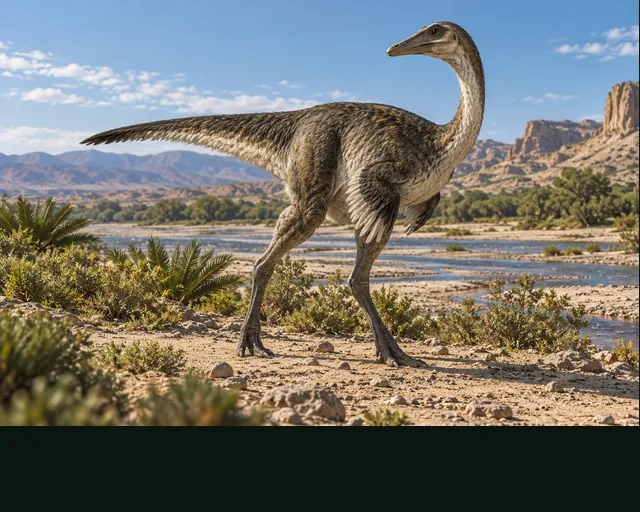
The skull was small compared with the body, about 25 centimetres long. The eye socket was a large opening, about 6 centimetres high, and the nostrils were long and turned upwards.
Why did Garudimimus have no teeth?
Both the upper and lower jaws were toothless. The tips of the jaws had many tiny holes for nerves and blood vessels and had sharp, thin edges, which scientists take as a sign of a horny beak like that of a bird. A beak could have been used to pluck and nip off food.
In 2015 Andrew Cuff and Emily Rayfield reconstructed the jaw muscles of Garudimimus and two ornithomimids in a computer study. Garudimimus came out with the weakest bite of the three, so they suggested that ornithomimosaurs held plant material in the beak and pulled it away with neck muscles rather than crushing it. A separate 2019 comparison of skull mechanics also placed Garudimimus with animals that depended on processing food later in the gut rather than in the mouth. Because the evidence comes from skull shape and models, the diet is usually described as plants or a mixture of plants and other food, not as a confirmed menu.
Is Garudimimus an ornithomimosaur or a deinocheirid?
Garudimimus is an ornithomimosaur, a group of toothless, long-legged theropods sometimes called bird-mimic dinosaurs. It mixes features of early and later members. Like the more advanced ornithomimids it had no teeth, but unlike them it still had a small first toe on each foot, giving it four toes, and its legs were short and stocky rather than built for speed.
How it fits within the group is debated. Barsbold first placed it in its own family, Garudimimidae. After new Deinocheirus skeletons were described in 2014, a large analysis grouped Garudimimus with Deinocheirus in the family Deinocheiridae, which is the placement that the Paleobiology Database uses. A 2019 analysis instead found Deinocheirus near the base of the ornithomimosaur family tree and Garudimimus in a more advanced position, and a 2020 study recovered the two as close relatives again. Harpymimus, which kept some teeth, is another early Mongolian relative.
Garudimimus: horn and foot mistakes corrected
This genus is a good example of how early interpretations can change. In 1988 an illustrator showed Garudimimus with a prominent horn on the snout, and other authors described a crest. A full redescription by Yoshitsugu Kobayashi and Barsbold in 2005 showed that the supposed horn was simply the left prefrontal bone, a bone near the front of the eye socket, that had slipped out of position after death.
Some researchers had also reconstructed its foot as arctometatarsalian, meaning that the upper end of the middle foot bone was pinched between its neighbours, and a few even assigned foot bones to other dinosaurs. The 2005 study found that the foot was not distorted and did not have this pinched structure. Any reconstruction of Garudimimus today should therefore show a smooth, beaked head.
Where and when Garudimimus lived
Garudimimus lived in the Late Cretaceous in the Bayan Shireh Formation, rock laid down by meandering rivers and lakes on a plain with a semi-arid climate. Turtles and crocodile relatives from the same formation show that there was permanent water. Published dates for the formation are broad. One radiometric study gave an age of about 95.9 to 89.6 million years ago, while the Paleobiology Database lists Garudimimus between about 93.9 and 83.6 million years ago, and the Natural History Museum gives roughly 99 to 89 million years ago. Because these ranges differ, this page does not give a single date.
Garudimimus shared its world with other dinosaurs such as the dromaeosaurid Achillobator, therizinosaurs like Erlikosaurus and Segnosaurus, and plant-eaters including the armoured Talarurus.
Classification and fossil record
The Paleobiology Database taxonomic record catalogues Garudimimus under Deinocheiridae. This is the immediate parent in that catalogue, rather than a complete list of evolutionary relationships.
The corroborated occurrence sample includes Mongolia; those are modern discovery locations, not a complete ancient geographic range.
Research starting point
The catalogue links Garudimimus to Barsbold, 1981, published in Sovmestnaia Sovetsko-Mongol’skaia Paleontologicheskaia Ekspeditsiia Trudy. This identifies a research starting point; the catalogue’s citation alone does not verify every later reconstruction or species assignment.
For the meaning of taxonomic terms and how evidence is checked, see the glossary and editorial policy.
Quick answers
- Is Garudimimus a dinosaur?
- Yes. Garudimimus was a theropod dinosaur, a toothless, beaked member of the ornithomimosaur group that lived in what is now Mongolia.
- When did Garudimimus live?
- It lived in the Late Cretaceous. Dating of its rock formation varies between studies, but most estimates fall roughly between 99 and 84 million years ago.
- How big was Garudimimus?
- Sources give about 3.5 to 4.7 metres in length. The only skeleton belongs to a sub-adult with an incomplete tail, so the true adult size is uncertain.
- What did Garudimimus eat?
- Its toothless beak and weak bite suggest it ate plants or a mix of plants and other food. No stomach contents have been found, so this is an anatomical inference.
- Did Garudimimus have a horn?
- No. Older drawings showed a horn on the snout, but a 2005 redescription showed it was a displaced prefrontal bone from the eye region.