Jurassic Dinos editorial · Updated · Source-based review
What is Gigantoraptor?
Gigantoraptor was a large Late Cretaceous Inner Mongolian oviraptorosaur with a toothless lower jaw and elongated limbs.
Distinctive features and evidence
Its skeleton shows that oviraptorosaurs were not restricted to small-bodied forms. Feathered relatives do not establish exactly how much plumage covered this much larger animal, and its beak does not settle every aspect of feeding.
Genus overview and research references.
Gigantoraptor fossil discoveries
The first Gigantoraptor bone was found by accident. In 2005 the Chinese palaeontologist Xu Xing was being filmed at a quarry in Inner Mongolia where the sauropod Sonidosaurus had been found, and he dug out a thigh bone for the camera. When it was cleaned, he realised it did not come from a long-necked sauropod but from a very large theropod. Xu and colleagues named Gigantoraptor erlianensis in 2007, after the Erlian basin.
The type specimen is a single, incomplete and disarticulated skeleton. It includes a nearly complete lower jaw, some vertebrae, parts of the shoulder, arm, hand and hip, and both leg bones with a very complete foot, but no skull. In 2015 a large jaw fragment from the Bayan Shireh Formation was reported that closely resembles the Gigantoraptor jaw. Its describers called it an indeterminate caenagnathid because it was incomplete, although later authors suggested it might be another Gigantoraptor.
How big was Gigantoraptor?
Gigantoraptor is the largest oviraptorosaur known from skeletal remains. The skeleton suggests a length of about 8 metres, with a hip height of around 3.5 metres, and one study estimated 8.6 metres. Mass estimates range from about 1.4 to 2 tonnes. These figures are estimates scaled from an incomplete skeleton.
That is roughly three times the length of Citipati, the biggest oviraptorosaur known earlier. Both the thigh bone and shin bone are more than one metre long, which is unusual for such a large theropod, and the long bones of its arms were also proportionally long. Many bones, especially the vertebrae, were hollowed by air spaces, which probably reduced weight.
Did Gigantoraptor have feathers?
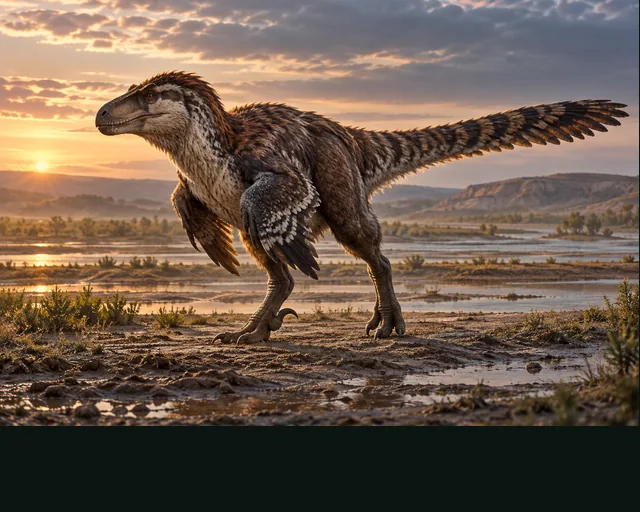
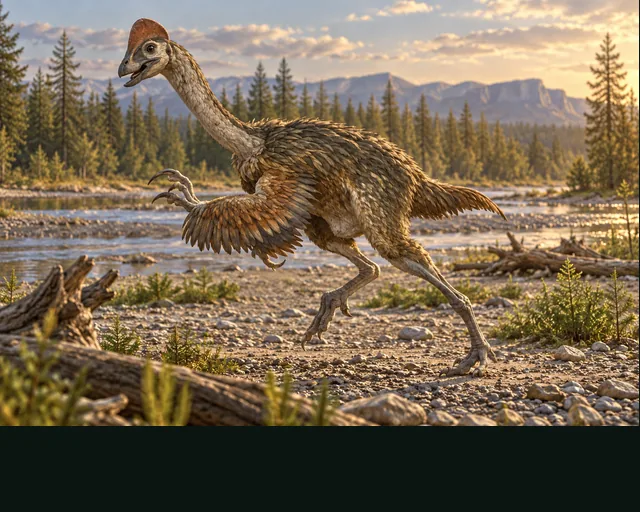
No feathers have been found with the only Gigantoraptor skeleton. Smaller relatives such as Caudipteryx are known with feathers, so Gigantoraptor probably had some, but its size is an open question. Xu’s team suggested that it may have lost much of its body covering, because very large animals keep heat more easily, while the arms may still have carried feathers for display or for covering eggs. The Natural History Museum notes plainly that we do not know whether Gigantoraptor had feathers.
What did Gigantoraptor eat?
The jaws are the main clue. They are toothless, very deep and rounded at the front, with sharp shelves along the top edges and signs of a horny beak. A 2017 study suggested that the jaw joint allowed a forward-and-back sliding motion, which could have produced a shearing bite for cutting plants and perhaps meat. The broad snout led the authors to propose a non-selective feeder.
So most descriptions say omnivore or herbivore, with occasional meat possible. It is an inference from the shape of the lower jaw only, since no skull or stomach contents are known.
Growth, eggs and where Gigantoraptor lived
A study of the leg bone’s growth rings in 2007 indicated that the individual died at about 11 years old and was still a young adult, suggesting faster growth than in many other large theropods. Very large oviraptorosaur eggs, laid in rings about three metres across, have been linked to giant relatives of this kind, and in 2018 researchers proposed that an animal of this size sat in the empty centre of the ring, which could have avoided crushing the eggs. That is a hypothesis, not an observation.
Gigantoraptor lived in the Iren Dabasu Formation, a river valley with floodplains under a semi-arid climate. The formation’s age is uncertain: one study dated it to about 95.8 million years ago with a wide margin of error, while other work has suggested a younger age, so no precise date is given here. Neighbours included the ornithomimosaur Archaeornithomimus and the tyrannosauroid Alectrosaurus.
Classification and fossil record
The Paleobiology Database taxonomic record catalogues Gigantoraptor under Caenagnathidae. This is the immediate parent in that catalogue, rather than a complete list of evolutionary relationships.
The corroborated occurrence sample includes China; those are modern discovery locations, not a complete ancient geographic range.
The sourced length estimate for Gigantoraptor is 8–8.6 metres. This is an estimate for the reconstructed animal, not a measurement shared by every individual. See the body-size discussion and linked evidence for context.
Research starting point
The catalogue links Gigantoraptor to Xu and Tan, 2007, published in Nature. This identifies a research starting point; the catalogue’s citation alone does not verify every later reconstruction or species assignment.
For the meaning of taxonomic terms and how evidence is checked, see the glossary and editorial policy.
Quick answers
- Is Gigantoraptor a dinosaur?
- Yes. Gigantoraptor was a giant theropod dinosaur in the oviraptorosaur group that lived in what is now Inner Mongolia, China, in the Late Cretaceous.
- How big was Gigantoraptor?
- Estimates are about 8 to 8.6 metres long and roughly 1.4 to 2 tonnes. These come from one incomplete skeleton, so the figures are approximate.
- Did Gigantoraptor have feathers?
- Unknown. No feathers were found with it. Smaller oviraptorosaurs had feathers, but a giant body may have lost some body covering, so reconstructions are educated guesses.
- What did Gigantoraptor eat?
- Its toothless beaked jaws suggest mostly plants with perhaps occasional meat. Scientists infer this from jaw shape; no stomach contents have been found.
- Is Gigantoraptor an oviraptorid?
- Probably not. It was first described as a primitive oviraptorid, but later analyses place it in the related group Caenagnathidae.