Jurassic Dinos editorial · Updated · Source-based review
What is Muttaburrasaurus?
Muttaburrasaurus was a Cretaceous Australian plant-eating ornithopod named for Muttaburra in Queensland.
Distinctive features and evidence
Its relatively informative remains support anatomical comparison with other ornithopods. Proposed positions in the family tree have changed, so a specific subgroup label should be paired with the analysis that supports it.
Genus overview and research references.
Muttaburrasaurus fossil discoveries
The first skeleton was found in 1963 by a grazier, Doug Langdon, at Rosebery Downs Station beside the Thomson River near Muttaburra. Palaeontologist Alan Bartholomai and entomologist Edward Dahms collected it. After long preparation, Bartholomai and Ralph Molnar named it in 1981 and honoured the finder in the species name langdoni.
The type specimen, QM F6140, comes from the Mackunda Formation and includes parts of the skull and lower jaw, vertebrae, pelvis and limbs. A separate skull found in 1987 at Dunluce Station, from older rock called the Allaru Mudstone, was judged by Molnar to be a different, unnamed species. Teeth and bones from near Hughenden and from Lightning Ridge, where some are opalised, may also belong to the genus. Casts of the skeleton are displayed in several Australian museums, and the animal is Queensland’s official fossil emblem.
How big was Muttaburrasaurus?
A length of about 7 to 8 metres is the usual figure, and the holotype thigh bone is 1,015 millimetres long. Weight estimates have changed a lot. Early figures were around 2.8 tonnes, but a 2020 volume-modelling study suggested roughly 7.9 tonnes, and a 2026 study using limb-bone equations suggested about 8.9 tonnes. Such a spread shows how sensitive weight estimates are to the method used.
What did Muttaburrasaurus eat?
Its powerful jaws carried shearing teeth. In more advanced ornithopods, replacement teeth lined up with the old ones to form a tooth battery, but in Muttaburrasaurus new teeth grew directly beneath the old ones and only one erupted generation was present, which ruled out a chewing motion. In 1981 Molnar speculated that it might have been an omnivore that occasionally ate carrion. By 1995 he preferred the view that the tooth system evolved in parallel with that of horned dinosaurs, for cutting tough plants such as cycads.
A 2026 re-study of the holotype skull suggested a selective feeder with a strong sense of smell. The same study proposed salt glands in the nose, which could fit with eating plants from salty coastal habitats. This is a proposal, not something that has been confirmed.
Did Muttaburrasaurus have a nose crest or a thumb spike?
Earlier reconstructions gave it a hollow bump on the snout that was read as a sound-making chamber or display feature, and a thumb spike. Later work found that the bump is part of a very long premaxilla, the front bone of the upper jaw, and is unlikely to have been a resonating chamber. Molnar himself later doubted the thumb spike.
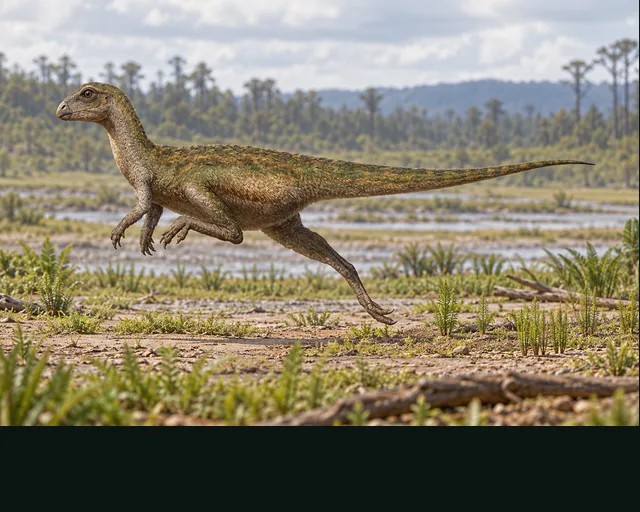
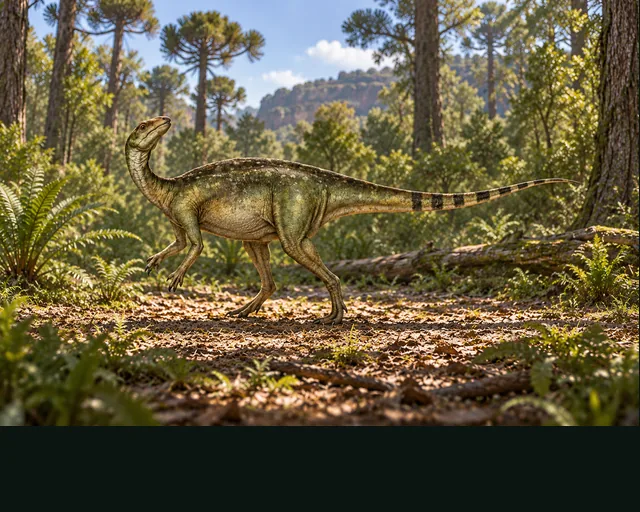
Most evidence points to mainly two-legged walking, backed by short forelimbs and ear-canal shape. Four-legged movement may have been used when moving slowly or browsing. A notable trait is the presence of teeth in the premaxilla, rare in an ornithischian of this size.
Where does Muttaburrasaurus fit in the family tree?
Molnar first placed it among the iguanodontids. Later authors proposed other groups, including camptosaurids (the family of Camptosaurus) and dryosaurids, and studies by Andrew McDonald indicated a place among the rhabdodontids. A 2022 analysis found it to be an early rhabdodontomorph. A 2024 study instead placed it in Elasmaria, a Gondwanan group, and a 2026 redescription suggested it may not even belong to Iguanodontia. The Natural History Museum entry lists it within Iguanodontia, a group of plant-eating ornithopods that you can compare with Iguanodon.
Because the position keeps changing, a label should be linked to the study behind it. The age is also approximate: the type area is estimated at about 96 million years ago, plus or minus about 9 million, from zircon dating, and the Dino Directory gives 110 to 100 million years.
Classification and fossil record
The Paleobiology Database taxonomic record catalogues Muttaburrasaurus under Elasmaria. This is the immediate parent in that catalogue, rather than a complete list of evolutionary relationships.
The corroborated occurrence sample includes Australia; those are modern discovery locations, not a complete ancient geographic range.
The sourced length estimate for Muttaburrasaurus is 7–8 metres. This is an estimate for the reconstructed animal, not a measurement shared by every individual. See the body-size discussion and linked evidence for context.
Research starting point
The catalogue links Muttaburrasaurus to Bartholomai and Molnar, 1981, published in Memoirs of the Queensland Museum. This identifies a research starting point; the catalogue’s citation alone does not verify every later reconstruction or species assignment.
For the meaning of taxonomic terms and how evidence is checked, see the glossary and editorial policy.
Quick answers
- Is Muttaburrasaurus a dinosaur?
- Yes. Muttaburrasaurus was a plant-eating ornithopod dinosaur from Cretaceous Australia, named after the Queensland town of Muttaburra.
- When did Muttaburrasaurus live?
- It lived in the Albian to Cenomanian stages of the Cretaceous. One zircon-based estimate for the type area is about 96 million years ago, with a wide margin of error.
- How big was Muttaburrasaurus?
- It was about 7 to 8 metres long. Weight estimates range from about 2.8 tonnes in early work to roughly 8 to 9 tonnes in recent studies.
- What did Muttaburrasaurus eat?
- It was a plant eater with shearing teeth. Researchers have suggested tough plants such as cycads, and a 2026 study suggested it was a selective feeder.
- Where was Muttaburrasaurus found?
- The type skeleton was found near Muttaburra in Queensland, Australia. Teeth and bones that may belong to it come from Hughenden and Lightning Ridge.