Jurassic Dinos editorial · Updated · Source-based review
What was Leaellynasaura?
Leaellynasaura was a small Early Cretaceous plant-eating dinosaur from southeastern Australia. It is often discussed as a polar dinosaur because the region lay much farther south at the time. Its history also shows why researchers must check which bones truly belong to a named animal.
What makes the fossil distinctive?
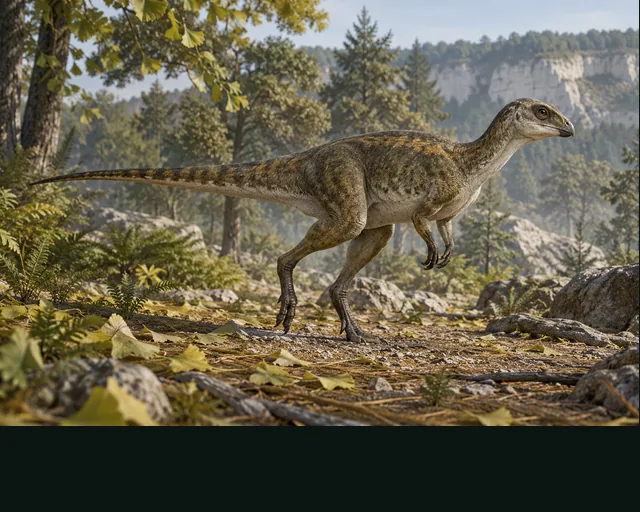
Skull fragments and teeth form the secure basis for identifying Leaellynasaura. More complete, long-tailed skeletons have sometimes been attributed to it, but later reassessment questioned those assignments. As a result, a very long tail in a familiar illustration should not be treated as a settled measurement of the named genus.
Where was it found and how was it named?
The dinosaur was described in 1989 from material associated with Dinosaur Cove in Victoria. The genus honours Leaellyn Rich, daughter of researchers Tom Rich and Patricia Vickers-Rich. Excavation in coastal rock required considerable effort. The species name acknowledges supporters whose contributions helped make the fieldwork possible.
What can we infer, and what remains uncertain?
Living at high latitude would have involved strong seasonal changes in daylight, even though the Cretaceous climate was warmer than the modern polar environment. Large eyes and other possible adaptations have been discussed, but the available skull material limits some interpretations. Do not turn the label polar into proof of hibernation or a coat of fur. The evidence supports a small ornithischian in a southern ecosystem; detailed stories about its daily life must remain distinguishable from that foundation.
Is its extremely long tail certain?
No. Some long-tailed skeletons formerly referred to Leaellynasaura cannot be confidently assigned to it. Reconstructions should distinguish those referrals from securely identified skull material.
How can you check the evidence?
The Paleobiology Database record catalogues Leaellynasaura under Elasmaria. Its linked bibliography identifies this research starting point: T. H. Rich and P. Vickers-Rich. 1989. Polar dinosaurs and biotas of the Early Cretaceous of southeastern Australia. National Geographic Research 5(1):15–53. Open the bibliographic record. A catalogue entry establishes the source trail; it does not independently verify every later illustration or behavioural claim.
Use the dated genus overview to follow the references behind the discovery and anatomy discussed above. When sources disagree, compare which specimen and rock layer each author studied. A reconstructed whole animal can combine original bones with comparisons to relatives; those two kinds of evidence should not be confused. The account above explains the particular limits that matter for Leaellynasaura, rather than supplying unsupported size, speed or lifespan figures.
Read the image and keep exploring
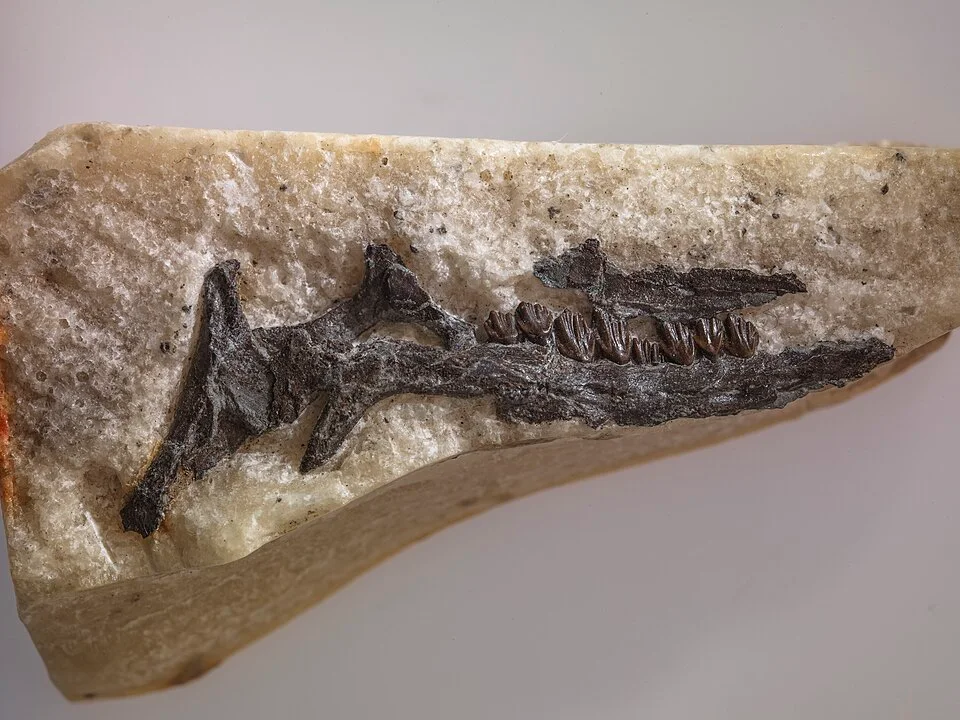
A close view of Leaellynasaura jaw material shows the tooth row; it does not establish a complete body reconstruction. A displayed specimen or skeletal mount can include restored parts. Its appearance should be read alongside the original specimen description.
Compare Hypsilophodon, Dryosaurus, Muttaburrasaurus. Find more names in the L index and explore ornithischian field notes. The glossary explains unfamiliar fossil terms.
Quick answers
- Where have Leaellynasaura fossils been found?
- The discoveries discussed here come from Australia. Modern place names describe discovery locations, not a complete ancient geographic range.
- When did Leaellynasaura live?
- It is placed in the Cretaceous period. See the discovery discussion for qualifications about the particular rock layers and dating.
- Where can I compare Leaellynasaura with related dinosaurs?
- Follow the related field notes below. Comparisons explain shared anatomy; they do not imply that all the animals lived together.