Jurassic Dinos editorial · Updated · Source-based review
What is Minmi?
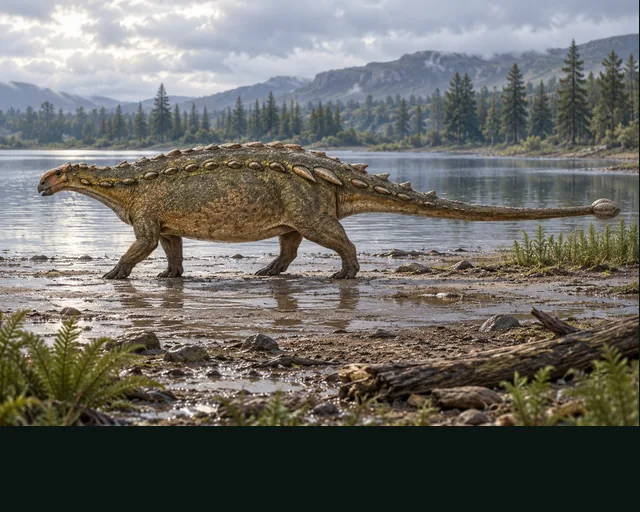
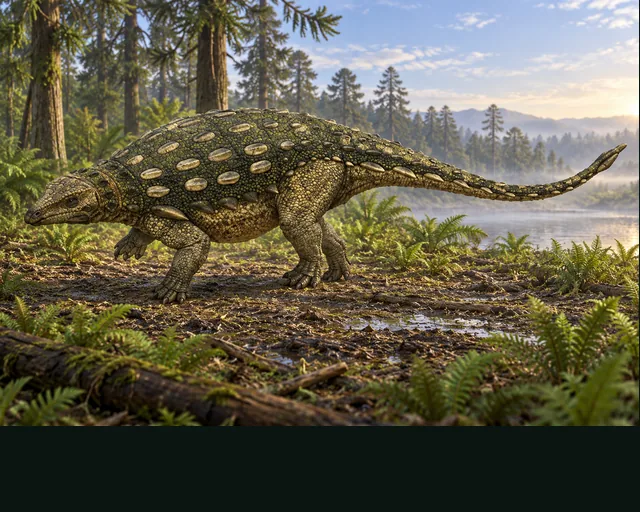
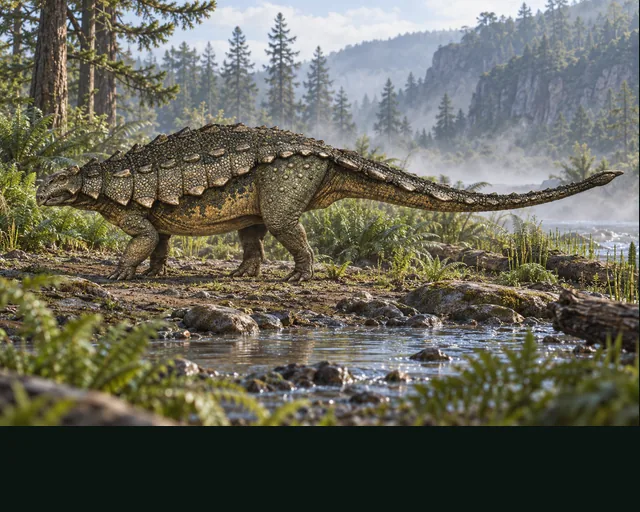
Minmi was a small armored plant-eating dinosaur from Early Cretaceous Australia.
Distinctive features and evidence
Its Australian provenance broadens an ankylosaur comparison beyond northern continents. The short overview supports this introduction, but armor placement, species assignments and adult measurements need more specific sources before expansion.
Genus overview and research references.
Minmi fossil discoveries
In 1964 Alan Bartholomai of the Queensland Museum found a chalky nodule containing an armoured dinosaur skeleton near Minmi Crossing, north of Roma, Queensland. Ralph Molnar named and described Minmi paravertebra in 1980. The species name refers to unusual bony plates running along the sides of the backbone, which he called paravertebrae and which are now understood as ossified tendons.
The type specimen (QM F10329) is a partial skeleton without a skull. It includes eleven back vertebrae, ribs, a right hind leg and plates of belly armour. It was the first thyreophoran, or armoured dinosaur, found in the southern hemisphere. The word ‘minmi’ itself has an uncertain origin: it may be a local Aboriginal word for a big lily, or it may come from ‘min min’, a name for a ghostly will-o’-the-wisp light.
Minmi and Kunbarrasaurus: which skeleton is which?
In 1989 a far more complete skeleton, including the skull and armour still in position, was found and referred to as Minmi sp. For years most books and illustrations were based on this second animal rather than on the incomplete type specimen. In 2015 that skeleton was named as a separate genus, Kunbarrasaurus. So older pictures and descriptions of ‘Minmi’ may really show Kunbarrasaurus, and only the type material and a few other pieces are Minmi proper.
How big was Minmi?
Minmi was small for an armoured dinosaur. Gregory Paul estimated in 2016 that it was about 3 metres long and weighed around 300 kilograms, a figure that is one estimate based on limited remains. It walked on four legs and had relatively long limbs for an ankylosaur, which may have helped it dash for cover in low vegetation, though that is a suggestion rather than something proven.
Is Minmi an ankylosaur?
Molnar placed Minmi in the Ankylosauria in 1980, but where it fits inside the group has changed repeatedly. A 2011 analysis found it to be the most basal ankylosaurid, while a 2024 analysis recovered it as an ankylosaur of uncertain family, and a 2023 analysis placed it outside both ankylosaurs and stegosaurs. For comparison, Ankylosaurus lived in western North America near the very end of the Cretaceous, while Muttaburrasaurus was another Cretaceous Australian plant-eater, an ornithopod rather than an armoured dinosaur.
The name itself was also questioned. In 2015 Arbour and Currie found no feature unique to the type specimen, which would make Minmi a nomen dubium, or doubtful name. The Kunbarrasaurus description found new distinguishing traits, and a 2021 study argued Minmi is distinct, so it is generally treated as valid. The Paleobiology Database still marks it as doubtful.
What did Minmi eat, and where and when did it live?
A 2000 study by Molnar and Clifford concluded that Minmi was a low browser and grazer, feeding on plants close to the ground, such as ferns, seeds, fruit and flowering plants. This is an interpretation of its anatomy, not direct evidence.
The type specimen comes from the Minmi Member of the Bungil Formation, a lagoon deposit in Queensland. It was first dated to the Barremian-Valanginian but was later recalibrated to the Aptian. Overall Minmi is placed in the Early Cretaceous, about 120 to 112 million years ago, depending on the source.
Classification and fossil record
The Paleobiology Database taxonomic record catalogues Minmi under Ankylosauridae. This is the immediate parent in that catalogue, rather than a complete list of evolutionary relationships.
The corroborated occurrence sample includes Australia; those are modern discovery locations, not a complete ancient geographic range.
The sourced length estimate for Minmi is about 3 metres. This is an estimate for the reconstructed animal, not a measurement shared by every individual. See the body-size discussion and linked evidence for context.
Research starting point
The catalogue links Minmi to Molnar, 1980, published in Memoirs of the Queensland Museum. This identifies a research starting point; the catalogue’s citation alone does not verify every later reconstruction or species assignment.
For the meaning of taxonomic terms and how evidence is checked, see the glossary and editorial policy.
Quick answers
- Is Minmi a dinosaur?
- Yes. Minmi was a small, four-legged armoured dinosaur, an ankylosaur, from the Early Cretaceous of Queensland, Australia.
- How big was Minmi?
- One 2016 estimate gives about 3 metres in length and around 300 kilograms. It is small for an armoured dinosaur, but the estimate rests on limited fossils.
- When did Minmi live?
- Minmi lived in the Early Cretaceous, in the Aptian stage, about 120 to 112 million years ago according to published ranges.
- What is the difference between Minmi and Kunbarrasaurus?
- Kunbarrasaurus is a nearly complete skeleton once called Minmi sp. and named as its own genus in 2015. Minmi proper is based on a partial skeleton without a skull.
- Where was Minmi found?
- The type specimen was found near Minmi Crossing, north of Roma, Queensland, in the Bungil Formation of Australia.