Jurassic Dinos editorial · Updated · Source-based review
What was Bissektipelta?
Bissektipelta was an armoured dinosaur from Late Cretaceous Uzbekistan. It is known especially for braincase material from the Bissekty Formation. The braincase is the bony enclosure around the brain and associated nerves, making it a useful window into anatomy that cannot be seen in an external reconstruction.
What makes the fossil distinctive?
CT scanning allows researchers to examine internal spaces without cutting the fossil apart. A digital cast of those spaces can reveal the paths of nerves and blood vessels. It is not a preserved brain: soft tissues do not necessarily fill every cavity in exactly the same way.
Where was it found and how was it named?
The original material was first named as a species of Amtosaurus in 2002. It received the separate genus name Bissektipelta in 2004 after the identity of Amtosaurus was reassessed. Additional braincases expanded opportunities to compare the internal anatomy of these armoured dinosaurs.
What can we infer, and what remains uncertain?
Studies of the skull have discussed sensory abilities and heat exchange. Such proposals depend on anatomy and comparisons with living animals. A braincase cannot directly provide an intelligence score, a record of behaviour or a complete body outline. Missing armour arrangements should not be invented simply by copying Ankylosaurus. The most distinctive educational feature here is what modern imaging can recover from a limited fossil.
Can a fossil braincase tell us an animal’s IQ?
No. It can reveal anatomical structures and support comparisons, but it cannot provide a modern intelligence-test score.
How can you check the evidence?
The Paleobiology Database record catalogues Bissektipelta under Ankylosauridae. Its linked bibliography identifies this research starting point: J. C. Parish and P. M. Barrett. 2004. A reappraisal of the ornithischian dinosaur Amtosaurus magnus Kurzanov and Tumanova 1978, with comments on the status of A. archibaldi Averianov 2002. Canadian Journal of Earth Sciences 41:299-306. Open the bibliographic record. A catalogue entry establishes the source trail; it does not independently verify every later illustration or behavioural claim.
Use the dated genus overview to follow the references behind the discovery and anatomy discussed above. When sources disagree, compare which specimen and rock layer each author studied. A reconstructed whole animal can combine original bones with comparisons to relatives; those two kinds of evidence should not be confused. The account above explains the particular limits that matter for Bissektipelta, rather than supplying unsupported size, speed or lifespan figures.
Read the image and keep exploring
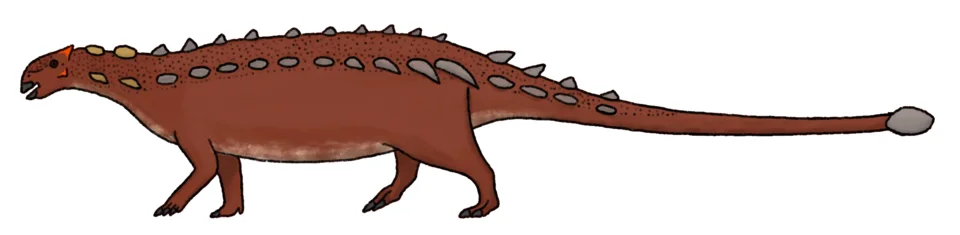
This whole-body Bissektipelta restoration uses comparisons for anatomy beyond the well-studied braincases; armour and colours are interpretive. This is an artistic reconstruction: colours, soft tissues and missing anatomy include interpretation, not a photograph of a living dinosaur.
Compare Ankylosaurus, Gobisaurus, Kunbarrasaurus. Find more names in the B index and explore ornithischian field notes. The glossary explains unfamiliar fossil terms.
Quick answers
- Where have Bissektipelta fossils been found?
- The discoveries discussed here come from Uzbekistan. Modern place names describe discovery locations, not a complete ancient geographic range.
- When did Bissektipelta live?
- It is placed in the Cretaceous period. See the discovery discussion for qualifications about the particular rock layers and dating.
- Where can I compare Bissektipelta with related dinosaurs?
- Follow the related field notes below. Comparisons explain shared anatomy; they do not imply that all the animals lived together.