Jurassic Dinos editorial · Updated · Source-based review
What is Megaraptor?
Megaraptor was a Late Cretaceous Argentine theropod that gave Megaraptora its name.
Distinctive features and evidence
Several incomplete skeletons document limb anatomy more fully than the head. Its lineage should not be equated with dromaeosaurid raptors simply because the name ends in raptor.
Genus overview and research references.
Megaraptor fossil discoveries
The first Megaraptor fossils were collected in January 1996 by the Argentine palaeontologist Fernando Novas in the Portezuelo Formation of Neuquén Province, Patagonia. They were only a few bones: a forearm bone, a finger bone, part of a foot bone and one enormous claw bone. Novas described them in 1998 and, believing the claw came from the foot, compared the animal with dromaeosaurids and troodontids.
In 2004 a second specimen, with an almost complete hand, showed that the giant claw belonged to the first finger of the hand. A young skeleton described in 2014 added a skull, but its identity is now questioned, and a 2025 study pointed out differences that might mean it belongs to a different relative, or might simply reflect growth. At least seven partial specimens have been referred to Megaraptor, and only two include skull parts, so much of the animal is still unknown.
How big was Megaraptor?
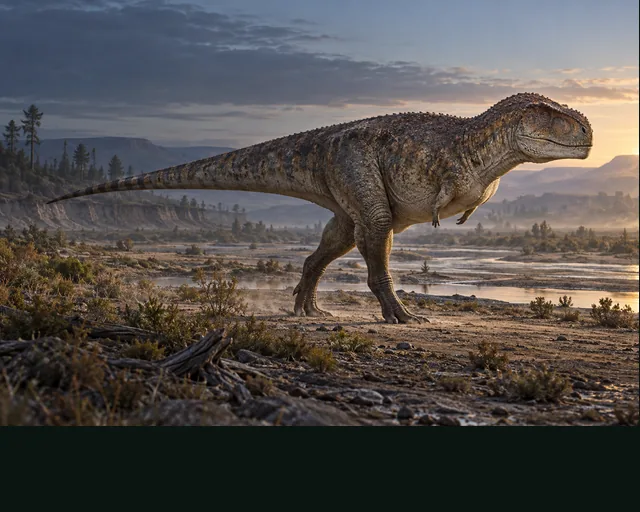
There is no complete skeleton, so size comes from scaling. Novas estimated the first specimen at around 8 metres long, and Gregory S. Paul in 2010 suggested 8 metres and about one tonne. Porfiri and colleagues reached 9 to 10 metres in 2014 by using Allosaurus proportions, while Larramendi and Molina-Pérez estimated 8.3 metres and 1.3 tonnes in 2016, using other megaraptorans for comparison. These figures differ, so a reasonable summary is a large predator of roughly 8 to 10 metres.
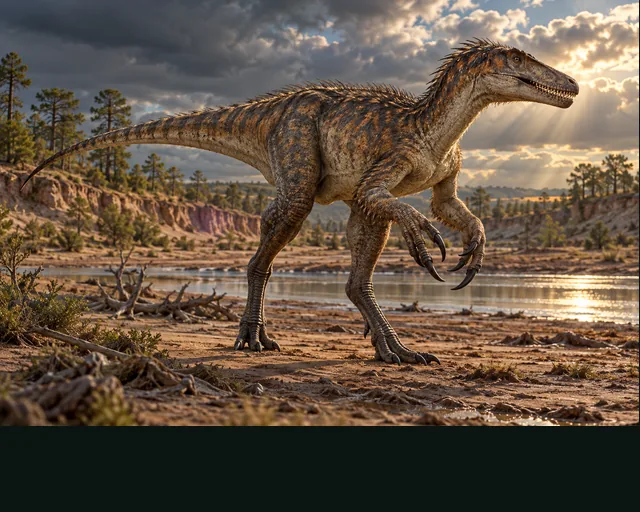
The hand claw is the best-preserved measure: the claw bone of the first finger is about 35 centimetres along its curve, and in life a horn sheath would probably have made it longer.
What did Megaraptor eat and how did it hunt?
Megaraptor’s skull was long, low and rather slender compared with other large predators, but its arms were strong, with big muscle attachment areas and long, strongly curved claws. Early on it was suggested that the claws were used to open carcasses, but most researchers now favour a role in catching prey. Scientists think it may have gripped animals with its hands and pulled them toward its chest so the jaws could finish the job, as proposed for its relative Australovenator.
A 2025 study of the braincase found large structures linked to steady gaze during fast movement, which suggests it relied on vision and quick movement rather than smell. A 2007 idea that several animals found close together lived in groups has been questioned, since bodies can pile up after death.
Is Megaraptor a raptor?
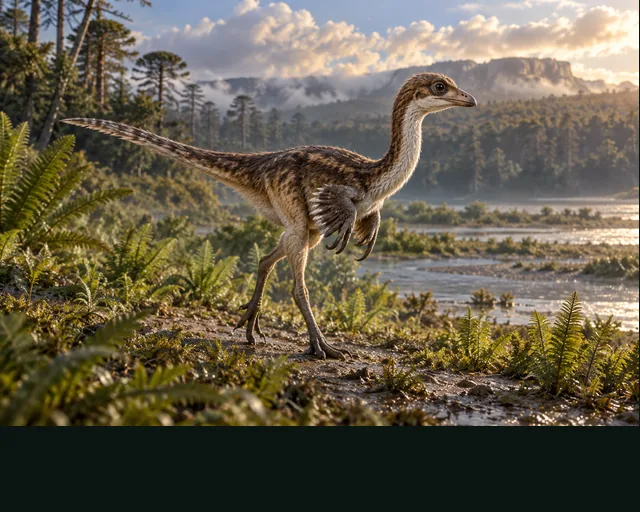
The name ends in “raptor”, but Megaraptor is not a dromaeosaurid like Velociraptor. Novas himself never said it was one, even though early artwork often drew it that way. Later studies variously placed it near carcharodontosaurs, and, since 2014, mostly within the coelurosaurs, possibly close to tyrannosaurs.
The family Megaraptoridae and the larger group Megaraptora are named after it. Experts still disagree about where the whole group belongs on the theropod family tree, so any single placement should be taken as the current best attempt.
Where and when Megaraptor lived
Megaraptor lived late in the Cretaceous, in the Turonian and early Coniacian stages, with the Paleobiology Database giving an occurrence range of about 93.9 to 85.7 million years ago. The Portezuelo Formation was a river system in a humid climate. Neighbours included the long-necked titanosaur Futalognkosaurus, the theropod Unenlagia, the abelisaurid Elemgasem, turtles, fish and pterosaurs.
Classification and fossil record
The Paleobiology Database taxonomic record catalogues Megaraptor under Megaraptoridae. This is the immediate parent in that catalogue, rather than a complete list of evolutionary relationships.
Discovery and naming history
A large claw in material found in 1996 was initially interpreted as belonging to the foot, influencing the 1998 naming. Later evidence identified the characteristic claw with the hand, changing the comparison with dromaeosaurids. Historical overview.
The corroborated occurrence sample includes Argentina; those are modern discovery locations, not a complete ancient geographic range.
Research starting point
The catalogue links Megaraptor to Novas, 1998, published in Journal of Vertebrate Paleontology. This identifies a research starting point; the catalogue’s citation alone does not verify every later reconstruction or species assignment.
For the meaning of taxonomic terms and how evidence is checked, see the glossary and editorial policy.
Quick answers
- Is Megaraptor a dinosaur?
- Yes. Megaraptor was a large theropod dinosaur from Argentina, and it gave its name to the megaraptoran group of predators with huge hand claws.
- When did Megaraptor live?
- Megaraptor lived in the Late Cretaceous, in the Turonian and Coniacian ages. The Paleobiology Database gives an occurrence range of about 93.9 to 85.7 million years ago.
- How big was Megaraptor?
- Estimates cluster around 8 to 10 metres long and one to 1.3 tonnes, scaled from incomplete skeletons, so the figures are approximate.
- Is Megaraptor a dromaeosaur?
- No. Despite the name ending in raptor, it was not a dromaeosaurid. Later studies placed it among coelurosaurs, possibly near tyrannosaurs, though its exact position is debated.
- What was Megaraptor's claw for?
- Its first-finger claw, about 35 centimetres long, was originally mistaken for a foot claw. Scientists now think it helped grip prey and draw it toward the jaws.