Jurassic Dinos editorial · Updated · Source-based review
What is Australovenator?
Australovenator was a megaraptoran theropod from Australia’s Cretaceous Winton Formation, with prominent grasping forelimbs.
Distinctive features and evidence
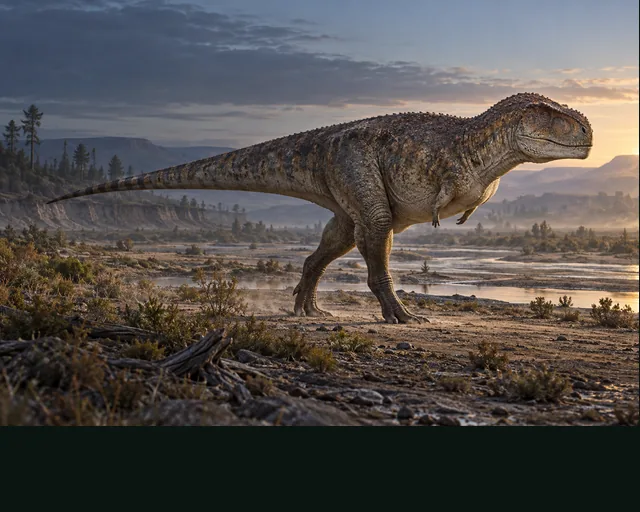
The name-bearing skeleton includes limb, pelvic and lower-jaw elements but lacks a complete skull. Its large hand claws make a useful contrast with abelisaurids’ reduced arms, while the wider relationships of megaraptorans remain debated.
Genus overview and research references.
Australovenator fossil discoveries
The main skeleton was found in 2006 at the “Matilda Site” on Elderslie Station, about 60 kilometres north-west of Winton in central Queensland. Excavations were run by the Australian Age of Dinosaurs museum together with the Queensland Museum. The bones were mixed in with those of a sauropod later named Diamantinasaurus, and many were locked inside a hard mineral lump, so preparation went on for years.
The first preparation phase revealed teeth, a lower jaw bone, ribs, part of the pelvis, parts of both arms and legs and a huge curved hand claw. Further bones from the same lump were described in later years: the arms and hands in 2012, the hind legs in 2013 and the right lower jaw in 2015. There is still no skull, but the pieces include both lower jaws, many teeth, upper arm bones, and parts of the hands and feet.
How big was Australovenator?
Australovenator was a medium-sized meat-eater. Scott Hocknull, who described it, gave a length of about 6 metres and a hip height of about 2 metres in a 2009 interview. Later estimates of its weight vary: Gregory S. Paul suggested about 500 kilograms in 2016, while Roger Benson and colleagues calculated about 310 kilograms in 2014. That range shows how uncertain size estimates are for an incomplete skeleton. It was smaller than some South American megaraptorans but is counted among the largest meat-eating dinosaurs known from Australia.
Hocknull nicknamed it the “cheetah of its time” because it was lightly built, with slim legs and a narrow lower jaw. The nickname is a comparison of body build, not a measured running speed.
How did Australovenator use its arms and claws?
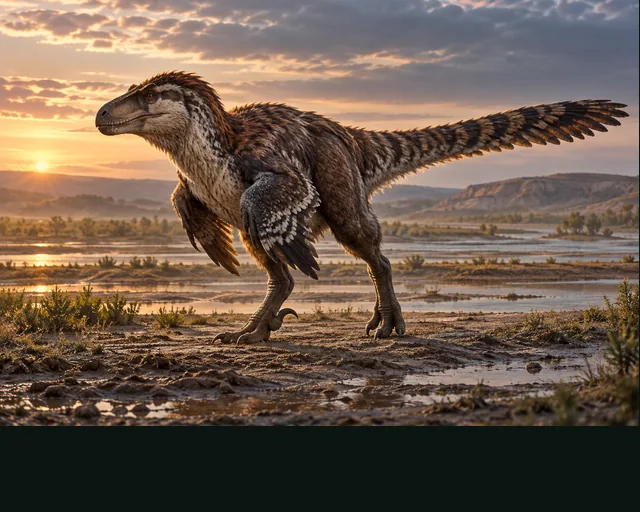
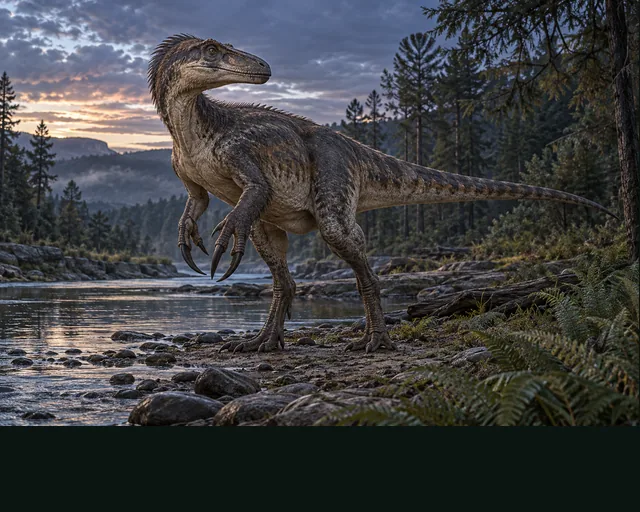
The arms were the most striking part of the skeleton. The upper arm bone had an S-shaped curve, and the fingers ended in sickle-shaped claws, the largest of them on the first finger. Computer models published in 2015 found that the arm was flexible, with unusually extendable fingers, and suggested that it could pull prey towards the chest. The authors linked this to the animal’s light jaws, suggesting it relied on hands as well as mouth to deal with food. This is a modelled interpretation, not an observed behaviour.
The teeth were recurved and serrated, and the front and rear ones differed in shape, which hints that they did slightly different jobs. One toe bone is splayed, a possible result of kicking impacts, and another shows an odd lump that might be from infection or arthritis, although that could not be confirmed.
Is Australovenator a megaraptoran?
Yes, according to most analyses. Australovenator is placed in Megaraptora, a group of long-armed, big-clawed theropods known from Australia, South America and Asia, and usually as a basal member of the family Megaraptoridae. Close relatives include Megaraptor from South America and Fukuiraptor from Japan.
What megaraptorans are is less clear. When Australovenator was named in 2009 it was described as an allosauroid, a relative of Allosaurus. Later studies argued over whether megaraptorans were carcharodontosaurs, early coelurosaurs or close to tyrannosauroids, and most recent work favours a coelurosaur position. Scientists regard the question as still open.
When and where Australovenator lived
Sources date the Winton Formation differently. The original 2009 description called it latest Albian, the end of the Early Cretaceous, while more recent accounts date the lower Winton to the late Cenomanian, around 95 million years ago, in the early Late Cretaceous. Its fossils may also extend further: fragmentary megaraptoran remains from Victoria have been tentatively linked to Australovenator and are older.
The Matilda Site is interpreted as a former oxbow lake or river bend on the edge of an inland sea. Plants included ferns, ginkgoes and flowering plants. Other animals included sauropods such as Diamantinasaurus, crocodile relatives, turtles, lungfish and a pterosaur. Australia lay far to the south, at roughly the latitude of present-day Patagonia.
Classification and fossil record
The Paleobiology Database taxonomic record catalogues Australovenator under Megaraptoridae. This is the immediate parent in that catalogue, rather than a complete list of evolutionary relationships.
Discovery and naming history
The name-bearing partial skeleton was found in the Winton Formation in 2006 and described by Scott Hocknull and colleagues in 2009. Its bones were associated with sauropod remains at the discovery site, but association alone does not establish how the animals interacted. Historical overview.
The corroborated occurrence sample includes Australia; those are modern discovery locations, not a complete ancient geographic range.
Research starting point
The catalogue links Australovenator to Hocknull and White, 2009, published in PLoS ONE. This identifies a research starting point; the catalogue’s citation alone does not verify every later reconstruction or species assignment.
For the meaning of taxonomic terms and how evidence is checked, see the glossary and editorial policy.
Quick answers
- Is Australovenator a dinosaur?
- Yes. Australovenator was a carnivorous theropod dinosaur, a megaraptoran from Queensland, Australia.
- When did Australovenator live?
- Sources differ: the 2009 description said latest Albian, while later accounts date the rock to the late Cenomanian, about 95 million years ago. Either way it was mid-Cretaceous.
- How big was Australovenator?
- About 6 metres long, by the describing team's 2009 estimate, with weight estimates from roughly 310 to 500 kilograms. The skeleton lacks a skull, so all figures are uncertain.
- Is Australovenator a megaraptoran?
- Yes. It is usually considered a basal megaraptorid, though the wider relationships of megaraptorans are still disputed.
- Where was Australovenator found?
- The main skeleton came from the Winton Formation near Elderslie Station, north-west of Winton in central Queensland, Australia.