Jurassic Dinos editorial · Updated · Source-based review
What is Limaysaurus?
Limaysaurus was an Argentine rebbachisaurid sauropod represented by the species Limaysaurus tessonei.
Distinctive features and evidence
Its Patagonian record adds a southern example to the rebbachisaurid lineage. Exact ages in introductory summaries deserve checking against formation studies; the genus’s identity and group provide the firmer foundation here.
Genus overview and research references.
Limaysaurus fossil discoveries in Patagonia
Limaysaurus comes from Neuquén Province in northwestern Patagonia, Argentina, about 15 kilometres southwest of the town of Villa El Chocón. The main specimen is a partial skeleton with the rear part of the skull. Lieto Francisco Tessone spotted it in 1988, and the species name tessonei honours him. José Bonaparte later collected it together with a second fragmentary adult skeleton, and a smaller individual was found nearby. The best skeleton is reported to be about 80 percent complete, which makes it one of the most complete Cretaceous sauropods found in South America.
Why was Limaysaurus once called Rebbachisaurus?
When Jorge Calvo and Leonardo Salgado first described the animal in 1995, they called it Rebbachisaurus tessonei, placing it in a genus first named for fossils from Morocco. In 2004 Salgado, Alberto Garrido, Sergio Cocca and Juan Cocca decided it deserved a genus of its own and named it Limaysaurus, after the Limay river. The new name reflects the view that the Patagonian animal is related to the African one but distinct from it.
How big was Limaysaurus?
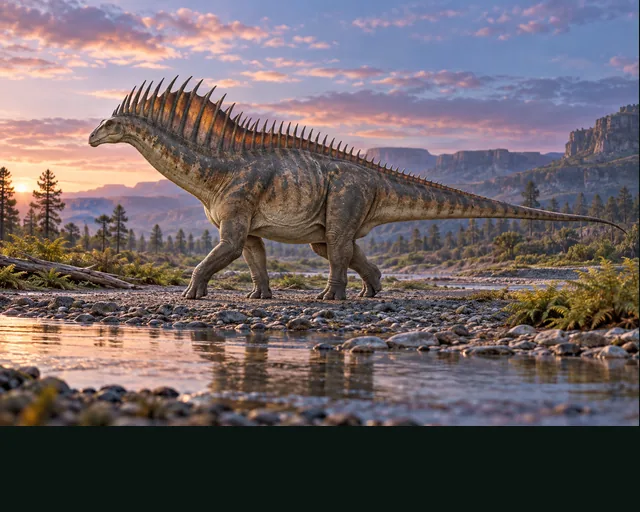
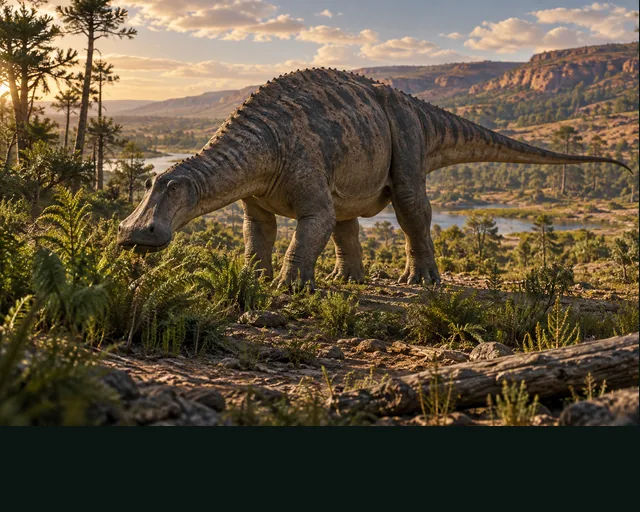
Limaysaurus was a medium-sized sauropod. Gregory Paul estimated in 2010 that it was about 15 metres long and weighed around 7 tonnes, but that is a single published estimate. The spines that rose from its backbone were tall and plain, shaped like a straight “I” rather than forked at the top as in Diplodocus. Its teeth were curved, while those of Diplodocus were pencil-shaped.
Is Limaysaurus a rebbachisaurid?
Yes. Rebbachisaurids are a family within the diplodocoids, the group that includes Diplodocus, but they lack the forked neck spines of diplodocids and are treated as more primitive. A 2011 study placed Limaysaurus in its own subfamily, the Limaysaurinae. Close relatives include Rebbachisaurus from Morocco, which the Natural History Museum notes is known from only a few bones so its reconstruction is speculative, and Nigersaurus from Niger, where some of the family developed batteries of teeth. The close link between South American and African rebbachisaurids has been taken as support for a land connection between the continents around 100 million years ago.
Where and when Limaysaurus lived
Limaysaurus is dated to the Albian stage of the Early Cretaceous, although its age has been revised. The rocks were once thought to be Cenomanian, but a 2026 study cited in the source material re-dated the Candeleros and Huincul formations to the early Albian, about 111 and 106 million years ago respectively. The type locality is also described as part of the Lohan Cura Formation, so the exact rock unit is not settled, and the Paleobiology Database lists Limaysaurus occurrences between about 113.2 and 93.9 million years ago. One account says it lived on plains with large, shallow lagoons, under a mild, humid climate, alongside Andesaurus and Giganotosaurus.
Classification and fossil record
The Paleobiology Database taxonomic record catalogues Limaysaurus under Limaysaurinae. This is the immediate parent in that catalogue, rather than a complete list of evolutionary relationships.
The corroborated occurrence sample includes Argentina, Brazil; those are modern discovery locations, not a complete ancient geographic range.
Research starting point
The catalogue links Limaysaurus to Salgado and Garrido, 2004, published in Journal of Vertebrate Paleontology. This identifies a research starting point; the catalogue’s citation alone does not verify every later reconstruction or species assignment.
For the meaning of taxonomic terms and how evidence is checked, see the glossary and editorial policy.
Quick answers
- Is Limaysaurus a dinosaur?
- Yes. Limaysaurus was a medium-sized, plant-eating sauropod dinosaur from the Early Cretaceous of Patagonia, Argentina.
- When did Limaysaurus live?
- Limaysaurus is now dated to the Albian stage of the Early Cretaceous, roughly 111 to 106 million years ago in a recent re-dating of its rock units, though older studies placed it later, in the Cenomanian.
- How big was Limaysaurus?
- Gregory Paul estimated about 15 metres long and 7 tonnes in 2010. That is one published estimate for a medium-sized sauropod, not a measured value.
- Is Limaysaurus a rebbachisaurid?
- Yes. Limaysaurus belongs to the sauropod family Rebbachisauridae, and its closest relatives include Rebbachisaurus from Morocco and Nigersaurus from Niger.
- Where was Limaysaurus found?
- Limaysaurus was found in Neuquén Province, northwestern Patagonia, Argentina, about 15 kilometres southwest of Villa El Chocón.